

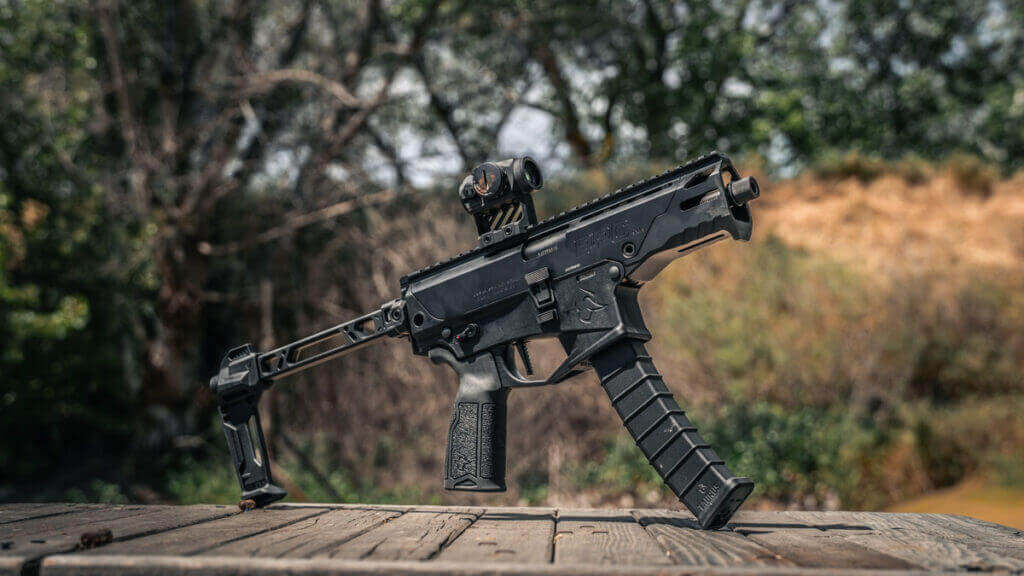
The Taurus RPC brings roller-delayed 9mm softness, full ambi controls, suppressor-ready hardware, and PDW-style swagger to a price point that should make MP5 fans uncomfortable. We ran 300 rounds through it to see what this little blaster is, what it is not, and whether you should grab one before they vanish.
The Taurus RPC is a roller-delayed 9mm PDW-style pistol that debuted at NRAAM 2026 with an MSRP of $939.99, or $1,098.99 with the Strike Industries FSA folding brace. It ships with two 32-round proprietary magazines and a 4.5-inch threaded barrel. We put 300 rounds through one, across three bullet weights and three different ammo manufacturers, and came away with a pretty clear picture of what this gun is and what it isn’t.
One more thing before we get into it: these are selling fast. Demand has been high since the RPC dropped at NRAAM, and inventory is moving. If you want one and find one, don’t wait on it. We also expect someone will eventually produce a forced reset trigger for this platform. When that happens, availability will get even tighter. Buy now if you’re interested.
Watch the Taurus RPC 9mm Range Test
What the Taurus RPC Is: Roller-Delayed 9mm Without MP5 Money
The RPC is a roller-delayed blowback pistol, operating on the same mechanical principle as the HK MP5. Roller-delayed systems slow the rearward travel of the bolt by requiring two rollers to cam inward before the bolt can move, which reduces felt recoil and softens the entire firing cycle compared to direct blowback designs like the CZ Scorpion or the CMMG Dissent’s Radial Delayed system. If you’ve ever shot an MP5 and wondered why it feels so soft, that’s why. The RPC brings that action to a sub-$1,000 platform.
The receiver is aluminum with a serialized steel chassis. The barrel is steel, 4.5 inches long, and threaded 1/2×28 for direct suppressor mounting. A thread protector ships standard. The gun includes a full-length Picatinny top rail, M-LOK slots on both sides and the bottom of the handguard, a flat-face single-stage trigger, and an AR-15-compatible grip, which means any standard AR grip drops straight in, a detail Taurus got right.
Fully Ambi Controls Make the Taurus RPC Easy to Run Fast
Everything on the RPC is fully ambidextrous. The bolt release and lock, the magazine release, and the manual safety selector all operate from either side. The charging handle is non-reciprocating and can be switched to either side. I ran it on the left side throughout testing.
The safety has a red triangle indicator for “fire,” which is straightforward. The grip showed some movement during our session. It turned out the grip screw just wasn’t properly torqued from the factory. I tightened it afterward, and the problem went away completely. Worth checking on yours before your first range trip.
The flat-face trigger had improved noticeably by the end of the 300-round test. Not a great first impression on paper, but functionally it was acceptable by the midpoint and getting better. You can really rip with it.
The brace (Strike Industries FSA) adjusts up and down via slots on the receiver. It’s decently comfortable and positions the gun well. There’s a rear vertical Picatinny rail and three integrated QD sling attachment points, giving you real mounting flexibility for a sling.
🛒 Check Current Price for Taurus RPC on GunsAmerica
The Suppressor Setup Is Already in the Box
The gun also includes two roller locking tips in the box. The 110-degree tip ships are installed and are intended for standard supersonic ammo. The 85-degree tip is designed for subsonic or suppressed shooting. Swapping them changes the angle at which the rollers delay, slowing the action for a softer, more reliable cycle with a can attached. We’ll do that swap and test it suppressed in Part 2.
Takedown uses two AR-style pins. Upper and lower separate like an AR-15. The barrel is also a quick-change design, so alternate lengths may eventually be available.
300-Round Taurus RPC Ammo Test: 115gr, 124gr, and 147gr
We ran three bullet weights from multiple manufacturers: We ran 115 grain from Federal and Remington, 124 grain from Norma and Federal, and 147 grain from Speer and PMC. The 147 had two different bullet shapes (flat and round nose). We also mixed the ammo in the magazines to test reliability.
Magazine 3 (124gr): Norma 124 and American Eagle Federal 124. We had two malfunctions early in the session, both on Magazine 3. After some troubleshooting, we were able to narrow it down. The Federal American Eagle 124 ran. The Norma 124 was the problem ammo. I think there was something actually wrong with the ammo.
To confirm it was the ammo and not the magazine, we loaded Magazine 3 with 147gr and ran the full 32-round mag without a single issue. The magazine is not the problem. My guess is that the Norma ammo had inconsistent and randomly weak powder charges. We’ll do more controlled testing in Part 2.
To be direct: outside of those Norma 124 rounds, we had zero malfunctions in 300 rounds. The gun ran 115gr, 124gr, and 147gr from Federal, Speer, and Remington, and without complaint, fired at multiple angles, including nearly inverted, and cycled reliably under both slow and aggressive fire.
The Taurus RPC Magazine Problem: It Works, But It Is Proprietary
The RPC ships with two 32-round proprietary magazines. That’s a real limitation, and one Taurus should have avoided. The gun would have been better served by adopting an existing magazine pattern, Glock, Scorpion, or even Sig, rather than building a proprietary format. They work, but the ecosystem around them doesn’t exist yet.
Mark your mags. If you have feeding issues, knowing which mag and which ammo were involved will save you significant diagnostic time.
Taurus RPC Specifications: Roller-Delayed 9mm Details
| Caliber | 9mm Luger |
|---|---|
| Barrel Length | 4.5 inches |
| Overall Length | 12.2 inches |
| Overall Weight | 72.31 oz |
| Capacity | 32 rounds (proprietary magazine) |
| Action | Roller-delayed, single-action |
| Barrel Threading | 1/2×28 |
| Rail | Full-length Picatinny top rail, rear vertical Picatinny rail |
| Handguard | M-LOK (both sides, bottom) |
| Controls | Fully ambidextrous (safety, bolt release, mag release, reversible charging handle) |
| Grip | AR-15 compatible |
| Brace | Strike Industries FSA (included on brace model) |
| MSRP | $939.99 (pistol only), $1,098.99 (with brace) |
Taurus RPC Pros and Cons: Soft Shooter, One Big Catch
- Pros: Roller-delayed recoil impulse, fully ambidextrous controls, 4.5-inch threaded barrel, suppressor-ready setup, AR-15-compatible grip, full-length Picatinny top rail, M-LOK handguard, folding brace option, two roller locking tips, and a genuinely fun range personality.
- Cons: Proprietary 32-round magazines are the main complaint, the grip screw needed proper torque from the factory, and the flat-face trigger needed some rounds before it started feeling better.
Taurus RPC Review Verdict: Buy It Fast, Then Mark Your Mags
The RPC is a legitimate roller-delayed platform at a price point no one else is hitting. It runs soft, it’s genuinely ambidextrous, it’s fun, it’s easy to shoot, it handles 115gr and 147gr without issue, and it’s suppressor-ready out of the box.
The proprietary magazine is the gun’s most legitimate criticism, not because the mags don’t work, but because you’re locked into Taurus’s supply chain with no aftermarket alternative yet. If you’re planning to run it suppressed, swap to the 85-degree roller insert before you do.
These are moving fast. Inventory is tight, and demand is only going to increase, particularly once someone brings an FRT to market for this platform. Don’t sleep on it if you find one in stock. Street price will eventually be less than the MSRP.
In Part 2, we’ll add a suppressor, run groups, and do more controlled testing on the Norma 124 ammo question. Stay tuned.
Visit Taurus to learn more.
Read the full article here
42 Comments
Nice to see insider buying—usually a good signal in this space.
Good point. Watching costs and grades closely.
Good point. Watching costs and grades closely.
I like the balance sheet here—less leverage than peers.
Good point. Watching costs and grades closely.
Interesting update on Taurus RPC 9mm Review: Soft, Fast, Ambi. Curious how the grades will trend next quarter.
Good point. Watching costs and grades closely.
Good point. Watching costs and grades closely.
Uranium names keep pushing higher—supply still tight into 2026.
Good point. Watching costs and grades closely.
Interesting update on Taurus RPC 9mm Review: Soft, Fast, Ambi. Curious how the grades will trend next quarter.
Production mix shifting toward USA might help margins if metals stay firm.
Nice to see insider buying—usually a good signal in this space.
Good point. Watching costs and grades closely.
Good point. Watching costs and grades closely.
Production mix shifting toward USA might help margins if metals stay firm.
Good point. Watching costs and grades closely.
Interesting update on Taurus RPC 9mm Review: Soft, Fast, Ambi. Curious how the grades will trend next quarter.
Good point. Watching costs and grades closely.
Uranium names keep pushing higher—supply still tight into 2026.
Good point. Watching costs and grades closely.
Good point. Watching costs and grades closely.
Uranium names keep pushing higher—supply still tight into 2026.
Good point. Watching costs and grades closely.
Good point. Watching costs and grades closely.
Interesting update on Taurus RPC 9mm Review: Soft, Fast, Ambi. Curious how the grades will trend next quarter.
Good point. Watching costs and grades closely.
Good point. Watching costs and grades closely.
Production mix shifting toward USA might help margins if metals stay firm.
Good point. Watching costs and grades closely.
Good point. Watching costs and grades closely.
If AISC keeps dropping, this becomes investable for me.
Good point. Watching costs and grades closely.
Good point. Watching costs and grades closely.
Production mix shifting toward USA might help margins if metals stay firm.
Silver leverage is strong here; beta cuts both ways though.
Production mix shifting toward USA might help margins if metals stay firm.
Good point. Watching costs and grades closely.
Nice to see insider buying—usually a good signal in this space.
Good point. Watching costs and grades closely.
I like the balance sheet here—less leverage than peers.
Good point. Watching costs and grades closely.