

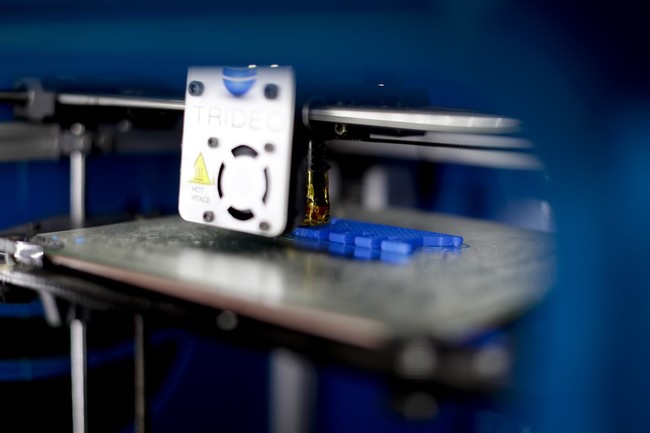
My view of technology is complicated, in part because while so much of it is awesome and beneficial, other advances seem to take something away from what it means to be human. One bit of tech I’ve been stoked about for a while is 3D printing. The idea that I can, from the comfort of my home, make so many things with the push of a few buttons, things that will benefit my household, amuse my family, and possibly start a manufacturing venture, is just amazing.
And the fact that I can use it to make guns is pretty dope, too.
But it’s no surprise that there are some who think that, because bad people can make guns, no one should be able to make them. Bad people buy guns, make car bombs, and a host of other things, but that doesn’t matter. 3D printers are the boogieman these days, even though the numbers show they’re still a small percentage of firearms used in crimes.
And the tech community seems to have some concerns about the push.
What makes the current wave of legislation different is the wide net it casts beyond the finished product, upstream into the information, websites, and tools used to make things today. Washington’s ESHB2320 and California’s AB 1263 are not just about the weapon. They are about the pipeline that creates it, from files to platforms to machines. From an enforcement standpoint, that progression is logical. If you can’t reliably stop the finished product, you move upstream to its source. But additive manufacturing complicates that strategy, because the same pipeline that produces a firearm component also produces everything else.
That “everything else” is not hypothetical. In medicine, additive manufacturing enables the fabrication of patient-specific implants with complex lattice structures that promote bone growth. In aerospace, components like the GE LEAP fuel nozzle consolidate dozens of parts into a single unit, reducing weight while improving durability and performance. At the consumer level, desktop printers have turned garages and small workshops into rapid prototyping labs, where individuals can iterate on ideas at speeds and costs that once required industrial infrastructure. All of this depends on a simple premise: The printer doesn’t care what it is making. The moment that changes, the innovations and resulting technology change with it.
California’s proposed AB 2047 would require printers to actively scan and block certain designs. New York policymakers have pointed to AI-driven detection tools as a model for enforcing compliance at the hardware level. These systems are often described as safeguards, and in controlled environments, they can be effective. But scaling them into consumer hardware introduces a different dynamic. A printer that evaluates every file before printing is no longer just executing instructions. It’s enforcing rules. It’s introducing barriers to innovation and manufacturing and throttling the speed of product development.
And it should be noted that this is from an author who seems sympathetic to the issue being addressed. He argues that the trend of so-called ghost guns being recovered, which is small but increasing, is what should matter more than the raw numbers. In other words, this isn’t someone who is pro-gun taking issue with not being able to make guns anymore.
No, this is someone sympathetic but who doesn’t want to see the Law of Unintended Consequences kick the rest of the tech community in the balls.
The problem here is that, like so many other cases, the people who are making the laws don’t actually understand the technology they want to regulate. They might ask if something is possible, and upon learning it is, decide that it is, therefore right that they mandate it. They don’t tend to worry about second- or third-order effects. That’s not something they even think about because, in their mind, it’s irrelevant.
But if the government gets in the business of telling companies what their printers can and cannot make, then some innovations aren’t going to happen because the parts they need are too similar to something that might be used in a firearm.
Due to technology, we’ve gotten away from people being able to invent many products in their garage, and that was always the backbone of what made America great. 3D printers restore that to a very real degree, also allowing small manufacturing businesses to be created without millions in investments before producing the first product.
For lawmakers to screw with that, especially over something that doesn’t actually have the impact they claim it does, is just idiotic.
I get the tech side being concerned. They should be, because it won’t stop with guns. It never has and never will.
Editor’s Note: The radical Left will stop at nothing to enact their radical gun control agenda and strip us of our Second Amendment rights.
Help us continue to report on and expose the Democrats’ gun control policies and schemes. Join Bearing Arms VIP and use promo code FIGHT to receive 60% off your membership.
Read the full article here
32 Comments
Production mix shifting toward USA might help margins if metals stay firm.
Good point. Watching costs and grades closely.
Nice to see insider buying—usually a good signal in this space.
Good point. Watching costs and grades closely.
I like the balance sheet here—less leverage than peers.
Good point. Watching costs and grades closely.
Good point. Watching costs and grades closely.
Silver leverage is strong here; beta cuts both ways though.
If AISC keeps dropping, this becomes investable for me.
Good point. Watching costs and grades closely.
Good point. Watching costs and grades closely.
Interesting update on Tech Community Expressing Concerns Over 3D Printer Restrictions. Curious how the grades will trend next quarter.
Good point. Watching costs and grades closely.
I like the balance sheet here—less leverage than peers.
Exploration results look promising, but permitting will be the key risk.
The cost guidance is better than expected. If they deliver, the stock could rerate.
Good point. Watching costs and grades closely.
I like the balance sheet here—less leverage than peers.
Good point. Watching costs and grades closely.
Good point. Watching costs and grades closely.
The cost guidance is better than expected. If they deliver, the stock could rerate.
Good point. Watching costs and grades closely.
I like the balance sheet here—less leverage than peers.
Uranium names keep pushing higher—supply still tight into 2026.
Good point. Watching costs and grades closely.
Good point. Watching costs and grades closely.
Exploration results look promising, but permitting will be the key risk.
Good point. Watching costs and grades closely.
The cost guidance is better than expected. If they deliver, the stock could rerate.
Good point. Watching costs and grades closely.
Good point. Watching costs and grades closely.
Exploration results look promising, but permitting will be the key risk.