

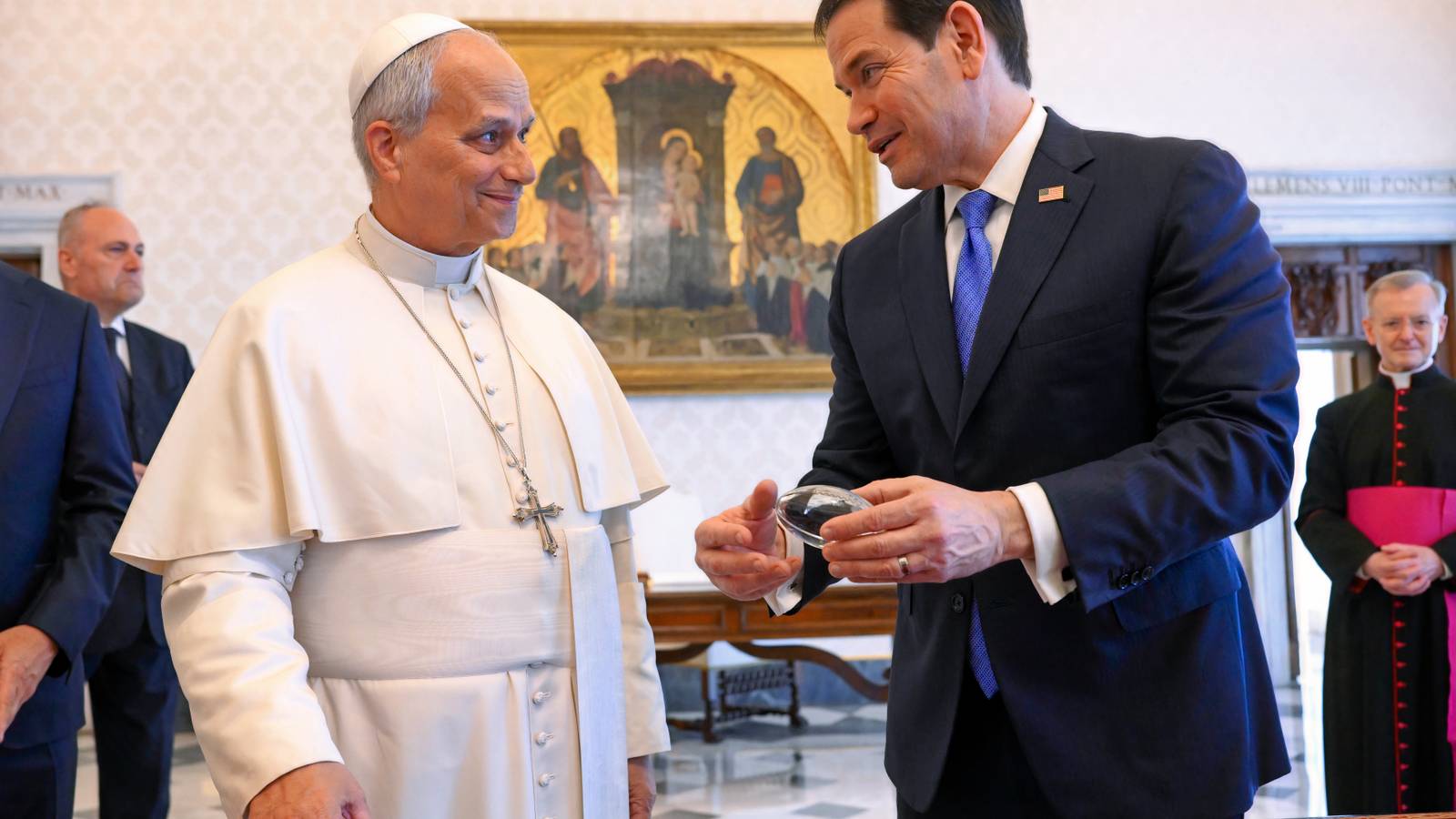
President Donald Trump’s feud with Pope Leo XIV has evolved beyond disagreements over Iran and military escalation into a broader ideological and political clash involving immigration, Catholic theology, humanitarian policy and growing tensions between the White House and the Vatican over the direction of U.S. foreign policy and moral leadership.
The increasingly public dispute involving Trump, Vice President JD Vance, Secretary of State Marco Rubio, and senior Vatican officials has transformed into one of the most consequential confrontations between a U.S. administration and the Catholic Church in years, forcing the White House into an increasingly delicate balancing act as the Vatican positions itself as a global voice advocating restraint, humanitarian protections and peace.
While Rubio’s recent Vatican meetings were initially viewed as a diplomatic effort to calm tensions after Trump publicly attacked Pope Leo over Iran, the broader conflict has since widened into disputes involving immigration, nationalism, Catholic social teaching and competing visions of global leadership.
“President Trump has great respect for the more than one billion Catholics around the world, especially the Catholic Americans who helped power his landslide election victory in 2024,” White House spokesperson Taylor Rogers told Military.com on Thursday.
The White House has pushed back on suggestions that tensions with the Vatican reflect broader friction with Catholic Americans.
“There has never been a greater president for Catholic Americans than President Trump, and his strong record proves it,” she added. “He stopped the weaponization of the federal government against Christians, proudly defended and expanded our religious rights, pardoned pro-life activists, stopped the chemical mutilation of our nation’s children, and protected parents’ rights.”
Rubio’s Vatican trip was framed by reports this week as an emergency diplomatic effort to stabilize deteriorating relations between Washington and the Holy See after Trump’s attacks on Pope Leo escalated into one of the most visible clashes between a U.S. president and the Vatican in years.
The Associated Press described Rubio’s visit as a “fence-mending” mission, while The Washington Post reported Vatican officials privately viewed Trump’s attacks on Pope Leo as deeply offensive to the church despite public efforts to lower tensions surrounding the dispute.
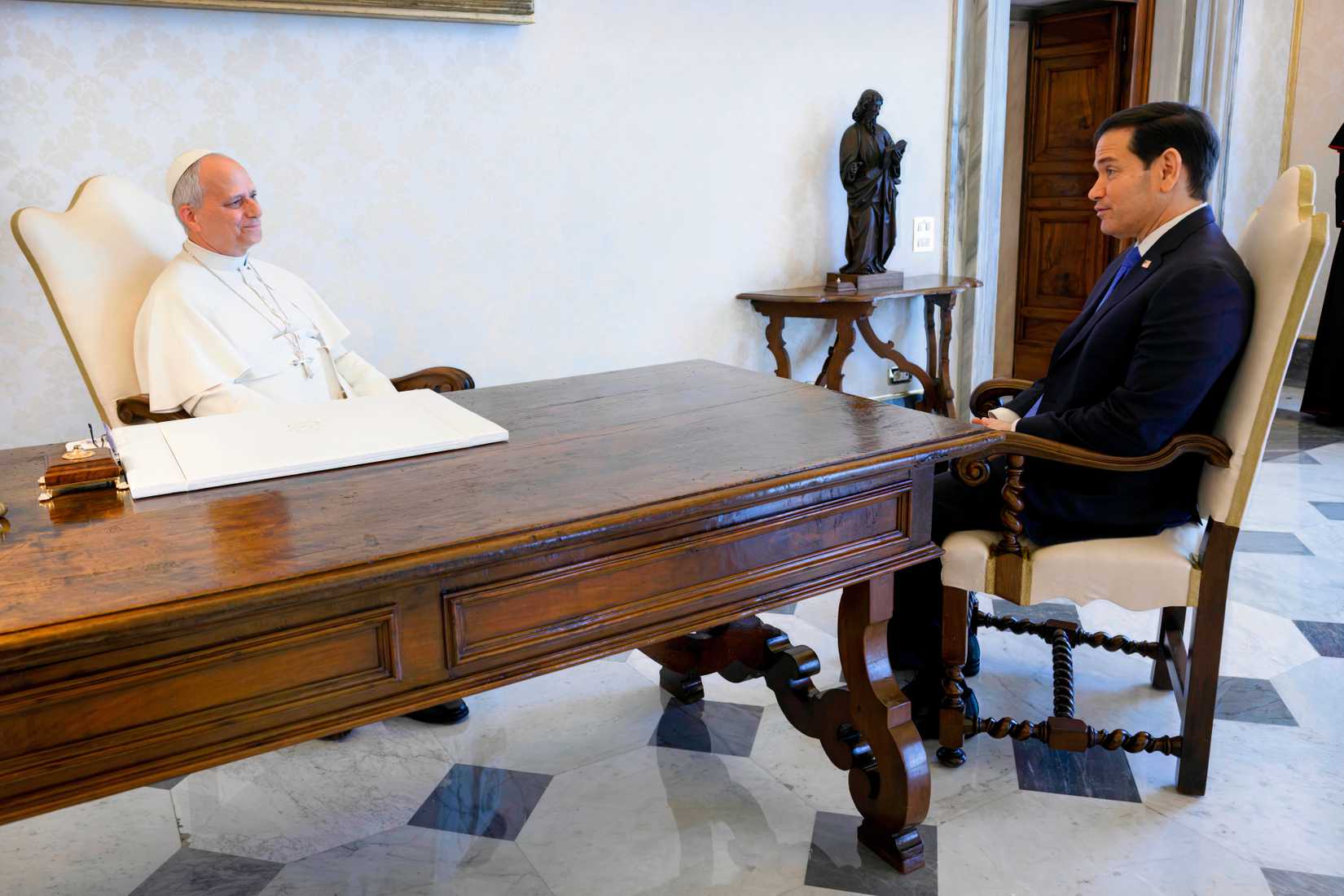
State Department spokesperson Tommy Pigott said Rubio and Pope Leo discussed the situation in the Middle East and “topics of mutual interest in the Western Hemisphere,” adding that the meeting reflected the “strong relationship between the United States and the Holy See” and their shared commitment to “promoting peace and human dignity,” according to the Associated Press.
Rubio’s role in the administration’s Iran strategy has drawn contrast to Vice President Vance, as both have taken different public postures while trying to defend Trump’s broader approach to the conflict.
“The president will always speak clearly about how he feels about the U.S. and U.S. policy,” Rubio told reporters while at the U.S. Embassy to the Holy See in Rome. “I think we can do that and continue to also have a very productive and fruitful and important relationship with the church, because it plays an important role in the world as well.”
The Vatican provided Military.com with the Holy See Press Office’s official May 7 bulletin documenting Rubio’s meetings with Pope Leo XIV, Cardinal Pietro Parolin and Archbishop Paul R. Gallagher. According to the Vatican statement, the talks “reaffirmed” a “shared commitment to fostering sound bilateral relations between the Holy See and the United States of America.”
The Vatican also said the meetings included exchanges on “countries experiencing war, political tensions and difficult humanitarian situations” and emphasized “the need to work tirelessly for peace.”
Trump’s Clash With Pope Leo Intensifies
The diplomatic stakes surrounding Rubio’s recent Vatican appearance comes on the heels of Trump criticizing Pope Leo in public remarks and online posts, falsely suggesting the pontiff supported Iran obtaining nuclear weapons and accusing him of endangering Catholics by opposing the war.
In one Truth Social post, Trump called Pope Leo “weak on crime and weak on Iran,” accusing the pontiff of undermining U.S. and Israeli efforts to confront Tehran. During remarks at the White House, Trump suggested the pope’s repeated calls for de-escalation were “helping the enemy” and claimed the Vatican was “sending the wrong message” as tensions involving Iran intensified.
Trump’s attacks quickly escalated into one of the most public clashes between a U.S. president and the Vatican in years, drawing backlash from Catholic leaders and foreign policy observers who argued the pope’s anti-war messaging reflected longstanding church doctrine opposing nuclear escalation and broader regional conflict.
Pope Leo pushed back, telling journalists that the church’s mission is to preach peace and that Catholic teaching has long opposed nuclear arms.
“The Church has spoken out for years against all nuclear arms, on that there is no doubt,” Pope Leo told reporters.
The clash erupted after Pope Leo intensified calls for de-escalation following renewed military tensions involving Iran, Israel and the United States. The pope has repeatedly warned against broader regional war, civilian casualties and the growing risk of nuclear confrontation— positioning the Vatican as one of the most prominent international voices pushing for restraint.
The dispute carries unusual political and diplomatic weight because Leo is the first American-born pope in history, giving the public clash between the Vatican and the White House far greater resonance inside the United States than previous papal disputes involving foreign leaders.
The tensions also come as the administration faces growing pressure over the Iran war, including congressional efforts to block war funding and force a larger debate over U.S. military involvement.
Immigration and Theology Divide Deepens
The dispute between the White House and the Vatican has also increasingly expanded beyond Iran and foreign policy into broader ideological disagreements involving immigration, nationalism and Catholic social teaching.
Pope Leo has repeatedly emphasized humanitarian protections, refugee concerns and global solidarity in public remarks since becoming pope, placing him at odds with some Trump administration rhetoric surrounding immigration enforcement and nationalism.
The widening divide has increasingly drawn Vance into the broader conflict as Catholic intellectuals, theologians and Vatican observers debate competing visions of Christianity, nationalism and the church’s global role.
Vance, a Catholic convert who has frequently defended stricter immigration policies and nationalist rhetoric, has become a central figure in growing debates over whether parts of the American conservative movement are drifting away from traditional Vatican positions involving migration, humanitarian protections and international cooperation.
Vanessa Corcoran, an advising dean at Georgetown University who studies religion and diplomacy, said the meeting should not be viewed solely as a reactive response to Trump’s attacks on the pope.
“The pope is the leader of the global Catholic Church, and it is in his interests as a peacemaker to help facilitate conversations with diplomats around the world,” Corcoran told Military.com.
Corcoran also said Pope Leo has made diplomacy and humanitarian outreach central to his papacy, including efforts involving Ukraine, Russia and the Middle East.
“For Pope Leo, every person impacted by war, regardless of faith or nationality, is on his mind and in his prayers,” she said.
Rubio Scrambles to Calm Vatican Fallout
Rubio, a practicing Catholic and one of the administration’s most experienced foreign policy officials, appeared to take a more measured tone ahead of his Vatican meeting, emphasizing diplomacy, religious freedom and humanitarian concerns while avoiding direct confrontation with Pope Leo.
“The president speaks candidly about American interests and national security,” Rubio said last Friday, claiming the United States could still maintain a productive diplomatic relationship with the Vatican despite disagreements over Iran and regional security policy.
The secretary of state’s visit was widely viewed as an effort to prevent the increasingly public dispute between the White House and the Vatican from spiraling into a broader diplomatic rupture as tensions involving Iran continue to escalate.
Rubio also defended continued engagement with the Vatican despite media focus on Trump’s attacks, emphasizing the Catholic Church’s global influence and humanitarian role.
“The church is an important global institution and has a presence all over the world,” Rubio said. “The Pope just returned from Africa … many of whom are threatened by the spread of radical Islamic terrorism.”
Rubio also met with Cardinal Pietro Parolin, the Vatican secretary of state and one of the pope’s top diplomatic advisers. Parolin strongly defended Pope Leo before the meeting, calling Trump’s attacks “strange,” according to the Associated Press.
“Attacking him like that or criticizing what he does seems a bit strange to me, to say the least,” Parolin said last week.
The State Department said Rubio and Parolin discussed humanitarian efforts in the Western Hemisphere, efforts to achieve a durable peace in the Middle East and the U.S.-Holy See partnership in advancing religious freedom.
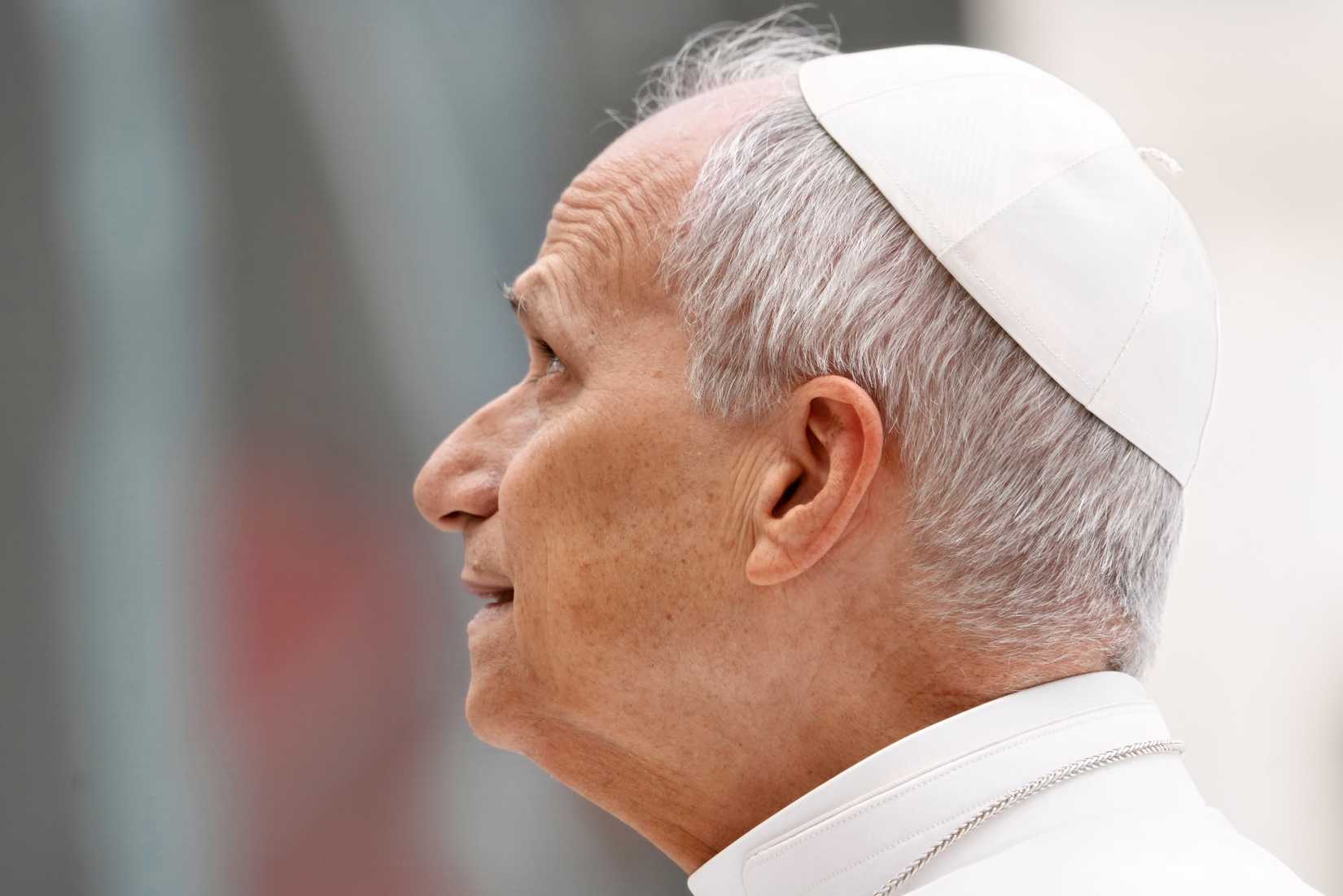
Rubio also pointed to Cuba as an example of ongoing U.S.-Vatican cooperation, saying Washington recently provided $6 million in humanitarian assistance distributed through Catholic aid agencies and had offered additional aid to Havana.
The Vatican’s official bulletin repeatedly characterized the discussions as “cordial,” language diplomats and Vatican observers often view as carefully calibrated during periods of geopolitical tension.
Catholic Political Fallout Growing
New polling and political analysis shows the escalating Trump-Pope feud may be creating growing political risks among Catholic voters, particularly moderates and non-MAGA Republicans uncomfortable with the administration’s rhetoric surrounding Iran, immigration and religion.
A Washington Post-ABC News-Ipsos poll cited by NCR and other Catholic outlets found that 61% of Catholics reacted negatively to Trump’s criticism of Pope Leo, while 70% responded positively to the pope’s calls for peace and diplomacy.
The polling also showed Trump’s approval among white Catholics dropped from 63% in February to 49% in the newer survey environment, while his overall approval among Catholics stood at 38%.
The same survey found broad backlash to some of Trump’s broader religious-war messaging, including strong negative reactions to an AI-generated image depicting Trump as Jesus Christ and comments warning that “a whole civilization will die tonight” if Iran failed to reach an agreement with the United States.
Corcoran said many Catholics were stunned by Trump’s public attacks on the pope, particularly accusations that Leo was “weak on crime.”
“Advocating for peace and for the protection of the most vulnerable is inherent in the pope’s job description,” Corcoran said. “There are some that would say that he should focus on his pastoral role, but this is pastoral.”
Vatican Emerges as Global Counterweight on Iran
The Holy See has increasingly positioned itself as one of the world’s most prominent diplomatic voices urging restraint as tensions involving Iran, Israel and the United States continue to escalate across the Middle East.
Pope Leo has repeatedly called for negotiations, humanitarian protections and renewed international efforts to avoid a broader regional conflict, warning that continued escalation could deepen civilian suffering and destabilize multiple countries across the region.
Corcoran also pointed to Pope Leo’s broader diplomatic philosophy, saying the Vatican often works quietly behind the scenes rather than through public confrontation.
“There’s an awful lot of work that goes on behind the scenes to promote justice, to promote humanitarian causes,” she said.
The Vatican’s increasingly vocal position has elevated Pope Leo into a more visible role within international diplomacy at a time when many Western allies remain divided.
Read the full article here
43 Comments
The cost guidance is better than expected. If they deliver, the stock could rerate.
Production mix shifting toward USA might help margins if metals stay firm.
Good point. Watching costs and grades closely.
If AISC keeps dropping, this becomes investable for me.
Good point. Watching costs and grades closely.
Exploration results look promising, but permitting will be the key risk.
Good point. Watching costs and grades closely.
Exploration results look promising, but permitting will be the key risk.
Good point. Watching costs and grades closely.
Uranium names keep pushing higher—supply still tight into 2026.
Good point. Watching costs and grades closely.
Uranium names keep pushing higher—supply still tight into 2026.
Good point. Watching costs and grades closely.
If AISC keeps dropping, this becomes investable for me.
Interesting update on Tensions Grow Over Immigration and War. Curious how the grades will trend next quarter.
Good point. Watching costs and grades closely.
Good point. Watching costs and grades closely.
Uranium names keep pushing higher—supply still tight into 2026.
Good point. Watching costs and grades closely.
Interesting update on Tensions Grow Over Immigration and War. Curious how the grades will trend next quarter.
Nice to see insider buying—usually a good signal in this space.
Good point. Watching costs and grades closely.
Nice to see insider buying—usually a good signal in this space.
Good point. Watching costs and grades closely.
Good point. Watching costs and grades closely.
The cost guidance is better than expected. If they deliver, the stock could rerate.
Good point. Watching costs and grades closely.
If AISC keeps dropping, this becomes investable for me.
The cost guidance is better than expected. If they deliver, the stock could rerate.
I like the balance sheet here—less leverage than peers.
Good point. Watching costs and grades closely.
The cost guidance is better than expected. If they deliver, the stock could rerate.
Good point. Watching costs and grades closely.
Good point. Watching costs and grades closely.
Uranium names keep pushing higher—supply still tight into 2026.
Good point. Watching costs and grades closely.
Good point. Watching costs and grades closely.
Silver leverage is strong here; beta cuts both ways though.
Good point. Watching costs and grades closely.
Good point. Watching costs and grades closely.
If AISC keeps dropping, this becomes investable for me.
Good point. Watching costs and grades closely.
I like the balance sheet here—less leverage than peers.