

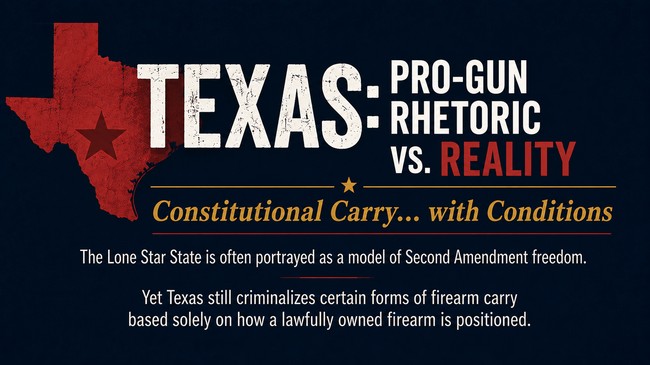
Texas has long positioned itself as a bastion of Second Amendment freedom. With its deep gun culture, cowboy heritage, and constitutional carry law enacted in 2021, the Lone Star State projects an image of unapologetic support for the right to keep and bear arms. Politicians often tout Texas as a model for the rest of the nation, where law-abiding citizens can carry without government permission. Yet, a closer examination of its statutes reveals a more nuanced, eye-opening picture.
Truth is, Texas does not even rank in the top 10 of the most pro-Second Amendment states in various assessments, precisely because its legal framework is still riddled with technical requirements that are problematic for responsible gun owners.
Recent events have brought this tension into sharp focus. The arrest of NBA star James Harden in Houston exemplifies how Texas’s vaunted permitless carry law falls short of the “shall not be infringed” ideal in practice. On June 13, 2026, police pulled over Harden during a traffic stop in downtown Houston. Officers spotted a handgun resting openly in the vehicle’s cup holder. Harden acknowledged ownership, but the firearm was not secured in a holster. He was arrested and charged with unlawful carrying of a weapon, a Class A misdemeanor.
This incident ignited widespread discussion on social media. Gun owners across platforms questioned the logic: In a “constitutional carry” state, why does a loose gun in one’s own car trigger criminal charges? The answer lies in the specifics of Texas Penal Code §46.02. While permit-less carry allows eligible adults (generally 21 and older, not otherwise prohibited) to carry handguns openly or concealed without a License to Carry (LTC), open carry of a handgun requires it to be in a holster if visible. This applies in public places and explicitly in motor vehicles. A handgun in plain view, such as in a cup holder, on a seat, or in a door pocket, must be holstered for lawful open carry. Concealed carry avoids the holster mandate, but visibility changes the rules.
Texas law does not define “holster” in exhaustive detail, but courts and enforcement interpret it as a device designed to secure the firearm to the person or vehicle in a manner that prevents it from being loose, ultimately the decision on what is considered “secure in a holster” is arbitrary and based on the opinion of law-enforcement officers. Even magnetic mounts or simply placing the gun in a safe direction often fails this test. The result is a technical violation that hands law enforcement and prosecutors a tool to charge individuals based on placement rather than any demonstrated threat or criminal intent. Harden was released on a low bond, and such cases often resolve with minimal consequences for first-time, law-abiding offenders. But the principle stays troubling.
This holster requirement for visible handguns in vehicles is not a minor footnote. It stems from pre-2021 laws and survived the push for constitutional carry. Before HB 1927, open carry was more restricted. The 2021 reform expanded rights by removing the permit requirement for holstered carry, but it preserved the holster mandate for anything visible. Proponents argue this balances public safety and open carry; critics see it as a half-measure that supports unnecessary government micromanagement of how citizens exercise a fundamental right. Compare this to states with stronger reputations for minimal interference. In places like Arizona, Vermont, or Alaska, often ranked higher for gun freedom, carry laws emphasize simplicity.
Many true “constitutional carry” areas impose fewer conditions on vehicle transport or visible carry, focusing prohibitions on prohibited persons, sensitive places, or reckless behavior rather than technical securing requirements. Texas’s more extensive statutes, including detailed rules on display in vehicles and watercraft, contribute to its absence from many top 10lists of gun-friendly states. Strong culture and pro-2A politicians are assets, but layered regulations undermine the claim of maximal liberty.
Defenders of Texas law point to progress. “Constitutional carry” was a significant victory after years of advocacy. Stand Your Ground and Castle Doctrine provide strong self-defense protection. Long guns enjoy broader open carry freedoms, and there are no statewide registration or permit mandates for ownership. Yet, the persistence of rules like the vehicle holster requirement reveals a reluctance to fully embrace the simplicity that “shall not be infringed” demands. In truly elite pro-2A environments, the default is liberty, with narrow, clearly justified exceptions. Technical gotchas erode trust and create opportunities for selective enforcement.
Social media reactions to the Harden case highlighted broader frustrations, with gun rights advocates noting the irony; a state that mocks “gun control” states for overregulation still gives officers discretion over cup holder placement. Others emphasized personal responsibility, secure your firearm properly, but the core complaint is philosophical. Why should law-abiding adults need to navigate such details in their private vehicle? This isn’t about celebrity exceptions; it’s about consistent principles. If the goal is empowering citizens as their own protectors, especially in rural areas with slow response times or urban settings with variable policing, laws should minimize friction for the compliant majority.
Broader Texas gun laws add context. Prohibited places are still extensive: schools, polling places, certain government buildings, and private property with proper signage. Age restrictions (with some court challenges for 18–20-year-olds) and disqualifiers for certain misdemeanors persist. While these exist nationwide, they illustrate that Texas has not purged all pre-existing controls. Extensive statutory language around carry modes creates gray areas that defense attorneys and instructors must constantly clarify. Firearms trainers often dedicate time to vehicle-specific scenarios precisely because of these nuances. Critics from the gun control proponents use such incidents to argue thatpermit-less carry is reckless, but that misses the point. Partial reforms invite exactly the kind of “gotcha” enforcement that undermines public confidence.
True Second Amendment maximalism would prioritize clear, minimal rules focused on prohibiting the dangerous rather than regulating the method of carry for the responsible. Texas has a vibrant gun culture and elected leaders who claim to champion 2A causes. Events like the Harden arrest, however, serve as teachable moments. They spark necessary debates about whether statutes truly reflect the state’s professed values. Gun owners should push legislators for further simplification: clearer definitions, broader allowances for vehicles without technical traps, and a continued emphasis on intent over form. Strong culture is vital, but when law still equips prosecutors with tools to penalize technicalities absent criminal mindset, it undercuts the promise of constitutional carry.
The Second Amendment is not a suggestion or a privilege granted by the state. It is an inalienable right. Texas has advanced farther than many states, but genuine unencumbered recognition is still lacking. Incidents like this remind us that rhetoric must align with reality, and that vigilance from the gun community is essential to close the gaps between profession and practice. For a state that prides itself on independence and self-reliance, settling for “mostly pro-2A” should be unacceptable.
The goal must be straightforward defense of the Second Amendment. Anything less is infringement.
Editor’s Note: The radical Left will stop at nothing to enact their radical gun control agenda and strip us of our Second Amendment rights.
Help us continue to report on and expose the Democrats’ gun control policies and schemes. Join Bearing Arms VIP and use promo code FIGHT to receive 60% off your membership.
Read the full article here
32 Comments
Uranium names keep pushing higher—supply still tight into 2026.
The cost guidance is better than expected. If they deliver, the stock could rerate.
Uranium names keep pushing higher—supply still tight into 2026.
Good point. Watching costs and grades closely.
Production mix shifting toward USA might help margins if metals stay firm.
Production mix shifting toward USA might help margins if metals stay firm.
If AISC keeps dropping, this becomes investable for me.
Good point. Watching costs and grades closely.
Exploration results look promising, but permitting will be the key risk.
Good point. Watching costs and grades closely.
Good point. Watching costs and grades closely.
Production mix shifting toward USA might help margins if metals stay firm.
Good point. Watching costs and grades closely.
Good point. Watching costs and grades closely.
Exploration results look promising, but permitting will be the key risk.
Good point. Watching costs and grades closely.
Good point. Watching costs and grades closely.
Nice to see insider buying—usually a good signal in this space.
Exploration results look promising, but permitting will be the key risk.
Good point. Watching costs and grades closely.
Good point. Watching costs and grades closely.
Interesting update on Texas: Pro-Gun Rhetoric vs. the Reality of Lingering Restrictions. Curious how the grades will trend next quarter.
Good point. Watching costs and grades closely.
Production mix shifting toward USA might help margins if metals stay firm.
Good point. Watching costs and grades closely.
If AISC keeps dropping, this becomes investable for me.
Good point. Watching costs and grades closely.
Exploration results look promising, but permitting will be the key risk.
Good point. Watching costs and grades closely.
Nice to see insider buying—usually a good signal in this space.
Good point. Watching costs and grades closely.
Good point. Watching costs and grades closely.