

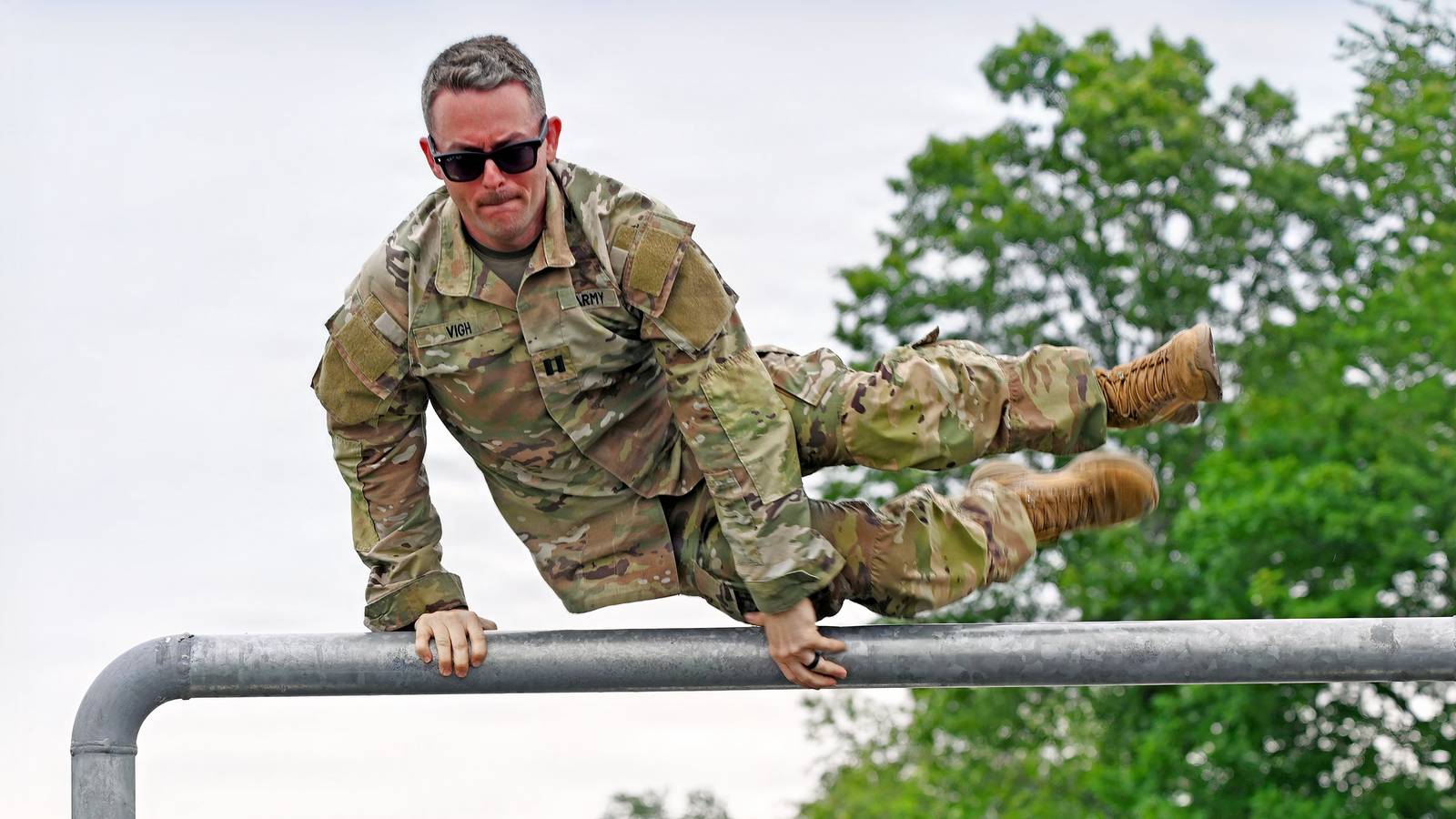
In tactical professions (military, police, firefighter, EMT), athletic specialization is a liability. Being too good at one athletic event often has an equal and opposite weakness. For instance, a 600-pound deadlift won’t help you on Mile 12 of a heavy ruck march, and a sub-5-minute mile won’t help you drag a 220-pound downed teammate to safety.
For decades, operators have been forced to choose: Train for a fitness test of calisthenics and running, or lift on their own. This often led to soldiers being too big and slow, or too fast and fragile. But the modern tactical athlete now requires a diverse set of fitness tests that assess all the elements of fitness needed to perform the job: strength, power, speed, agility, muscular stamina, endurance, flexibility/mobility and grip.
Tactical Athlete vs. Hybrid Athlete
The shift from pure “meathead” strength or pure skinny endurance to a hybridized, tactical performance model focuses on balancing the opposing demands of heavy load-bearing strength and durability with endurance in rucking/running/swimming and work capacity.
The terms “hybrid athlete” and “tactical athlete” tend to cross training circles; however, there are differences. A tactical athlete is not training for a trophy, a mirror, or a finish line alone. The tactical athlete trains for occupational readiness: the ability to perform physically demanding tasks under load, under stress, in unpredictable environments, and often while sleep-deprived, cold, wet, hungry or mentally fatigued. Military personnel, law enforcement officers, firefighters, rescue professionals and special operations candidates all fall into this category because their physical performance can directly affect mission success, team safety and survival.
While tactical athletes can use hybrid training methods, the demands of military service require a bit more. The term “hybrid athlete” usually refers to someone who trains to be both strong and aerobically capable, perhaps combining powerlifting with running, bodybuilding with endurance racing, or strength work with fitness competitions or obstacle course racing. In the military context, the tactical athlete is a more demanding version of the hybrid athlete. The goal is not just to lift heavy and run far; it is to lift, carry, drag, sprint, climb, swim, ruck, crawl, recover, shoot and think clearly while doing it. The tactical athlete must be durable across multiple energy systems and movement patterns because the job rarely asks for only one fitness quality at a time.
The Physiological Toll of the Job
The tactical professions come with a cost. Long hours, interrupted sleep, high stress, shift work, adrenaline spikes, heavy gear, repeated impact, heat and cold exposure and the mental load of decision-making all affect the mind and body. Training cannot ignore that reality. If the job already taxes the nervous system, joints, connective tissue and recovery systems, then every workout must be considered in the context of the total stress load, not just the training plan on paper. Some workouts require stress mitigation versus daily gut checks, burning the candle at both ends.
That is why stress mitigation, recovery and mobility are priorities in tactical fitness. They are optimal metrics for performance and longevity. Sleep quality, resting energy, joint range of motion, pain levels, heart rate response, grip endurance and the ability to come back strong for the next session all tell the athlete whether the program is building capability or simply adding more wear and tear. A tactical athlete who ignores recovery often becomes slower, tighter, more injury-prone and less dependable over time.
Mobility also deserves a permanent place in the program. Moving heavy loads through poor positions eventually catches up with the athlete. Ankles, hips, thoracic spine, shoulders and grip all need regular attention so the operator can squat, hinge, crawl, climb, carry, press, swim and run without compensation. Mobility work does not have to be complicated, but it must be consistent. A full range of motion, moving 10 to 15 minutes after training, before bed, or on a dedicated recovery day, can preserve movement quality and help extend a tactical career.
The Ultimate Goal of Tactical Fitness
Balancing strength and endurance as a tactical athlete means training for usefulness. The mission requires more than being big, strong, lean, fast, or able to run for hours. It requires the ability to perform under load, recover under stress, and remain durable for the long haul.
The goal of tactical fitness is not to become the best lifter, runner, swimmer, or endurance athlete in the room. The goal is to build a body that can answer the call on demand. That means developing strength without losing stamina, building endurance without sacrificing power, and training hard while still respecting recovery, mobility, and durability. For the tactical athlete, fitness is not a hobby or a competition category. Holistic fitness and health are part of the job. Train to be useful, train to be resilient, and train so you can keep showing up when others are done.
Read the full article here
44 Comments
The cost guidance is better than expected. If they deliver, the stock could rerate.
Nice to see insider buying—usually a good signal in this space.
I like the balance sheet here—less leverage than peers.
Good point. Watching costs and grades closely.
Uranium names keep pushing higher—supply still tight into 2026.
Silver leverage is strong here; beta cuts both ways though.
Good point. Watching costs and grades closely.
Silver leverage is strong here; beta cuts both ways though.
If AISC keeps dropping, this becomes investable for me.
Good point. Watching costs and grades closely.
Production mix shifting toward USA might help margins if metals stay firm.
Good point. Watching costs and grades closely.
Good point. Watching costs and grades closely.
If AISC keeps dropping, this becomes investable for me.
Good point. Watching costs and grades closely.
Silver leverage is strong here; beta cuts both ways though.
Good point. Watching costs and grades closely.
Production mix shifting toward USA might help margins if metals stay firm.
Silver leverage is strong here; beta cuts both ways though.
Good point. Watching costs and grades closely.
Good point. Watching costs and grades closely.
Exploration results look promising, but permitting will be the key risk.
Good point. Watching costs and grades closely.
Exploration results look promising, but permitting will be the key risk.
Good point. Watching costs and grades closely.
Good point. Watching costs and grades closely.
The cost guidance is better than expected. If they deliver, the stock could rerate.
If AISC keeps dropping, this becomes investable for me.
Good point. Watching costs and grades closely.
The cost guidance is better than expected. If they deliver, the stock could rerate.
Good point. Watching costs and grades closely.
Good point. Watching costs and grades closely.
Production mix shifting toward USA might help margins if metals stay firm.
Good point. Watching costs and grades closely.
Good point. Watching costs and grades closely.
Production mix shifting toward USA might help margins if metals stay firm.
I like the balance sheet here—less leverage than peers.
Good point. Watching costs and grades closely.
Nice to see insider buying—usually a good signal in this space.
Good point. Watching costs and grades closely.
Good point. Watching costs and grades closely.
Exploration results look promising, but permitting will be the key risk.
Good point. Watching costs and grades closely.
Good point. Watching costs and grades closely.