

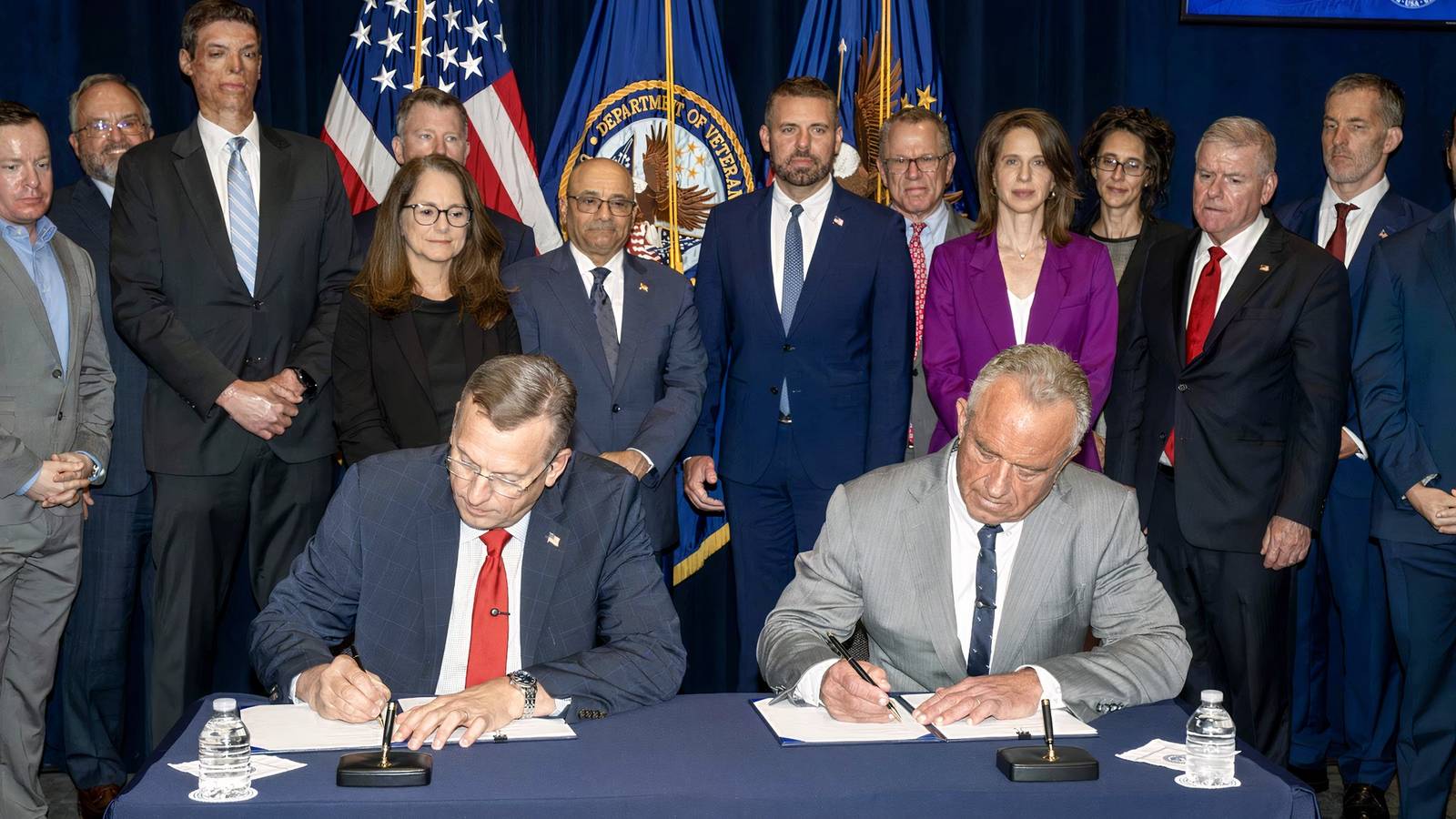
Seeking to expand treatment options for those veterans, the Department of Veterans Affairs and the Department of Health and Human Services on Monday launched a five-year partnership designed to accelerate research into psychedelic therapies and prepare the VA to deliver them if they receive federal approval.
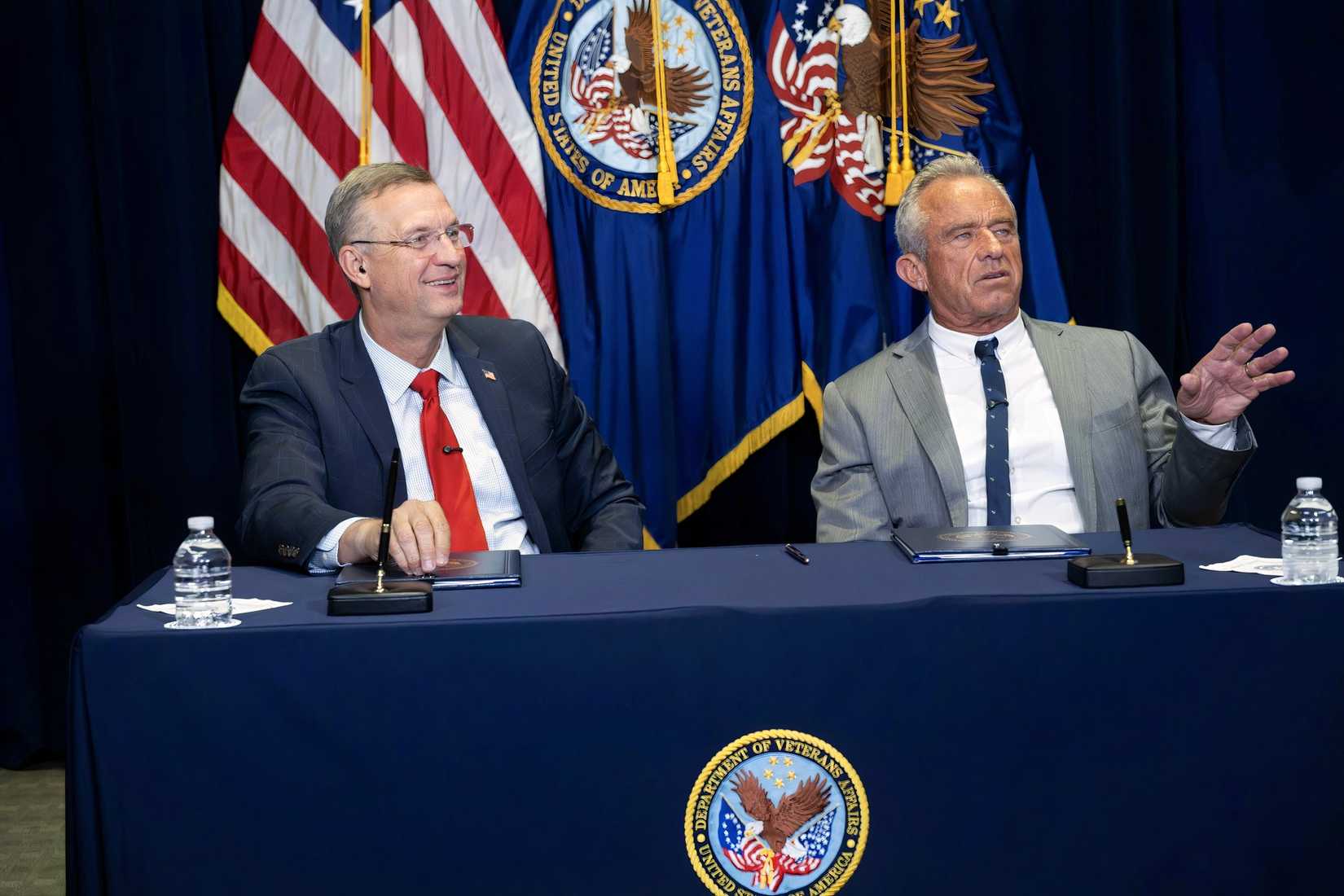
VA Secretary Doug Collins and Kennedy signed a memorandum of understanding at VA headquarters implementing President Donald Trump’s Executive Order 14401, which directs federal agencies to accelerate medical treatments for serious mental illness by expanding research, increasing clinical trial participation and improving coordination among agencies responsible for evaluating and delivering new therapies.
The agreement establishes closer collaboration between the two departments to expand clinical trials, train therapists and physicians, share research data with the Food and Drug Administration, and develop treatment protocols so veterans can more quickly access psychedelic-assisted therapies if the FDA determines they are safe and effective.
Nearly 6 million veterans live with mental illness or substance use disorders. About a million of them have serious mental illness, Kennedy said during the signing ceremony. These Americans answered our nation’s call. Now it is our turn to answer theirs. They deserve more than sympathy. They deserve every opportunity to heal.
Kennedy said the administration intends to follow science rather than politics as it evaluates emerging therapies.
“Strong evidence, not ideology or politics, must guide our medical decision making in this country,” he said. “These studies will help determine which therapies work, what the proper dosage is, which patients benefit, and how we can deliver these treatments safely.”
What the Partnership Does
The memorandum calls for the departments to:
- Increase participation in psychedelic clinical trials.
- Train therapists, nurses and physicians involved in psychedelic-assisted therapies.
- Collect and share data on safety, effectiveness and costs.
- Share research findings with the Food and Drug Administration to support review of successful therapies.
- Develop educational materials for veterans and patients if new treatments receive approval.
According to the VA, the department is currently participating in 20 active clinical trials focused on psychedelic therapies for mental health conditions, supported by more than $23 million in external funding.
While the announcement marks a significant expansion of federal cooperation, officials emphasized that psychedelic-assisted therapies remain experimental and will not become part of routine VA care unless they receive FDA approval.
“A scientific discovery alone is not enough,” Kennedy said. “When the FDA approves a new therapy, patients should not have to wait for years for the health care system to catch up. That’s why we’re acting now. This agreement begins preparing the VA today by developing clinical guidance, training providers and establishing treatment protocols so that veterans can benefit without unnecessary delay.”
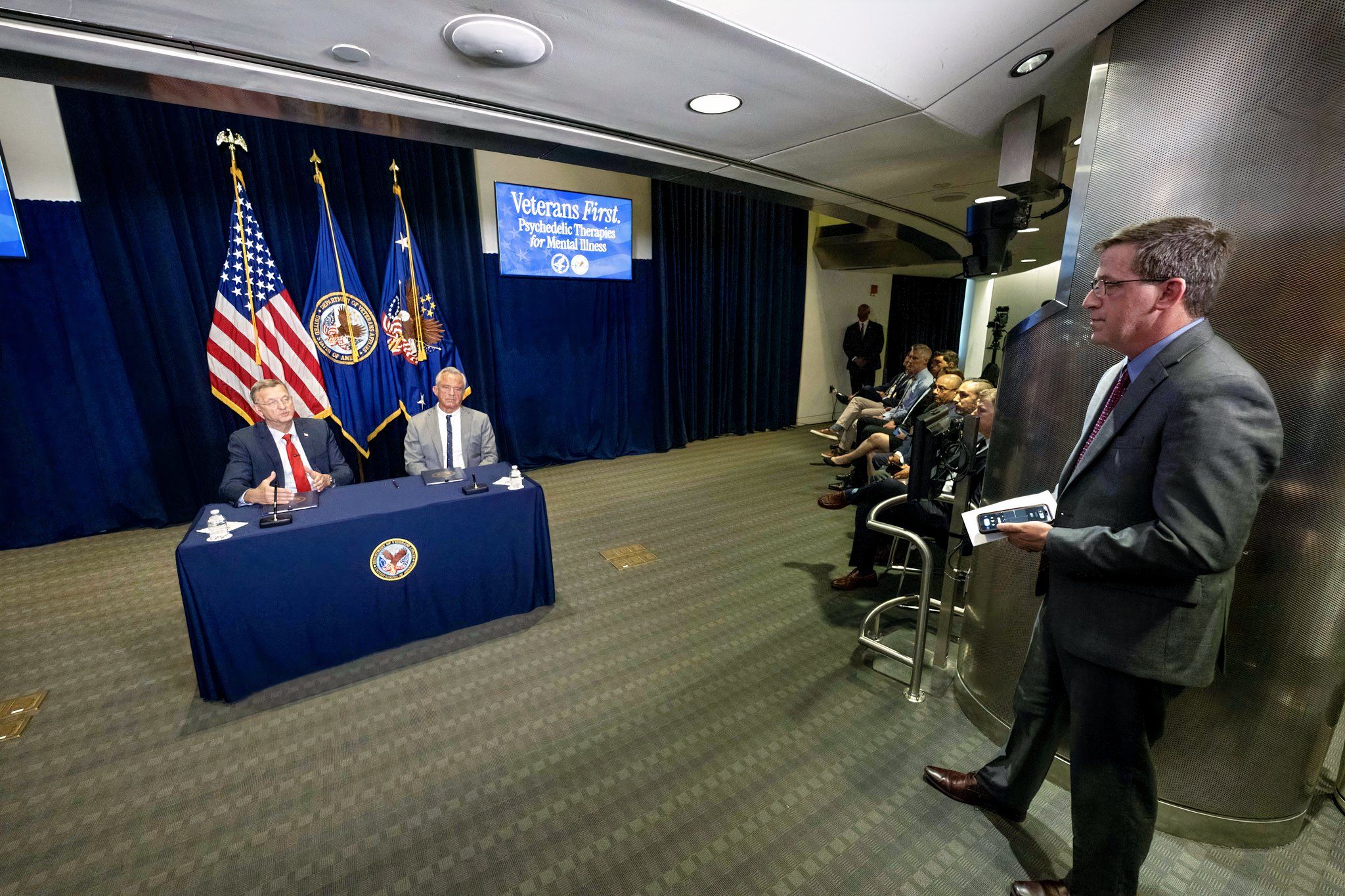
Following the ceremony, Military.com was the only news organization invited to question both cabinet secretaries, providing additional insight into how the administration plans to move psychedelic-assisted therapies from research into patient care.
Preparing for FDA Approval
Although psychedelic-assisted therapies remain under scientific review, Collins said the VA is already preparing for the possibility that treatments could become available in the future.
We’re already making plans to say, ‘How can we roll this out at different spots across the country and be prepared?’ Collins told Military.com. What we don’t want to have is everybody rush the doors of the VA … and we don’t have the trained clinical staff to actually carry out the protocols that need to be done to keep it safe and keep it effective.
That preparation extends beyond research.
Collins said the department is intentionally expanding the number of clinicians familiar with psychedelic-assisted therapies while developing the protocols needed to safely deliver care once treatments are approved.
“It’s not just the veteran getting treated; it’s training the clinicians who actually perform the therapy,” Collins said.
Unlike traditional medications, psychedelic-assisted therapies often involve extensive preparation, supervised treatment sessions and follow-up care. Collins said a single veteran undergoing MDMA-assisted therapy may require more than 100 clinical hours, making workforce preparation just as important as the scientific research.
So these clinicians have to have something they can use, Collins said. We’re going to open that up as much as we can, as quickly as we can, by training as many clinicians as possible.
He said the goal is to avoid a scenario in which veterans become eligible for a promising new therapy, but the VA lacks enough trained providers to safely deliver it.
Expanding Psychedelic Research
Collins said many veterans may not realize the VA has already been studying psychedelic-assisted therapies for years.
“Most people don’t know that the VA has been doing this, actually, for a while, but now this gives us an opportunity to expand it, lead the way, and also give even more treatments as we go into things like MDMA, psilocybin, and now ibogaine. These are the ones that we’re looking at to expand.”
He said the new partnership allows the VA and HHS to move beyond simply conducting research by coordinating funding, data sharing and implementation planning simultaneously.
“We have MDMA, psilocybin, ketamine we’ve been doing, but especially when it comes to ibogaine, which is the next big one, it allows us to work together not only from a funding and research standpoint … but us giving the real-time feedback and the data-sharing operation where we know exactly what’s happening with our veterans.”
For veterans, the agreement does not mean psychedelic-assisted therapies will immediately become available through the VA. Instead, officials said it is designed to ensure that if ongoing clinical trials lead to FDA approval, the department will already have the research, workforce and treatment protocols in place to begin offering care more quickly than has traditionally been possible.
Breaking Down Government Silos
Both Collins and Kennedy said one of the partnership’s biggest advantages is eliminating barriers that have historically slowed promising medical research.
It requires collaboration, Kennedy told Military.com. Everything requires FDA approval ultimately before we can actually start rolling this out to the public.
Kennedy said agencies across HHS, including the Food and Drug Administration, National Institutes of Health and Centers for Disease Control and Prevention, are now working together with the VA rather than independently.
“Silos are the place that these projects go to die traditionally,” Kennedy said. “We’ve now got two things that have never happened before. One is we have a president who has given us very, very urgent orders to make this happen and make this happen quickly.”
Collins said the partnership reflects a broader effort within the Trump administration to eliminate bureaucratic barriers between agencies.
“One of the things is that most people don’t know that the VA has been doing this actually for a while, but now this gives us an opportunity to expand it, lead the way,” Collins said. “Through the work and the leadership of Secretary Kennedy at HHS and the folks at his department and our department coming together, we’re not siloed like so many things in the past.”
He said that coordination is what gives him confidence that the effort can move more quickly than previous government initiatives.
“So what we’re going to be doing is leading the way,” Collins said. “With the partnership between the VA and HHS and all the partner agencies in between, you’re going to actually get the theory and the practical. You’re going to get the theory that says it’s safe, effective and doing what it’s supposed to do. And we’re going to be able to take it straight to our veterans and straight to others and say, ‘This is what we’re going to be able to do to get you the help you need.'”
For now, officials stressed that veterans should not attempt to self-medicate or replace evidence-based mental health treatments with psychedelic substances outside approved research settings.
“We don’t know if this works or not,” Kennedy told Military.com. “We need to find out for the vets. They made the ultimate sacrifice for us, and we’ve got to give them every chance that they can for healing.”
Read the full article here
34 Comments
Production mix shifting toward USA might help margins if metals stay firm.
Exploration results look promising, but permitting will be the key risk.
Good point. Watching costs and grades closely.
Exploration results look promising, but permitting will be the key risk.
Good point. Watching costs and grades closely.
Good point. Watching costs and grades closely.
Exploration results look promising, but permitting will be the key risk.
Good point. Watching costs and grades closely.
Good point. Watching costs and grades closely.
Silver leverage is strong here; beta cuts both ways though.
Uranium names keep pushing higher—supply still tight into 2026.
Good point. Watching costs and grades closely.
Nice to see insider buying—usually a good signal in this space.
Good point. Watching costs and grades closely.
Good point. Watching costs and grades closely.
Exploration results look promising, but permitting will be the key risk.
Silver leverage is strong here; beta cuts both ways though.
Good point. Watching costs and grades closely.
Nice to see insider buying—usually a good signal in this space.
Good point. Watching costs and grades closely.
Good point. Watching costs and grades closely.
Exploration results look promising, but permitting will be the key risk.
Good point. Watching costs and grades closely.
Good point. Watching costs and grades closely.
Silver leverage is strong here; beta cuts both ways though.
I like the balance sheet here—less leverage than peers.
The cost guidance is better than expected. If they deliver, the stock could rerate.
Silver leverage is strong here; beta cuts both ways though.
Good point. Watching costs and grades closely.
Silver leverage is strong here; beta cuts both ways though.
Good point. Watching costs and grades closely.
Exploration results look promising, but permitting will be the key risk.
Good point. Watching costs and grades closely.
Production mix shifting toward USA might help margins if metals stay firm.