


A major decrease in veteran homelessness rates is predicted this year, including one that may be historic.
On Monday, the nonprofit Community Solutions released a preliminary analysis of available 2026 point-in-time (PIT) count data on veteran homelessness. It works with more than 170 communities to secure housing and make homelessness rare and brief.
It comes before the U.S. Department of Housing and Urban Development (HUD) is expected to release its annual report this January, in which community data figures conduct PIT counts to estimate the national numbers of people experiencing homelessness in shelters and in unsheltered locations on a single night.
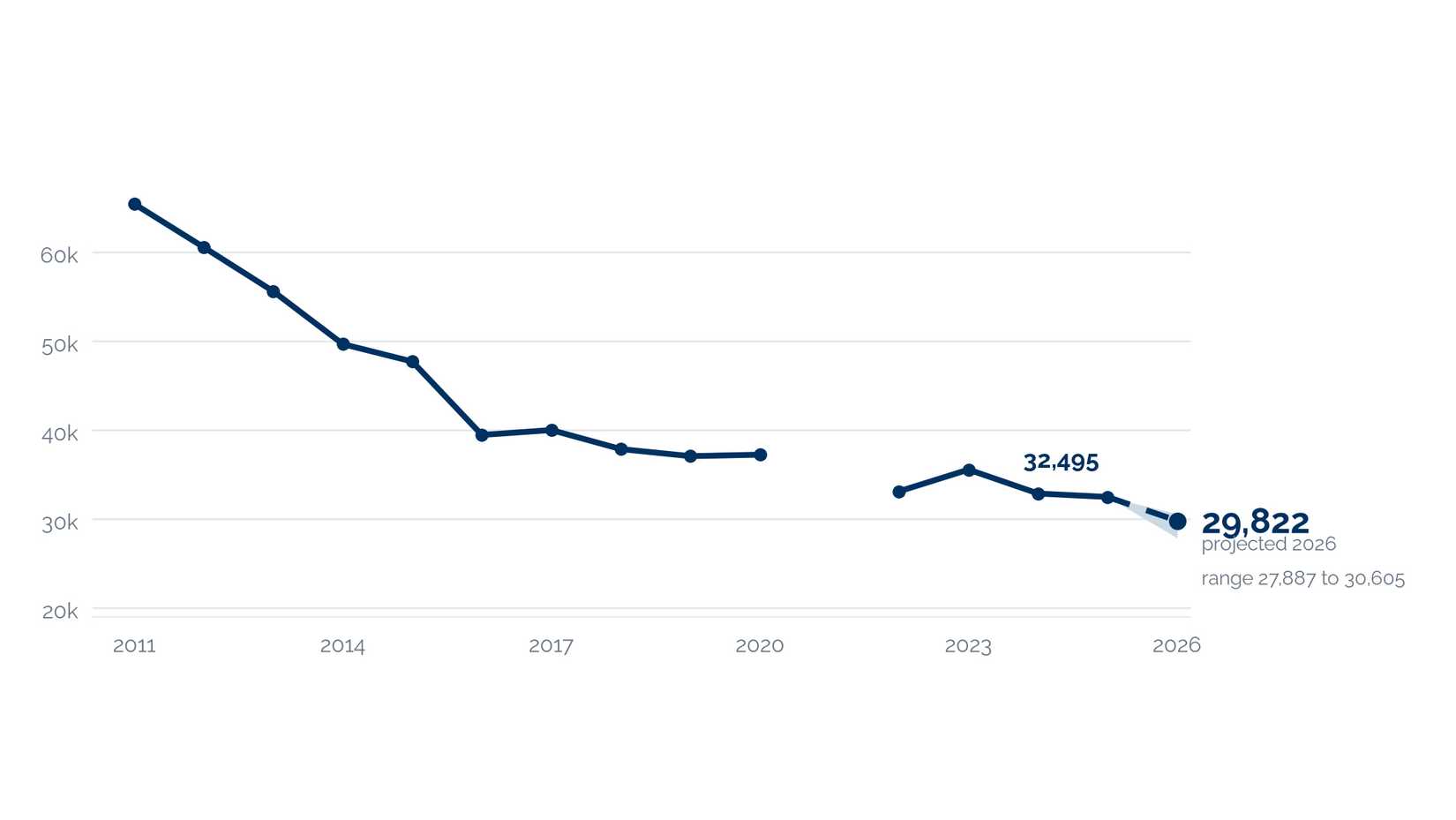
Findings by Community Solutions project an 8.2% veteran homelessness decline when compared to 2025. Numbers are also expected to fall below 30,000 in 2026, marking the first time ever since veterans were included in the Point-in-Time count beginning in 2009 (there was no figure in 2021 due to the COVID pandemic).
Adam Ruege, principal of policy and evaluation at Community Solutions, told Military.com he is “very confident” in their estimates.
“I worked at the VA back then [in 2011], so I remember those days when there were like 75,000 veterans in the Point-in-Time count,” Ruege said. “We actually thought that was an undercount, right? To go from 75,000 to now below 30,000…something has happened, something has worked, right?”
PIT is a congressionally mandated congressional requirement that every community that receives federal funds from HUD most conduct, for both sheltered and unsheltered individuals. The federal government uses community-specific data to track progress.
Data and Prediction Methodology
HUD has published the national PIT figure since 2007, usually releasing national estimates the following winter.
Community Solutions, utilizing locally published data from U.S. communities, forecasts a national downward shift in homelessness based on data from 182 of the over 380 HUD Continuum of Care Regions HUD Continuum of Care Regions.
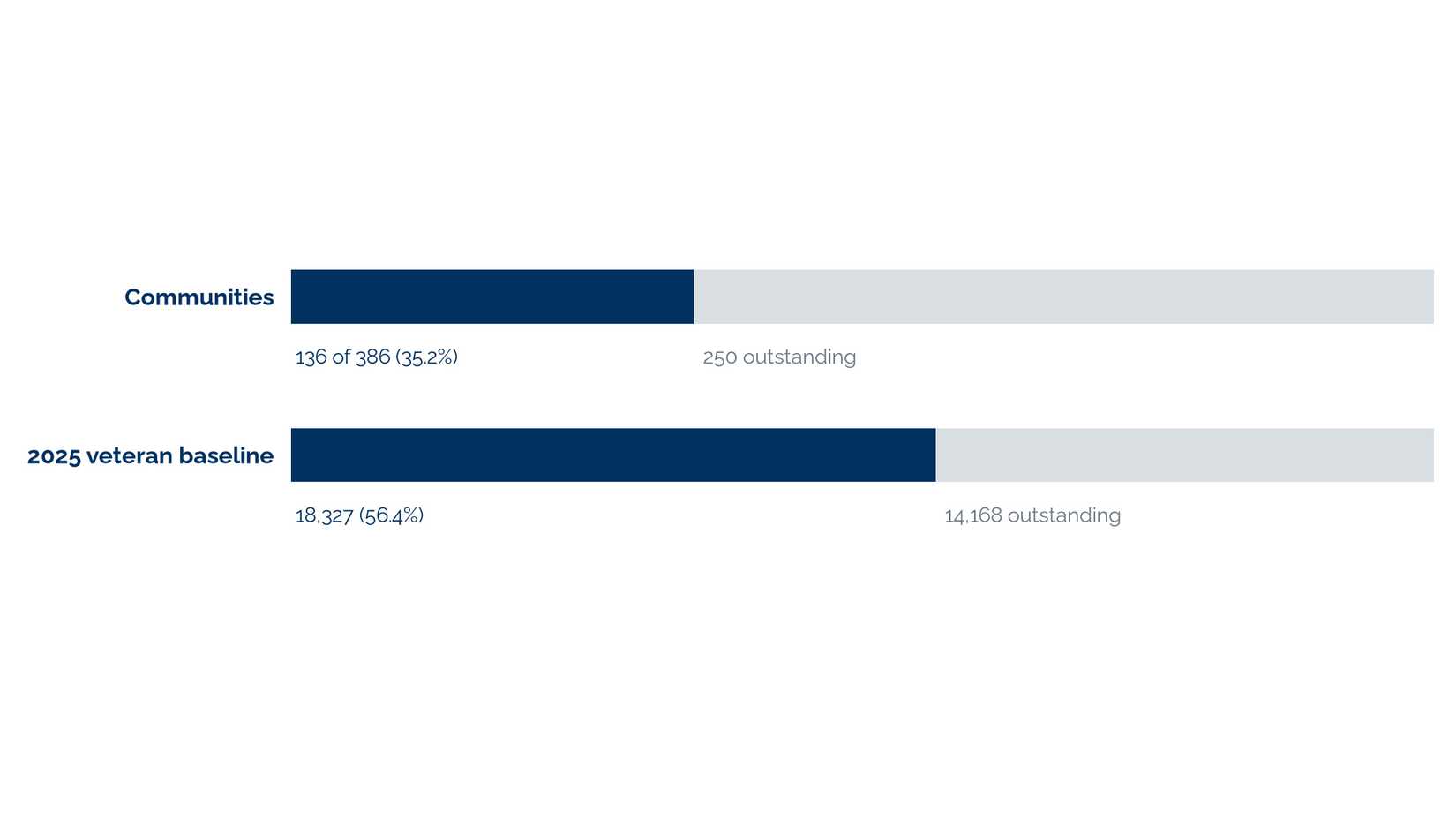
They used the base number of 15,729 veterans reported in the 136 published full 2026 counts and combined it with three possible estimates of the contribution from the outstanding communities.
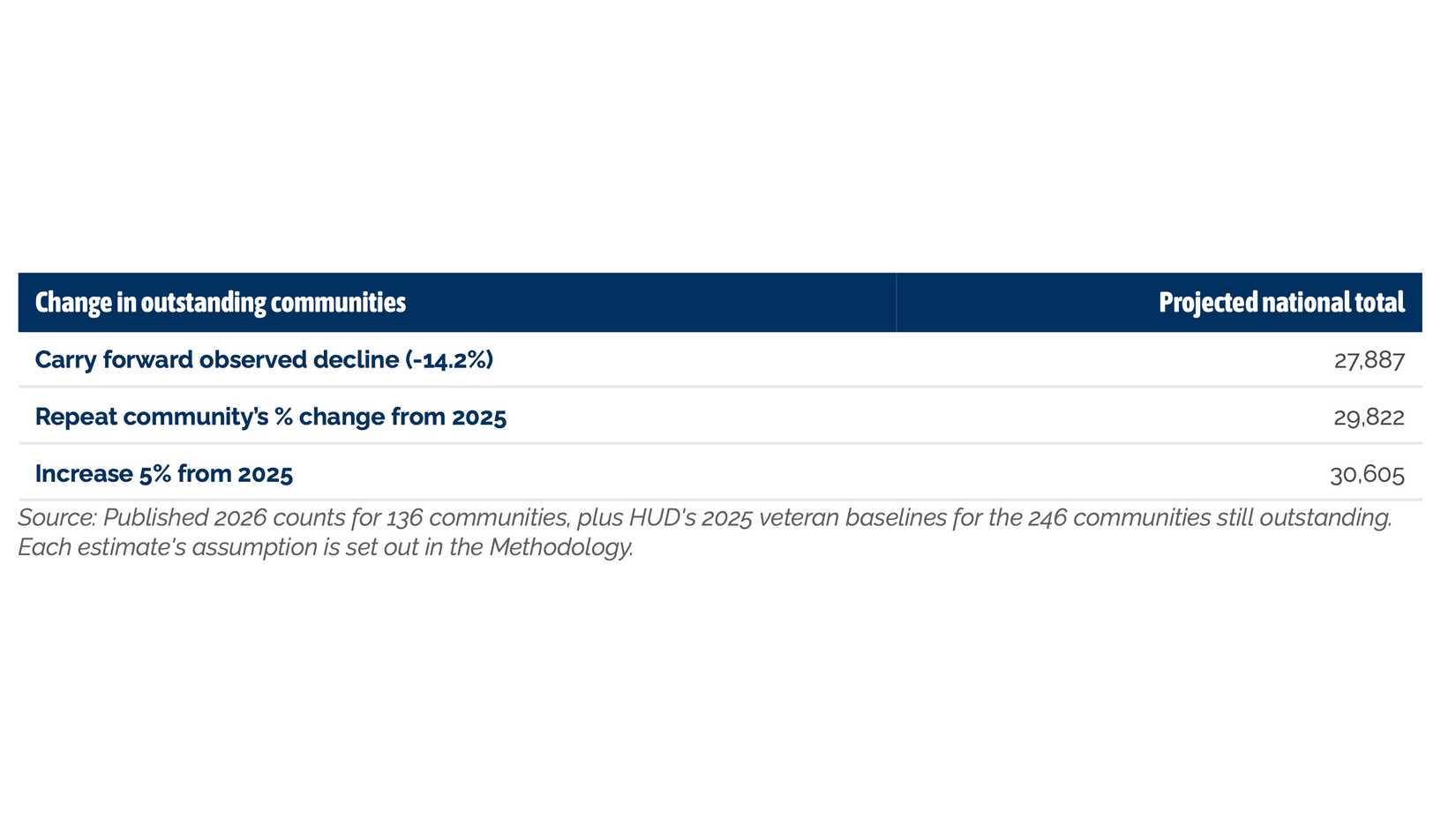
Three estimates for the outstanding communities produce national totals between approximately 28,000 and 30,600, according to Community Solutions. Meanwhile, remaining communities either match the 14.2% reduction already seen in reporting communities, repeat their own percent change from last year, or rise 5%. The second estimate is their projection, while the third is deliberately conservative.
So, Community Solutions identified that 246 outstanding communities accounted for 14,168 veterans (43.6%) in the 2025 PIT count. Estimate 1 carried forward the 14.2% decline seen to date in the 135 reporting communities, “an aggressive but feasible projection.”
Estimate 2 applies each outstanding community’s own percent decline from the 2025 final published count, which analysts said “represents a middle ground” projection-wise since year over year changes in such communities have been relatively stable.

In aggregate, the outstanding communities declined 0.5% in the most recent year for which all of them have counts, “so this estimate holds them close to flat while the reductions already reported stand,” the report says. That result in a national decline of 8.2%.
Estimate 3 applies a 5% increase to the outstanding communities, as part of a conservative attempt to set a high border on the projection range.
“These are estimates, right? We actually don’t know what the results will be,” said Ruege, who worked the last of his 18 years at the VA in the agency’s homeless program office. “We’ve done this for the last three years and each year we actually come out pretty close, about one or two percentage points away from what the final count has been for veterans specifically.”
Communities are weighed a certain way, too, he added. For example, Los Angeles is actually reporting close to a 25% decrease overall but that is believed to be weighted too much. I’ll get you the exact number here in a minute.
“That’s really weighing it too much,” Ruege said. “We don’t believe that based on the rest of the communities that have yet to report that they will be seeing such a large decrease. So, we are actually kind of mitigating that by saying the rest of the communities that have reported—they’re going to look like the previous year. That’s where we land on 8% and so that’s kind of a midpoint.”
2022 Was An Important Year for Reversing Veteran Homelessness
Community Solutions’ findings show that of the 135 matched communities, 87 counted fewer veterans in 2026, 44 counted more, and four were unchanged.
LA fell from 3,050 to 2,257 and accounted for 30.5% of the net reduction, while King County fell from its published baseline of 1,019 to 883 (though that baseline includes an older unsheltered component).
The five largest reductions accounted for 56.5% of the net decline, the 10 largest for 73.3%, and the 20 largest for 90.5%. The other 115 communities fell 2.6%.
The report notes how things have changed since the first Obama administration began tackling veteran homelessness.
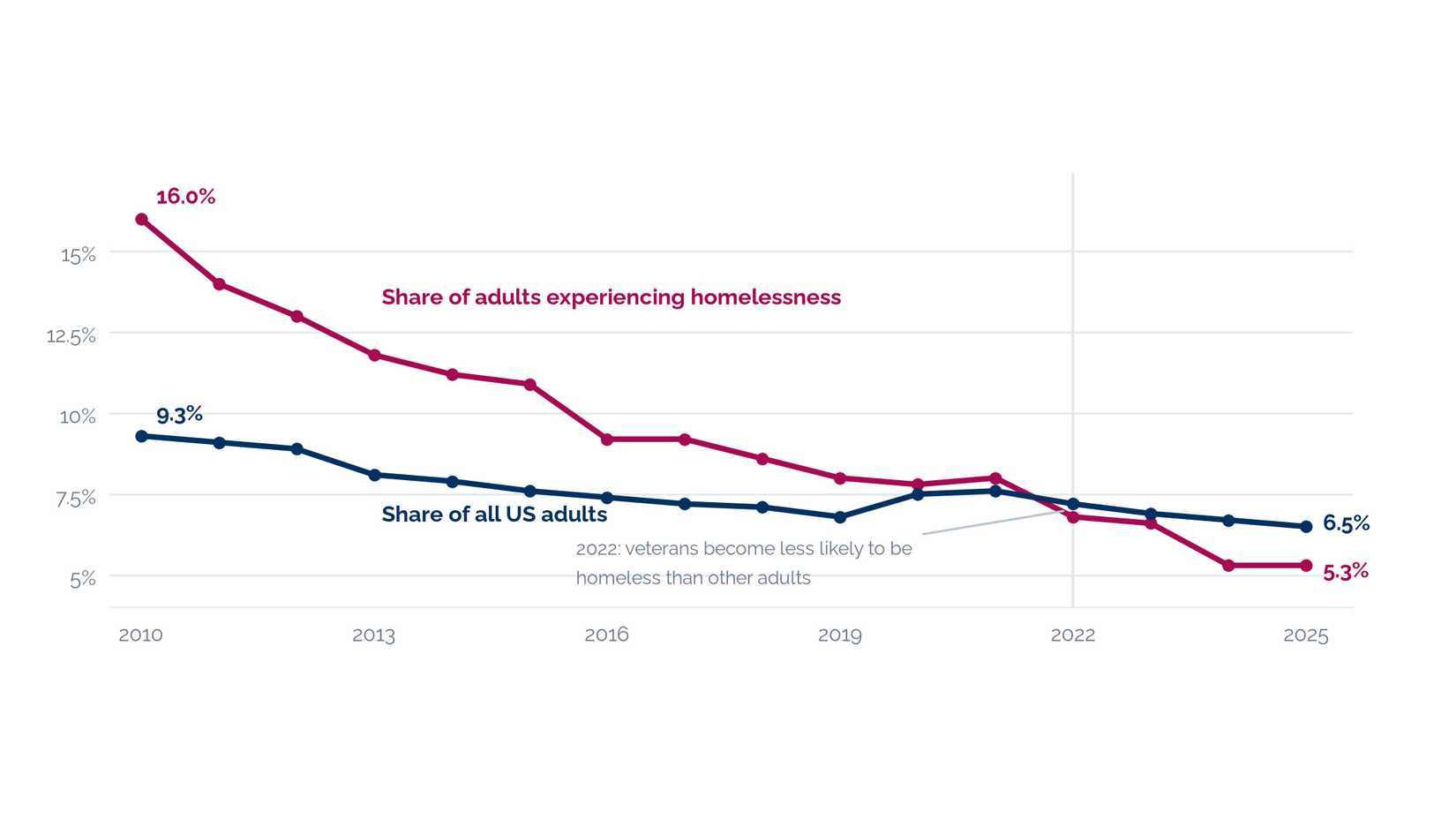
At that time, veterans comprised 9.3% of the general adult population and 16% of the adult homeless population. Veterans were nearly twice as likely to be homeless compared to non-veterans, making veteran status a risk factor for homelessness.
But over the years, positive progress has been achieved as both percentages have declined. However, the rate of veterans in the adult homeless population has more steeply declined. By 2022, veterans were less likely to be homeless compared to non-veterans and the risk factor is now considered a protective factor.
“I think an important thing here is the continued investment and focus of the VA on these services,” Ruege said. “So, whether it be housing for veterans, medical services for veterans—we are also seeing states absolutely helping fill gaps where there are gaps.
“Places like New Jersey, which has made incredible progress on supporting unchecked veterans living out in the streets. Places like Minnesota and Maine have statewide organizations that help fill in gaps for veterans. … This continued investment and focus on veteran homelessness actually led to the results that we’re getting.”
While the federal government helped drive the program, Ruege said that the state and local levels also deserve to be commended.
How Far Times Have Come
Ruege recalled his first VA job while based out of Columbus, Ohio, where he still resides.
He was conducting homeless outreach and would go out in the streets, underneath the bridges, look into cars—basically anywhere he could try to engage veterans.
That was how he got to know one guy named Frank (pseudonym) who lived underneath the bridge downtown. Frank served 15 years in the Marine Corps and after getting out of the service fell on hard times, developed a serious mental illness, and started to use alcohol to cope with his lot in life.
“I came back to him every week and said, ‘Frank, man, when are you ready? When are you ready to come inside?'” Ruege said. “At the time, the only option we had was a shelter. … I saw him for a couple of years, every week, and he never wanted to come inside because that wasn’t the place for him.”
The HUD-VASH program helped Frank. That was a joint initiative between the VA and HUD that provided housing choice or subsidized housing vouchers with clinical services.

“What changed for me, and what changed for the system, is when I could go out to Frank and say, ‘Hey, Frank, I got a place for you to live now. I got a voucher for you, and let’s go down to the public housing authority and get you signed up,” Ruege added.
Frank was the first veteran housed in HUD in Columbus, where he stayed for many years. Not only did HUD-VASH help him, it shined a broader lens for those like Ruege to imitate what worked.
In essence, they prioritized housing and services as cornerstones of driving positive results.
“For our organization and for so many of us who have worked in this, we are seeing results. … We can help support telling the story. We believe that communities can do more, Ruege said. “We do not want to let off the gas here because we do have a ways to go. It’s amazing to see the progress that has been made, but we do have a ways to go.”
Read the full article here
35 Comments
Interesting update on Veteran Homelessness Fell 8.2% in 2026, the Biggest Drop in 10 Years New Analysis Finds. Curious how the grades will trend next quarter.
Good point. Watching costs and grades closely.
Interesting update on Veteran Homelessness Fell 8.2% in 2026, the Biggest Drop in 10 Years New Analysis Finds. Curious how the grades will trend next quarter.
Good point. Watching costs and grades closely.
Good point. Watching costs and grades closely.
If AISC keeps dropping, this becomes investable for me.
Exploration results look promising, but permitting will be the key risk.
Uranium names keep pushing higher—supply still tight into 2026.
Interesting update on Veteran Homelessness Fell 8.2% in 2026, the Biggest Drop in 10 Years New Analysis Finds. Curious how the grades will trend next quarter.
Good point. Watching costs and grades closely.
If AISC keeps dropping, this becomes investable for me.
If AISC keeps dropping, this becomes investable for me.
Good point. Watching costs and grades closely.
Good point. Watching costs and grades closely.
Interesting update on Veteran Homelessness Fell 8.2% in 2026, the Biggest Drop in 10 Years New Analysis Finds. Curious how the grades will trend next quarter.
Good point. Watching costs and grades closely.
Uranium names keep pushing higher—supply still tight into 2026.
Good point. Watching costs and grades closely.
I like the balance sheet here—less leverage than peers.
If AISC keeps dropping, this becomes investable for me.
The cost guidance is better than expected. If they deliver, the stock could rerate.
Good point. Watching costs and grades closely.
I like the balance sheet here—less leverage than peers.
Silver leverage is strong here; beta cuts both ways though.
Good point. Watching costs and grades closely.
Silver leverage is strong here; beta cuts both ways though.
Good point. Watching costs and grades closely.
Exploration results look promising, but permitting will be the key risk.
Good point. Watching costs and grades closely.
The cost guidance is better than expected. If they deliver, the stock could rerate.
Production mix shifting toward USA might help margins if metals stay firm.
Good point. Watching costs and grades closely.
Good point. Watching costs and grades closely.
Interesting update on Veteran Homelessness Fell 8.2% in 2026, the Biggest Drop in 10 Years New Analysis Finds. Curious how the grades will trend next quarter.
Good point. Watching costs and grades closely.