


Stepping into the Pebble Flow is a pretty unique experience. In many ways, it’s unlike any other RV I’ve ever been in. From the unique Murphy bed layout in the rear to the electrochromic glass in the exterior-facing windows and bathroom door, the Flow just does “trailer” different from everyone else. In many ways, its design aesthetic and build quality is closer to modern electric cars from the likes of Tesla and Lucid than it is to any travel trailer from a legacy brand. I got to spend one night in the 2027 Pebble Flow at a campground on the chilly, windy, but beautiful Northern California coast, and while I ultimately came away impressed with what Pebble has achieved here, I also have a lot of concerns that carry over from my experience covering electric car startups and the nature of software-defined vehicles.
To cover the basics, Pebble is a Northern California RV startup that aims to bring trailers out of the dark ages and into the present by borrowing design and technology from modern electric vehicles. This idea stemmed from CEO Bingrui Yang, who rented an Airstream during the pandemic to go camping with his family, only to find the process was full of inconvenient, difficult, and gross stuff like dumping the black water tank. So, in typical Silicon Valley style, he set out to fix all of these problems with technology.
What Is It?
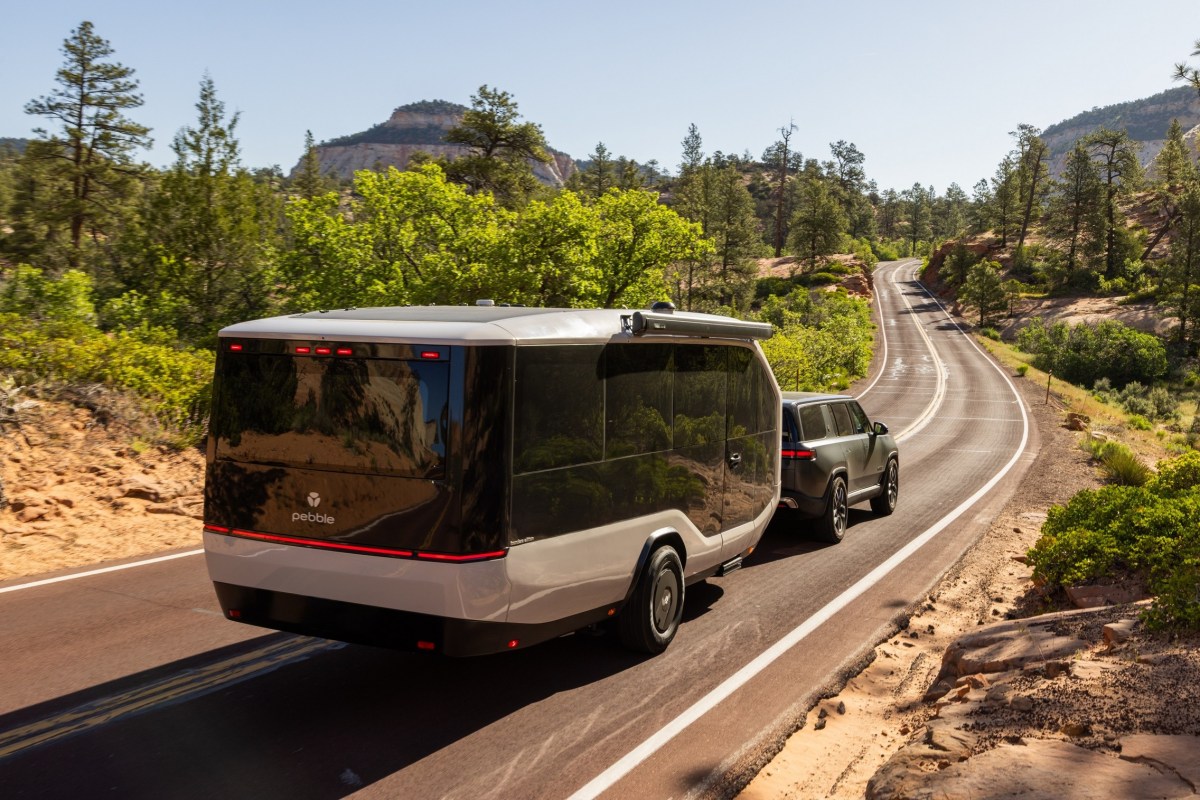
The Pebble Flow is a 25-foot trailer, making it relatively easy to maneuver and store. This is where it differs from traditional trailers. The Pebble Flow’s headline features are its automotive-grade 45-kilowatt-hour lithium-iron-phosphate battery pack and twin electric motors, one for each wheel.
The battery design lets you charge it at just about any EV charger, including fast chargers, and its capacity provides plenty of juice for all the electronic devices the Pebble packs. The motors mean that (as of model year 2027, but more on that later) the trailer can actually help tow itself, by which I mean motors in the wheels can supplement the horsepower and torque of the tow vehicle, lessening the hit to performance and fuel economy, or battery range if you’re in an EV. It can also use those motors to regenerate power while being towed, recharging its own battery.
Motors? Like An Electric Car?

The motors have another trick up their sleeves, too. They can drive the trailer independently of a tow vehicle, making maneuvering easier and allowing you to place the trailer more precisely on site. They also form part of the Pebble’s other big party trick: Magic Hitch. This system uses cameras to let the trailer drive itself to the tow vehicle, line up its hitch, and automatically lower itself onto the ball. Cool right?
The Flow has a dry weight of 5,900 pounds, a gross vehicle weight (GVWR) of 6,800 pounds, and a tongue weight of 680 pounds. This means you’ll need something heavier-duty than a Subaru to tow it, but you won’t need a three-quarter ton truck, either. Most of the owners I saw at the 2027 model-year launch event were towing with EVs like Rivians or Cybertrucks, midsize SUVs, or a handful of half-ton trucks like F-150 Raptors.
Changes For 2027

Most of the Flow’s specs stay the same for 2027, but a few major changes are worth noting if you’re interested. The biggest is the addition of a second floor plan. Previously, if you wanted a Pebble, your only option was a queen-size Murphy bed that opened up a space with a narrow ledge desk that many folks use as a mobile office. Now you can choose dual twin beds in that space, which can be combined into a king-size bed.
There is also an optional full-length powered awning that offers considerably more shade than the standard-length (also optional) awning. Pebble claims it provides nearly twice as much shaded area. For the extra $1,000 on top of the standard-length awning’s $2,000 price, it’s worth it.
Other physical changes include adding another interior color scheme. Previously, the only interior color was Aster White, which looks cool but might not be the most practical choice for folks who use their trailers hard. Now buyers can spend an additional $1,000 for a new Clay colorway, a warmer brown. If you buck up for the Founder’s Edition, the color change costs no extra.
Built Like A Car, But What’s It Like?
Some RVs can feel, for lack of a better word, cheap. Things creak or rattle. The trailer moves as you walk around inside it. Exterior noises aren’t well insulated. The Pebble, to its credit, avoids pretty much all of these things. It feels really solid. The interior materials are nice to the touch and seem hard-wearing. The drawer and cabinet latches are weighty and pleasant to use. They also push in flush, meaning you won’t snag yourself on them as you walk past.
The electrochromic glass seems like a gimmick on paper, but is incredible in practice, letting in plenty of light while maintaining privacy, though expanding the blackout version from the Founder’s Edition to the rest of the lineup would be nice for those who like to sleep in and don’t want to deal with hanging blackout curtains.
The exterior door feels weighty and closes with a satisfying thunk. The automotive-style door handle is also nice to use. The bathroom door is electrochromic glass, which is fine but ultimately unnecessary. The real issue is that the bathroom door has only an exterior latch, meaning you can lock it from the outside but not from the inside, and it doesn’t latch like the other doors. If you’re particularly narrow or small, this is a non-issue; if you’re not, you’ll spend your bathroom time holding the door shut.
There are many other clever design touches, like the swinging/sliding table in the front or the induction cooktop that lifts out of the counter and can be used outside, and it’s features like these where the Pebble really distinguishes itself. They aren’t reliant on the RV’s suite of software, and that’s a good thing in our book, for reasons which will be made clear later in this review.
A Software-Defined RV
The Pebble Flow is what the car industry calls a “software-defined vehicle.” In short, this means the manufacturer can change features and performance through software updates. Think Tesla. In some ways, this is good because you can see incremental improvements and rapid bug fixes, and Pebble owners have liked that (based on conversations with them during the launch event). Software-defined vehicles have downsides, but we’ll get into that later.
The big software improvements for the 2027 model year include a new Boost Mode that lets your trailer help push your vehicle using its hub motors, increasing tow vehicle efficiency at the cost of trailer battery charge. The Flow also gets reworked energy-management software that automatically wakes the vehicle to take advantage of solar charging when it’s most efficient.
Pebble has also improved its phone app and implemented its Scout AI agent, which monitors trailer functions to provide more tailored troubleshooting responses. Pebble claims each Scout instance has access to only a single trailer and doesn’t share the owner’s data.
A Jackery Partnership

Finally, Pebble announced a partnership with power station provider Jackery that gives Pebble owners more solar charging capability. The standard Flow has a 1.1kW panel on its roof, and the new options let buyers add up to 4kW of solar power. Of course, it’s not cheap. The Integrated Solar Package costs $5,000 and adds a solar connector to the trailer, letting you connect external panels. For an additional $4,000, you get four 500-watt portable solar panels from Jackery.
In practice, the all-electric, sleek, technology-laden Flow is pretty cool. Getting to camp and hitting one button on an iPad to deploy the stabilizers and self-levelers, among other things, is really convenient and easy. The AutoDump system, which automates most of the gross waste dumping process, is great. Remote-controlled driving of your trailer around is super fun, too, but of course, it all comes at a cost.
High Tech, High Price

The starting price for the Flow with the Magic Pack, which includes those automations, is $159,000 for a white exterior and white interior. Changing the interior or exterior color costs extra, as do the awnings and solar features I mentioned earlier. There’s no way around it: it’s expensive. The Founders Edition, which includes some of that stuff as standard, is an even more eye-watering $189,000.
For comparison, the Airstream Frank Lloyd Wright Usonian Edition trailer (one of the most jaw-droppingly pretty RVs your author has ever seen) is also $189,000, but it’s 28 feet long and from a brand that’s been making RVs for almost a century.
Here’s The Catch, Maybe

That last part matters and ties back to the whole software-defined vehicle thing. While the Pebble has a ton of really awesome features and automations that something more traditional like the Airstream doesn’t, most of them are directly dependent on the Pebble’s software to function. This is fine as long as Pebble, a startup that’s been around less than a decade, keeps supporting the product.
Supporting the product means Pebble must be willing to invest continued effort and resources in Flow, and it must also stay in business. That last one can be tough; just look at the long list of failed EV startups from the past two decades. If Pebble goes under (not saying it will, or is necessarily likely to) and doesn’t opt to open-source its software at that time, many people with very expensive trailers could be in a tough spot.
I was particularly concerned about this, so I asked Pebble whether it had plans in place to ensure owners could still keep their RVs going if something happened to the company. I didn’t get a response, even after waiting nearly a week. Take from that what you will.
Conversely, using our Airstream example (though this is by no means limited to that brand), look at how many thousands are still in use today, including those from the ’50s and ’60s. Specific pieces of equipment in a traditional trailer may become obsolete or unsupported by the manufacturer, but you can almost always replace that stove or A/C unit with something more modern and efficient.
In that case, you don’t need the manufacturer’s permission to make those changes outside the warranty period, or if you’re willing to give up your warranty. Conversely, with a software-defined vehicle, the manufacturer always holds all the keys, which limits repairability and modification. If you replace a control module with a used or aftermarket one, the manufacturer could use software to prevent it from working. The right to repair becomes a real concern, and I’m not just picking on Pebble here; many EV manufacturers today, including Tesla, Lucid, and Rivian, have this issue.
But Do I Want One?
So, after all that, did I enjoy my time in the Pebble Flow? Yeah, I genuinely did. It’s a very cool RV that does things no other RV currently can. It feels like it’s built relatively well, and the people at the company do seem like real enthusiasts, which is a good sign. Would I buy one? Hard no, at least for now. Too many variables and risks could leave you with a nearly $200,000 brick in your driveway, and that’s just too much of a gamble for most buyers.
For a deeper dive into the Pebble Flow, check out our review.

Read the full article here
44 Comments
Nice to see insider buying—usually a good signal in this space.
Good point. Watching costs and grades closely.
Good point. Watching costs and grades closely.
Interesting update on The 2027 Pebble Flow RV Is A Technological Triumph, But I Have Concerns. Curious how the grades will trend next quarter.
Good point. Watching costs and grades closely.
Silver leverage is strong here; beta cuts both ways though.
Uranium names keep pushing higher—supply still tight into 2026.
Good point. Watching costs and grades closely.
Good point. Watching costs and grades closely.
Interesting update on The 2027 Pebble Flow RV Is A Technological Triumph, But I Have Concerns. Curious how the grades will trend next quarter.
Uranium names keep pushing higher—supply still tight into 2026.
Good point. Watching costs and grades closely.
Good point. Watching costs and grades closely.
Production mix shifting toward Tactical & Survival might help margins if metals stay firm.
Good point. Watching costs and grades closely.
Good point. Watching costs and grades closely.
The cost guidance is better than expected. If they deliver, the stock could rerate.
Good point. Watching costs and grades closely.
Good point. Watching costs and grades closely.
I like the balance sheet here—less leverage than peers.
I like the balance sheet here—less leverage than peers.
Good point. Watching costs and grades closely.
Good point. Watching costs and grades closely.
Interesting update on The 2027 Pebble Flow RV Is A Technological Triumph, But I Have Concerns. Curious how the grades will trend next quarter.
Good point. Watching costs and grades closely.
Silver leverage is strong here; beta cuts both ways though.
Good point. Watching costs and grades closely.
Good point. Watching costs and grades closely.
Uranium names keep pushing higher—supply still tight into 2026.
If AISC keeps dropping, this becomes investable for me.
Good point. Watching costs and grades closely.
Good point. Watching costs and grades closely.
I like the balance sheet here—less leverage than peers.
Good point. Watching costs and grades closely.
Uranium names keep pushing higher—supply still tight into 2026.
Good point. Watching costs and grades closely.
Nice to see insider buying—usually a good signal in this space.
Good point. Watching costs and grades closely.
Good point. Watching costs and grades closely.
The cost guidance is better than expected. If they deliver, the stock could rerate.
Good point. Watching costs and grades closely.
Production mix shifting toward Tactical & Survival might help margins if metals stay firm.
Good point. Watching costs and grades closely.
Production mix shifting toward Tactical & Survival might help margins if metals stay firm.