


A good ratchet strap is boring in the best way: you cinch it down, forget about it, and arrive with everything you left with. The bigger your gear gets, the more essential it is to secure your load. Ratchet straps tighten down and hold a load securely, then let go with a simple release. The options span a range of strengths, lengths, and end fittings.
Lead tester Eric Phillips and contributor Chip Jordan ran the straps through a full year’s worth of seasons in the U.S. Southwest, from snowy, freezing alpine conditions to long stretches holding heavy loads. This duo strapped down hard coolers, lumber, and paddleboards. Phillips trailered a 2007 Suzuki DRZ 400 motorcycle and a 2022 Ski-Doo Summit snowmobile, and test mileage included a 2014 Ford F-150 Raptor and 2008 Ford F-250.
Mac’s Custom Tie-Downs are our best overall pick, with customizable end fittings, colors, and lengths. The Husky Ratchet Tie-Downs 4-Pack earned our budget award. And for massive loads, the Rhino Rack HD Ratchet Tie-Down Set delivers a whopping 1,736-pound working load limit.
Each strap was judged for load capacity, breaking strength, ratcheting function, handles, end fittings, and ease of use.
Editor’s Note: We updated our Ratchet Straps buyer’s guide on November 17, 2026, with a new intro, refreshed reviews with signposts and bottom-line summaries, and an all-new comparison chart.
The Best Ratchet Straps of 2026
Best Overall Ratchet Straps
Mac’s Custom Tie-Downs
Best Budget Ratchet Straps

Husky Ratchet Tie-Downs 4-Pack
Best Heavy-Duty Ratchet Straps

Rhino Rack HD Ratchet Tie-Down Set
Easiest to Use Ratchet Straps
Rhino Rack Retractable Ratchet Straps
Best Ratchet Straps Kit

Augo Heavy Duty Ratchet Straps
Best for Industrial Applications
US Cargo Control Ratchet Strap
Best Ratchet Strap for Light Loads
Uline Retractable Tie Downs 1″ x 10′
See more picks
Mac’s Custom Tie-Downs


Specifications
Pros & Cons
Pros
- Most thorough instructions and safety specs
- Nicest canvas storage bag and strap bands
- Multiple end fittings and color options
Cons
- Priciest option tested
- Non rubber handle
Bottom Line: A made-to-order premium strap with soft loops and an excellent canvas bag, though the bare handles feel underdressed for the price.
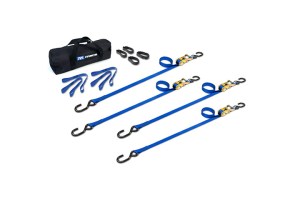
Hands down, Mac’s Custom Tie-Downs ($92) are the top-of-the-line when it comes to ratchet straps. Now, you might be thinking, why does one need custom tie-downs? Mac’s straps come with three different end fittings, so you can get the right strap for your application, and a plethora of color and length options let you match your motorcycle, UTV, or car.
The Tech: These 1-inch nylon straps have a 933-pound working load and a 2,800-pound breaking strength, which lets us carry heavier loads without worry. Each set comes with a canvas storage bag, soft loops for pulling down larger objects that a hook won’t pair with, and bands that keep the straps organized and compact or hold excess slack once they’re tightened. The ratchet itself, with its base, pawl, teeth, and handle, has a smooth release mechanism. Highly detailed instructions and safety manuals round out the package.
What We Like: The canvas bag was the most ergonomic and durable of any carrier we tested. The ratchet was easy to tighten and release, and the instructions mean even a first-time user can understand how to safely use, store, and take care of the straps.
What We Don’t: Given the high cost, we would have liked to see rubber coatings on the handles, like those on the Husky Ratchet Tie-Downs 4-Pack. At nearly four times the cost of our budget straps, these are a bit pricey.
Should You Buy It? If you love your gear and want it to stay safe, secure, and looking good in transit, these are a solid investment in our book. Discarded cargo can quickly become hazardous or broken, and we don’t want to lose any equipment on the road.
Husky Ratchet Tie-Downs 4-Pack

Specifications
Pros & Cons
Pros
- Priced affordably
- Rubber-coated handles
- Comes with carrying bag
Cons
- Only 500-pound breaking strength
- Shows wear quickly
Bottom Line: A cheap four-pack that has hauled dirt bikes and luggage for years, though it’s clunky, wears quickly, and caps out at 500 pounds.
Looking for a simple solution for your cargo carry? The Husky Ratchet Tie-Downs 4-Pack ($19) is a bundle of 1-inch ratchet straps that won’t break the bank.
The Tech: The 12-foot straps come in a quad pack with a small storage bag, and the polyester webbing is rated for a 500-pound working load. The design is basic, in a word. Broad, fairly wide handles let a range of hand sizes grab them comfortably, and a rubber jacket wraps the outer handle. A secondary interior handle, which isn’t as soft, is framed by the rubber one, and a sharp pull should loosen the load. The S-hooks are vinyl-coated.
What We Like: Over the years, our team has used and abused countless sets of Husky ratchet straps. Despite the low price and countless yanks, they continue to serve us year-round on everything from dirt bikes to luggage. That expansive length makes this collection useful for a broad range of jobs, and the rubber jacket is a nice touch.
What We Don’t: They aren’t the easiest to use, and the long tails can be hard to manage on small loads. The design feels clunky, the color options are extremely limited, and most modern straps run smoother. The straps and their S-hooks also quickly show wear, and a 500-pound working load may not be enough for some circumstances and users.
Should You Buy It? Sometimes butter isn’t the priority. This is a good design at an economic price that functions well enough for most people. If you need to triple the working load limit, check out the Rhino Rack HD Ratchet Tie-Down Set.
Rhino Rack HD Ratchet Tie-Down Set

Specifications
Pros & Cons
Pros
- High breaking strength and workload
- Large rubber-coated ratchet handles
- Large S-hooks with gates
- Includes pair of matching soft shackles
Cons
- Gates often won’t easily close due to their large size
- Flimsy storage bag
Bottom Line: A bargain heavy-hitter with a 1,736-pound working load, plush handles, and a lifetime warranty, though the oversized gates can be fussy on narrow bars.
Massive loads call for substantial ratchet straps. The Rhino Rack HD Ratchet Tie-Down Set ($32) is the right pair for the job.
The Tech: These 1.6-inch-wide polyester-and-silk straps have a whopping 1,736-pound working load limit and a 5,260-pound maximum breaking strength. The set is available as a dual-pack for $30 or a tetrad for $60. Each package comes with a carrying bag, stickers, two soft shackles (each 1.7 by 17 inches), and S-hook fittings with a gate. A lifetime warranty backs the straps.
What We Like: The softly padded, easy-to-grip handles were inviting to our digits and made letting off high-tension loads much easier. We also loved the included Velcro straps, which wrap around and sandwich the extra slack and help tidy the straps for storage. The locked gates don’t come unclipped, which is key. And with a lifetime warranty, you can squeeze every bit out of that 30 bucks.
What We Don’t: The storage bag wasn’t nearly as robust as the straps, and the instructions could be more detailed for first-time users. The gates are voluminous, which sometimes kept the S-hook from closing around certain bars, like a few on our tester’s snowmobile rack. The supplied soft shackles solve this issue.
Should You Buy It? If your loads exceed the weight limits of other straps, this should be top of mind. Unlike Mac’s Custom Tie-Downs, which cost $80 and lack rubber on the handles, this set pairs heavy-duty capacity with an affordable price and cushy handles. Just be ready to use the shackles on narrower anchor points.
Rhino Rack Retractable Ratchet Straps

Specifications
Pros & Cons
Pros
- Smooth, user-friendly ratchet system
- Retractable design automatically coils extra slack
- Rubber handles
- S-hooks with gates
Cons
- Low breaking strength
- Bulky ratchet is heavier and takes up more space than traditional design
- Shows wear quickly
Bottom Line: A one-button ratchet that retracts its own slack and shrugs off alpine abuse, trading some bulk and capacity for high speed.
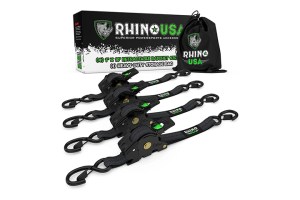
When we first saw the Rhino Rack Retractable Ratchet Straps ($37), we thought there was no way they could be that revolutionary. But after a few weeks of hard testing, we were thoroughly impressed with how easy they are to use compared to a normal ratchet strap.
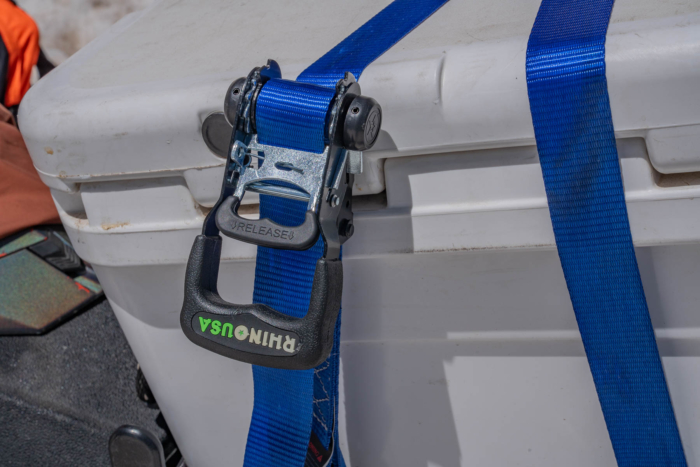
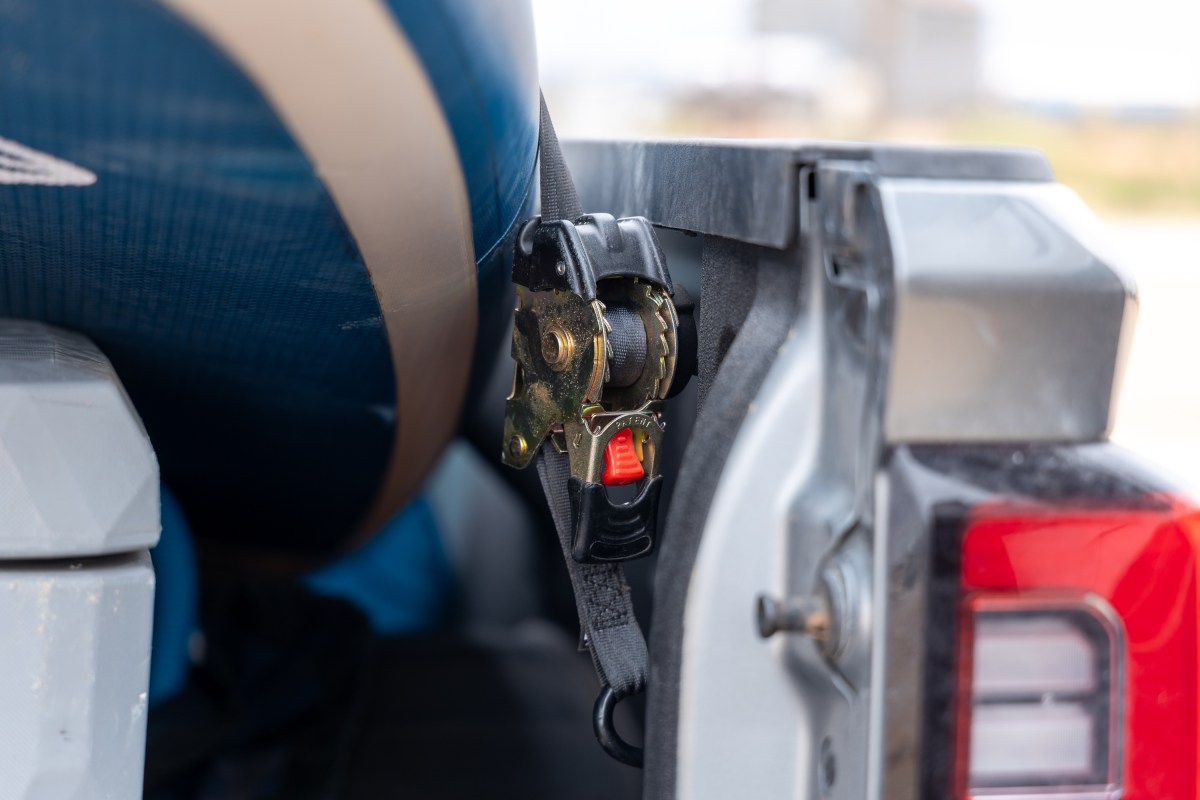
The Tech: The ratchet is one piece instead of two and works with a single button. The webbing is wound and stored in a spring-powered coil. Push the button to release slack when you pull on the strap, or to retract the excess webbing back into the coil. Once it’s in use, the system tightens like a normal ratchet, and when you want to let up, you just hit the button again. The 1-inch polyester-and-silk straps have a 403-pound working load.
What We Like: This retractable system is much easier and faster to use than a traditional ratchet. We tested these straps extensively for a week in the high-alpine backcountry, running the course setup and avalanche mitigation for a backcountry ski race. That involved a lot of tying down and readjusting loads of equipment on snowmobiles. After that hard daily use in the elements, the straps still worked just as easily.
What We Don’t: This innovative system is much bulkier and heavier than a normal ratchet, taking up more space. The power is a tad lower than other straps. After our hard use, there was visible discoloration where the straps had worn down.
Should You Buy It? If you dislike the typical involvement of ratchet straps or want to save time and effort strapping down equipment, these are a great option, as long as you don’t mind the lowered working load. If you want another retractable design with a similar 400-pound working load, the Uline Retractable Tie Downs are an alternative.
Augo Heavy Duty Ratchet Straps

Specifications
Pros & Cons
Pros
- Full kit includes a bag, bungee cords, and soft shackles
- Compact design keeps unit light and small
Cons
- For a heavy-duty ratchet we would like to see a higher breaking strength
- Long tails without a way to easily secure them
Bottom Line: A do-it-all four-pack that bundles shackles, bungees, and a roomy bag with compact, single-finger ratchets and 15 feet of reach.
The motherlode has arrived. No matter what you’re securing, the Augo Heavy Duty Ratchet Tie-Down Straps ($39) deliver the best complete tie-down bundle.
The Tech: This 4-pack of 15-foot, 1-inch polyester straps comes with everything you need: a large storage bag, soft shackles, and bungee cords for securing smaller loads. The ratchets are modest in size and lightweight thanks to a single-finger design that fits easily into your hand, and the working load is 733 pounds.
What We Like: The accessories mean you can secure everything from small boxes to large loads like motorcycles or ATVs. The 15-foot length gives you the reach and flexibility to strap down even the bulkiest loads, and the bungee cords add attachment points on the shorter side. The ratchets fold down more compactly than any other we tested and shine for their seamless ease of use.
What We Don’t: We’d prefer an included Velcro strap to tie down the tails of the lengthy webbing. Given the heavy-duty label, we also think the working load should be closer to 1,000 pounds, though 733 pounds is still beefy enough for most situations.
Should You Buy It? If you’re hauling a wide variety of loads, this is a very affordable package that covers small to extra-large gear. If you need a higher working load limit, the US Cargo Control Ratchet Strap also offers a 15-foot length with a working load of 1,100 pounds.
US Cargo Control Ratchet Strap

Specifications
Pros & Cons
Pros
- High work-load limit
- Multiple end attachment options
- Bulk ordering available
Cons
- No rubberized handles
- Lacks extras like storage bags or soft shackles
Bottom Line: A no-frills, compliance-ready strap with 1,100 pounds of working load for just a few bucks, built for the shop rather than the trail.
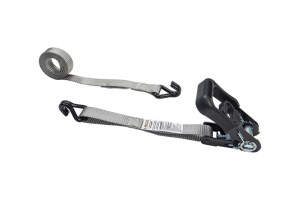
Starting a business in the outdoor industry? Simple and hard-working hit the mark with the US Cargo Control Ratchet Strap ($11).
The Tech: This no-frills strap has an impressive working load limit of 1,100 pounds and a breaking strength of 3,300 pounds, all packed into 1-inch polyester webbing. US Cargo Control offers strap options from 1-inch to 4-inch webbing, in varying lengths, colors, and end fittings, so you can find the exact strap for each use case. They also come at bulk-order discounted pricing, up to 100 straps. The straps meet the working load limits of various organizations, including FMCSA and DOT regulations, CVSA and WSTDA guidelines, and North American Cargo Securement standards.
What We Like: The diverse menu of lengths, end fittings, and colors, plus the impressive breaking strength and the bulk-order option, make these perfect for industrial uses. The bare-bones style suits commercial work, and the price is hard to beat.
What We Don’t: These straps don’t come with rubber handles, which makes them less ideal in outdoor or adverse weather conditions. At such a low price, it’s no surprise they leave out extras like storage bags or soft shackles.
Should You Buy It? For commercial or industrial applications, especially indoors, this is a solid selection that checks a boatload of boxes. If you don’t need as much working load but like the extra length, check out the 15-foot Augo Heavy Duty Ratchet Tie-Down Straps.
Uline Retractable Tie Downs 1″ x 10′

Specifications
Pros & Cons
Pros
- Very convenient no mess design
- Quality construction and materials
- Simple operation
Cons
- Roughly the same size and storage footprint as a standard ratchet strap
- Can be a little difficult to release with high tension
- Does not come with a storage bag
Bottom Line: A quiet, well-built retractable that ends the tail-and-tangle routine, though releasing it under heavy tension takes some muscle.
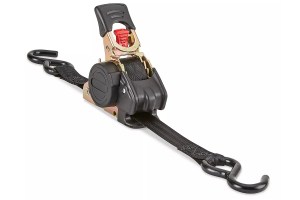
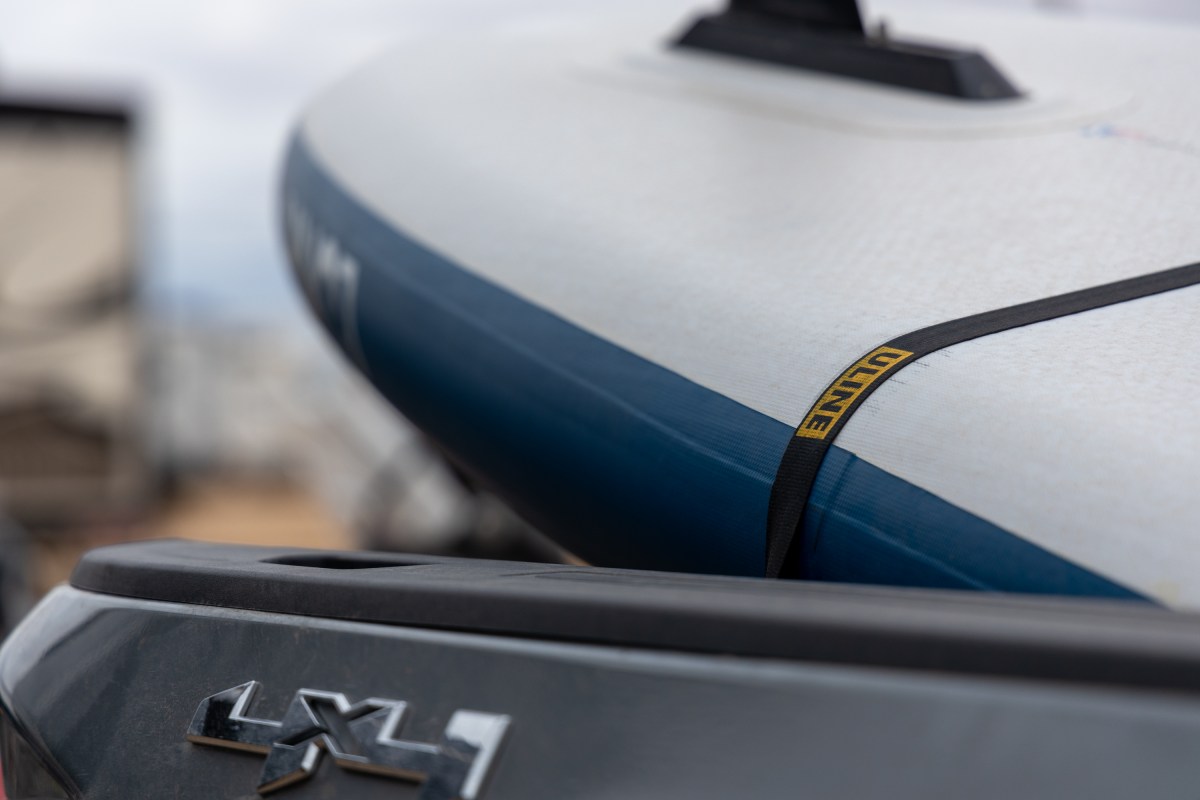
Traditional ratchet straps can be frustrating and time-consuming. There’s the leftover tail that you have to find something to do with once your load is secured, so it’s not flapping around in the breeze, waving at all the drivers behind you. Then you have to decide how to roll them up and store them so you don’t end up sorting out a bird’s nest next time. As an organizational design, the Uline Retractable Tie Downs ($17) solve this issue.
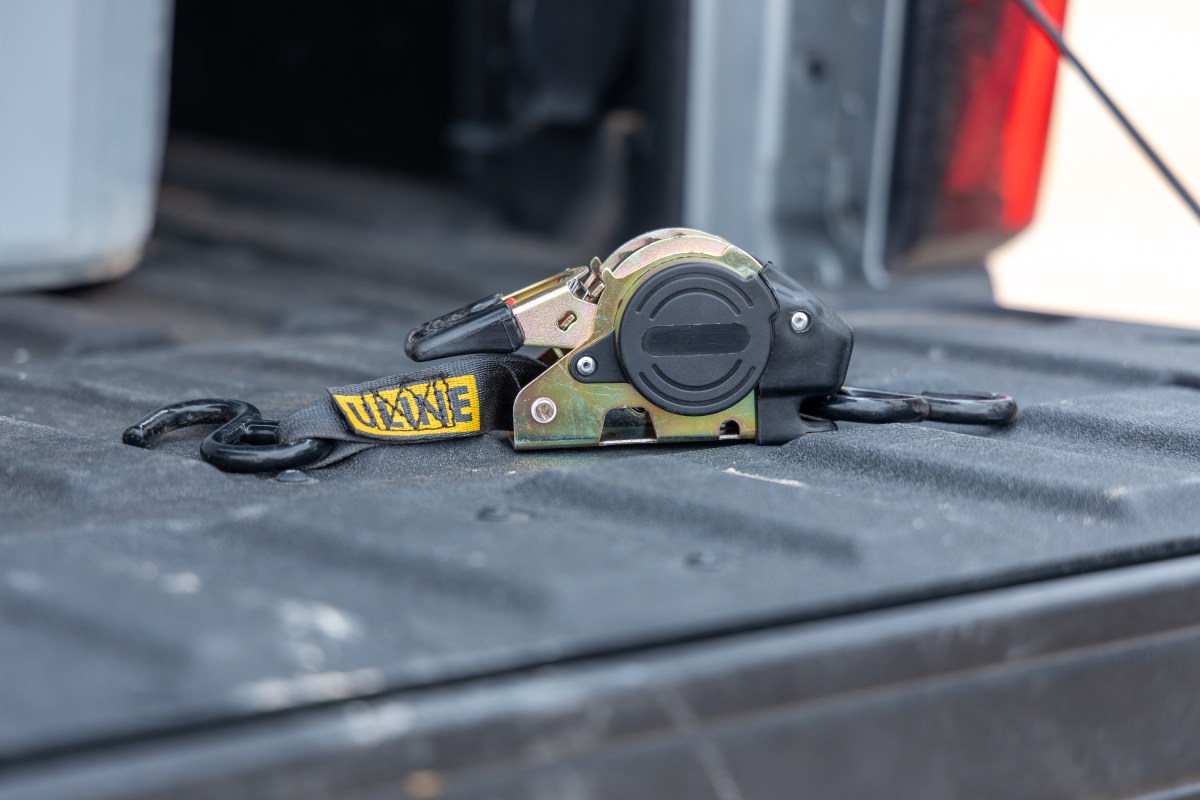
The Tech: We tested the 1-inch by 10-foot model, which has a 400-pound working load and a maximum capacity of 1,200 pounds. Uline also makes a 2-inch by 10-foot version with a maximum capacity of 3,300 pounds. The release system is made from a hefty piece of steel built to withstand the elements, and the retractable ratcheting mechanism works smoothly and is rather quiet. A one-finger button releases the strap. Despite the upgraded ratchet, the weight and overall footprint aren’t much different from a traditional ratchet strap. They’re sold individually as well, in case you need a single replacement.
What We Like: Right out of the box, we noticed the high-quality construction and materials. Securing most cargo, mowers, motorcycles, and dirt bikes is well within its wheelhouse, and you get the added benefit of easy storage. Overall, we really liked the functionality and quality of these straps at a comfortable price point.
What We Don’t: We had a bit of trouble releasing the strap when it was under a sizable amount of tension, though that could partly have been operator error. We also wished the straps came with a storage bag for even better organization, but it’s certainly not a deal-breaker. The working load is lower than most other favorites, like the US Cargo Control Ratchet Strap, which has a working load of 1,100 pounds.
Should You Buy It? If you’re tired of managing tails and tangles, this is a very solid, well-made unit that’s more than capable for the vast majority of everyday tasks. Should you need more strength, Uline has the 2-inch by 10-foot version.

Ratchet Straps Comparison Chart
Scroll right to view all of the columns: Price, Breaking Strength, Work Load, Width, and Materials.
|
Mac’s Custom Tie-Downs |
Husky Ratchet Tie-Downs 4-Pack |
Rhino Rack HD Ratchet Tie-Down Set |
Rhino Rack Retractable Ratchet Straps |
Augo Heavy Duty Ratchet Straps |
US Cargo Control Ratchet Strap |
Uline Retractable Tie Downs 1″ x 10′ |
|
|---|---|---|---|---|---|---|---|
|
Compare |
|
|
|
|
|
|
|
|
Price |
$80 |
$19 |
$32 (two-pack); $60 (four-pack) |
$37 (two-pack) |
$39 |
$11 |
$17 |
|
Width |
1” |
1” |
1.6” |
1” |
1” |
1” |
1” |
|
Breaking Strength |
2,800 lbs |
1,500 lbs |
5,208 lbs |
1,209 lbs |
2,200 lbs |
3,300 lbs |
1,200 lbs |
|
Work Load Limit |
933 lbs |
500 lbs |
1,736 lbs |
403 lbs |
733 lbs |
1,100 lbs |
400 lbs |
|
Material |
Nylon |
Polyester |
Polyester, silk |
Polyester, silk |
Polyester |
Polyester |
Polyester |
|
Lengths |
6’, 10’ |
12’ |
8’ |
10’ |
15’ |
6’, 10’, 15’, 20’ |
6’, 10’ |
|
Colors |
Blue, black, pink, red, orange, silver, purple, yellow, green |
Black with red stripes |
Black, green, blue, orange, red, grey |
Black, green, blue, orange, red, gray |
Black, blue, green, grey, orange, red, yellow |
Black, blue, grey, green, red, white, yellow |
Black |

How We Tested Ratchet Straps
Our Expert Testers
Lead tester and photographer Eric Phillips has been an outdoor professional for more than 10 years and is a lifelong automotive enthusiast. From growing up working as a ranger for his local Boy Scout camp to volunteering search and rescue in Crested Butte, Colo., Phillips has used ratchet straps for a ton of different scenarios over the course of his career and daily life.
Gear tester, photographer, and all-around outdoor enthusiast Chip Jordan has plenty of experience using ratchet straps, ropes, and webbing — throughout the past 15 years, he’s worked as a full-time firefighter and spent eight years in the Army with two combat deployments, and now works as an NCCCO certified crane operator.
Our Testing Grounds
Our GearJunkie test team lives in the heart of the Rocky Mountains — Southwestern Colorado — and they like to recreate pretty hard. We also have automotive testers in neighboring New Mexico. When it comes to testing ratchet straps, we wanted to put these straps to the test by ramping up the seasonal volume to match that of a year in the field. From the exposure to snow and below-freezing alpine conditions to lengthy durations holding gigantic, heavy loads, these straps took a beating.
Our Testing Process
The fleet of test vehicles included a 2014 Ford F-150 Raptor, 2008 Ford F-250, 2007 Suzuki DRZ 400 motorcycle, and a 2022 Ski Doo Summit snowmobile. We used the straps to secure a range of oddly shaped objects, like hard coolers and lumber, to each vehicle. There were even a couple of paddleboards tossed in for good measure. We also strapped down the snowmobile and motorcycle to their respective trailers for transport.
Throughout our field tests and personal experience, we determined the best ratchet straps based on various metrics, including load capacity, breaking strength, strap size, ratcheting function, handles, end fitting, materials, accessories, ease of use, durability, instructions and safety protocol, price, and overall quality.
Beyond our tests, we also considered the most popular, award-worthy, universal, and case-specific designs. These ratchet straps serve a range of uses, styles, and budgets, and we’re certainly happy with them.

Buyer’s Guide: How to Choose Ratchet Straps
Most of us have to take our gear from our house to the outdoors. Keeping things tied down and secure helps preserve the life of your gear and keeps both people and objects safe. That’s where ratchet straps come in.
Ratchet straps include two foundational pieces: the straps and the ratchet. The ratchet is the metal centerpiece of the system that tightens, holds, and releases tension on the strap.
The straps are typically 1-inch wide and range wildly by length and there are various attachment styles. Within the ratchet, there are specific pieces that make the unit function. The handle design and release mechanism are two of the key differentiators.
Ratchets
Ratchets have two opposing sides — a flat base and a handle — that work by using teeth to catch and hold tension. The teeth are located on a round gear that rotates. Those apexes are uniformly placed but asymmetrical in shape, with one steep edge that the spring-loaded pawl grabs. While tightening the ratchet, the threaded strap rolls around the axle. This movement shortens and tightens the strap across the load.
You only really need to know that the system captures progress and holds tension.
Release System
The opposite is true for the release. Inside each side is a shorter release arm. When you want to release the tension, you slide your hand into each release arm, pull up, and widely spread the handle like opening a book. Pulling the handle open while simultaneously holding both release arms allows the ratchet to free up tension.
Nearly all ratchets have a manual design where the user must pull slack out of the system before tension can snag the strap. The exceptions are the Rhino Rack Retractable Ratchet Straps and Uline Retractable Tie Downs.
Retractable System
These novel systems offered by Rhino and Uline are a single housing (instead of the separate flat base and handle) and can be operated with a button for the tighten and release. The extra webbing is wound around a spring-powered coil. Pushing the button can release the slack (with a pull) or retract the strap, which brings the excess webbing back into the coil. From here, the system can be tightened like a normal hand-operated ratchet.
When you want to release the strap, just hit the button again. This retractable ratchet system is much easier and faster to use than a traditional design without the release-and-tighten button.

End Fittings
End fittings are where the webbing has an affixed attachment on the ends of the strap. These points are used to connect the webbing to the anchor and come in multiple forms.
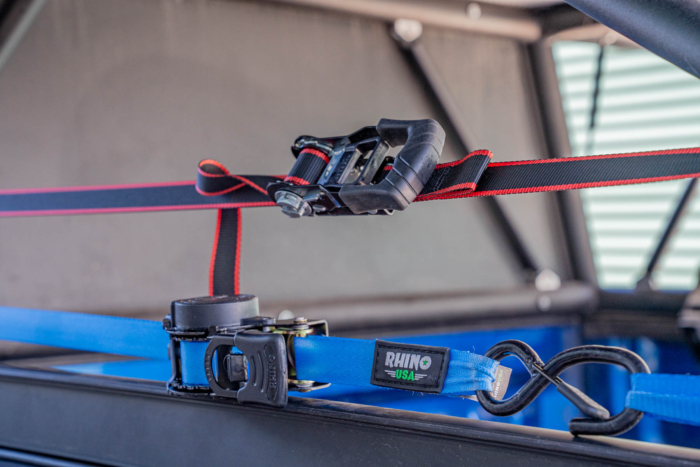
The standard three end fittings are S-hook, S-hooks with a gate, and a flat snap hook.
S-hook
S-hook — with or without a gate — is the standard option. This design can be as simple as a wire hook with a rugged vinyl coating for added protection. The curvature, circumference, and overall size can range a bit.
Some S-hooks have a gate, which is a spring-loaded trap that allows the hook to be an enclosed circle around whatever its clipped to. Like insurance, it also keeps the S-hook from unfastening due to an abrupt jolt during transit.
Flat snap hook
A flat snap hook is a specific attachment style that is best used with an existing D-ring anchor. Similar to a gate, a broad yet slender chip swings backward then snaps closed upon release. This is a great alternative when the orientation of other attachment hooks would put a twist in the webbing.
The flat snap hook is the most secure in terms of preventing the strap from disconnecting even when slack develops in the system.

Soft Loops or Shackles
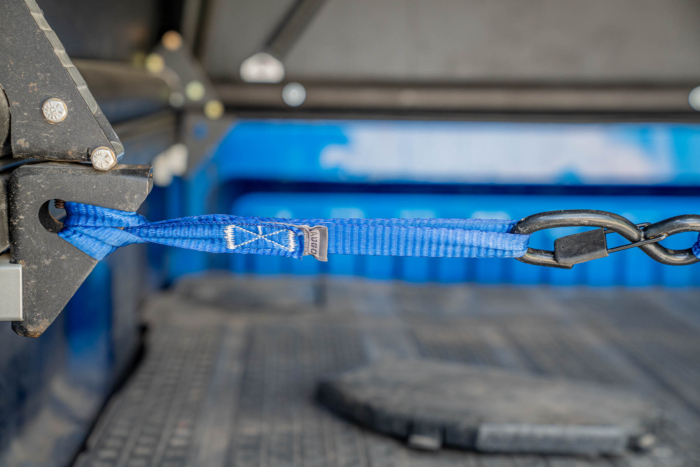
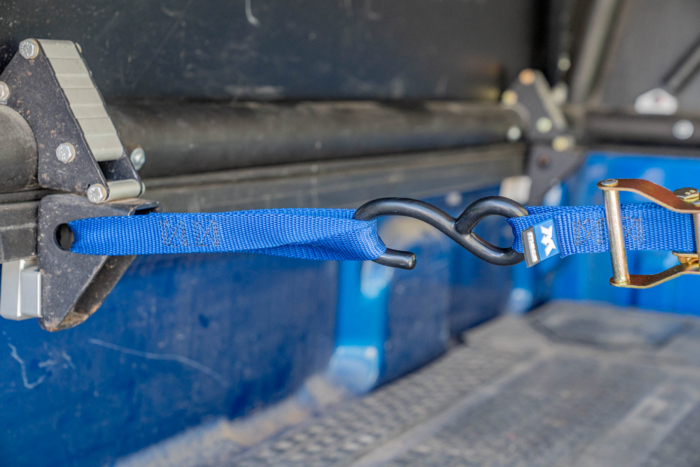
Soft loops are shorter webbing straps that can be used for girth hitching. A single shackle is looped around an object to create an anchor point that a hook would otherwise not be able to grab. Also called shackles, they can be used to prevent scratches on precious parts of gear like the shocks of a dirt bike.
Malleable and robust, shackles have a straight section of webbing with loops on each end, but one loop is straight while the other loop has a twist. First, you’ll thread the shackle around where it needs to be anchored with the two endpoints straddling that object. Simple and brilliant, you’ll feed the straight loop through the twisted loop and pull tight. The resulting anchor will have zero twists in the system. Now, a S-hook can grab the free side of the shackle.
Shackles are helpful if you need to wrap an anchor through the wheel and rim of your vehicle or around the handlebar of a bike, to name a couple examples. Soft loops simply open up customization for rigging anchors.
Both of the Rhino Ratchets — Rhino Rack Retractable Ratchet Straps and Rhino Rack HD Ratchet Tie-Down Set— as well as the Mac’s Custom Tie-Downs and Augo Heavy Duty Ratchet Tie-Down Straps come with soft loops included in the package. Those soft shackles are each rated for the same workload as their complimentary ratchet straps.
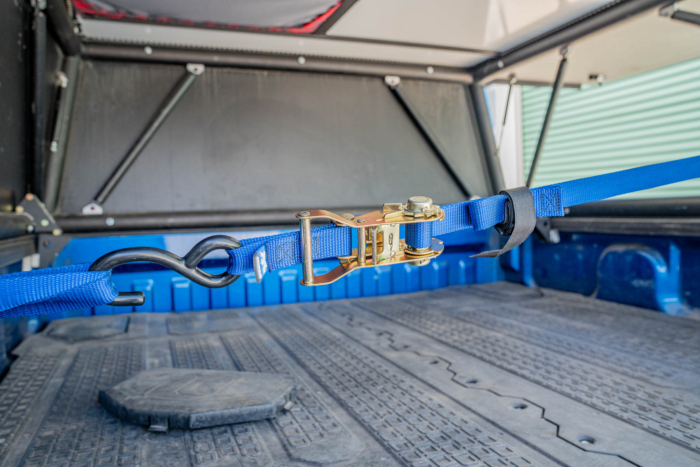
Materials
Ratchet straps are made of a few different materials.
The ratchet mechanism is made of steel. Some of the handles come with a rubber coating. The attachment S-hooks, with and without a gate, are built of steel with a vinyl coat. The webbing is typically manufactured from nylon, polyester, or a silk-polyester blend.
Nylon webbing — which comprises the Mac’s Custom Tie-Downs, for instance — has higher abrasion resistance compared to polyester but doesn’t do as well with water as the polyester webbing.
The water-absorption rate of nylon is higher than polyester, which leads to a lower tenacity, mold, or mildew. Furthermore, nylon can absorb more UV light, which accelerates the decomposition.
Generally, nylon is stronger in terms of breaking strength and working load but doesn’t hold up to the outdoor elements as much as polyester.
Breaking Strength & Working Load
When talking about load capacities of ratchet straps there are two crucial numbers: the breaking strength and the working load. They are both measured in pounds (lbs.) and can be easily confused. Let’s break the two terms down.

Breaking Strength
The breaking strength refers to the maximum weight that can be placed on the strap before the weakest point in the system fails.
Each part in a ratchet strap — from the S-hooks to the ratchet body to the webbing — has an individual breaking strength. The lowest number — or part that is most likely to fail first — sets the breaking strength for the entire system. For example, if the webbing is rated for 2,000 pounds but the S-hooks are only rated for 1,000 pounds, then the breaking strength of the entire ratchet strap would be 1,000 pounds.
If you’re hauling a hefty load, consider snagging the Rhino Rack HD Ratchet Tie-Down Set with a 5,260-pound breaking strength.

Working Load
A ratchet strap’s working load refers to the amount of weight that it can safely handle under normal conditions.
This number will always be smaller than the breaking strength. The working load is one-third of the breaking strength. To determine how much weight your ratchet strap can hold, check the working load. For example, to strap down a 1,000-pound motorcycle, you’ll need to use a ratchet strap that has a working load higher than 1,000 pounds.
On the lower end, the Husky Ratchet Tie-Downs 4-Pack offers a working load of 500 pounds, which is still suitable for a lot of applications.
Price & Value
Ratchet straps are not one-size-fits-all, and the price tags reflect the range of materials, sizes, attachment points, tightening mechanisms, and customization of each set.
Budget
If you don’t need anything fancy, the Husky Ratchet Tie-Downs ($22) are a great basic tie-down that is very affordable. They do tend to show wear rather quickly but somehow manage to keep chugging along season after season doing exactly what they’re supposed to. The Augo Heavy Duty Ratchet Tie-Down Straps ($39) have a bit more capacity for only a few more dollars. This kit covers a very wide range of load sizes and is a compact design. However, they could use some Velcro to secure the end of the excess strap.
Mid-Tier
Bumping up 10 to 20 bucks, you’ll get ratchet straps with a higher breaking strength and, in some cases, a broader width and a higher workload limit. Certain designs also have higher-end textile blends and adjustment mechanisms like the silk-polyester Rhino Rack Retractable Ratchet Straps ($40). You’ll also find the US Cargo Control Ratchet Strap ($11), which offers a higher working load than the Rhino Retractable Straps, but the Rhino’s have the added convenience of the retractable mechanism.
Conversely, the US Cargo straps do not have rubberized handles and do not come with soft shackles or a storage bag. And the Rhino Retractables are a bit on the bulky side.
If this is within your price range and you need the extra capacity, the US cargo straps will serve you better. If you don’t need the extra capacity, the retractable system’s no-mess design might be right for you.
Premium
The uppermost price tag of our favorite straps is on the Mac’s Custom Tie-Downs ($92). While they are not retractable, you do get high quality materials and the benefit of being able to choose from three different end fittings, so you can really dial in the straps to your specific needs. We appreciate the customizable features including the length and color in addition to the attachment ends. Even more, the Mac’s has a whopping breaking strength of 2,800 pounds, so you’re seeing greater durability, performance, and strength the more tie-downs cost.
You’ll also find the Uline Retractable Tie Downs ($17 each) and Rhino Rack HD Ratchet Tie-Down Set ($32). The Uline straps offer a retractable system, while The Rhino straps will most certainly get the job done with the highest breaking strength of the entire test pool at 5,260 pounds.
All of these straps offer premium materials and construction. It comes down to a matter of what your specific needs are. Convenience? Consider the Uline straps. Versatility? Take a hard look at the Mac’s Tie-Downs. Strength? The Rhino straps will certainly fit the bill.
Frequently Asked Questions
Ratchet straps may look intimidating, but once you know how to work one, they are easy to use.
First, feed the strap through the rectangular slot in the center of the ratchet. Then, connect both S-hooks to your anchor points. Pull all of the slack out of the strap using your hands. Once the slack is out, use the handle of the ratchet to leverage and tighten the strap — you’ll hear a clicking of the pawl against the teeth — until the tension is totally tight with zero budget. Tie up any extra strap in the tail that may be hanging out, or use the quaint Velcro strap that’s sometimes included in a kit, and you’re good to go.
To release the ratchet strap, locate the interior release arms using a finger on both sides of the ratchet: the flat base and the handle. While pulling each release arm, fold the ratchet completely open like a book until the two parts are relatively flat, and then gently tug away from the anchor. The strap should now be loose.
Alternatively, there is a self-contained retractable design, such as the Rhino Rack Retractable Ratchet Straps and Uline Retractable Tie Downs, that offers a simple, straightforward operation without the fuss of excess webbing.

Each ratchet strap has its own safety instructions and load ratings. Never exceed the tie-down’s rated capacity, as it could break. Unplanned releases of the load could recoil with deadly force. Also, never use a tie-down for towing purposes, lifting, lowering, or suspending objects.
The use of ratchet straps on public roads and highways is legal as long as they are used correctly and remain within their working load capacity limits.
For instance, the U.S. Cargo Control Ratchet Strap meets the working load limits of a large list of entities, including the regulations of the Federal Motor Carrier Safety Administration (FMCSA) and Department of Transportation (DOT), guidelines of the Commercial Vehicle Safety Alliance (CVSA) and Web Sling and Tie Down Association (WSTDA), and the standards of the North American Cargo Securement.
Environmental factors like sunlight, rain, snow, dirt, grit, or extreme changes in temperature can accelerate degradation of tie-downs. Additionally, abrasions, sharp surfaces, twisting, kinking, or knotting the tie-down could shorten the lifespan.
A heavily used or abused ratchet strap might only last a few months, while a properly stored and tactfully used tie-down might last up to a few years. Soft goods like the webbing used in tie-downs have a working lifespan of around five years.
Keep in mind, the lifespan will depend greatly on the cumulative hours of use, weather, and the environment. If you only pull out your ratchet straps for an overnight SUP trip every summer, that’s not a high volume of use.
Be sure to check the manufacturer’s guidelines for the lifespan, as well, and inspect your ratchet straps between uses. If you catch visible wear and tear like discoloration, holes, fraying, divots in the edge, mold, mildew, rusting, or disfigured plastic or metal then consider a replacement setup.

It is not recommended to haul a car with a ratchet strap (or a truck, for that matter). Ratchet straps are not designed with tow weight factored in and could fail dangerously when used that way.
We recommend keeping a properly-rated tow strap in your vehicle in the event that you’ll need a tow.
You’ll want to tighten each strap enough to safely and securely keep the cargo in place but not so tight that you begin to damage whatever cargo you are securing. You also do not want the straps to be so tight that it makes it nearly impossible to release the tension when removing the strap. This can sometimes make for a very unsafe, violent release that could be potentially harmful.


The Best Camping Lanterns of 2026
The Best Flashlights of 2026
Read the full article here
35 Comments
If AISC keeps dropping, this becomes investable for me.
If AISC keeps dropping, this becomes investable for me.
Good point. Watching costs and grades closely.
Silver leverage is strong here; beta cuts both ways though.
Good point. Watching costs and grades closely.
Good point. Watching costs and grades closely.
Nice to see insider buying—usually a good signal in this space.
Uranium names keep pushing higher—supply still tight into 2026.
If AISC keeps dropping, this becomes investable for me.
Good point. Watching costs and grades closely.
Good point. Watching costs and grades closely.
If AISC keeps dropping, this becomes investable for me.
If AISC keeps dropping, this becomes investable for me.
Exploration results look promising, but permitting will be the key risk.
Good point. Watching costs and grades closely.
If AISC keeps dropping, this becomes investable for me.
Exploration results look promising, but permitting will be the key risk.
Good point. Watching costs and grades closely.
Uranium names keep pushing higher—supply still tight into 2026.
Good point. Watching costs and grades closely.
I like the balance sheet here—less leverage than peers.
Good point. Watching costs and grades closely.
Good point. Watching costs and grades closely.
The cost guidance is better than expected. If they deliver, the stock could rerate.
Good point. Watching costs and grades closely.
Good point. Watching costs and grades closely.
Exploration results look promising, but permitting will be the key risk.
Exploration results look promising, but permitting will be the key risk.
Good point. Watching costs and grades closely.
Silver leverage is strong here; beta cuts both ways though.
Good point. Watching costs and grades closely.
Good point. Watching costs and grades closely.
Silver leverage is strong here; beta cuts both ways though.
Good point. Watching costs and grades closely.
Good point. Watching costs and grades closely.