

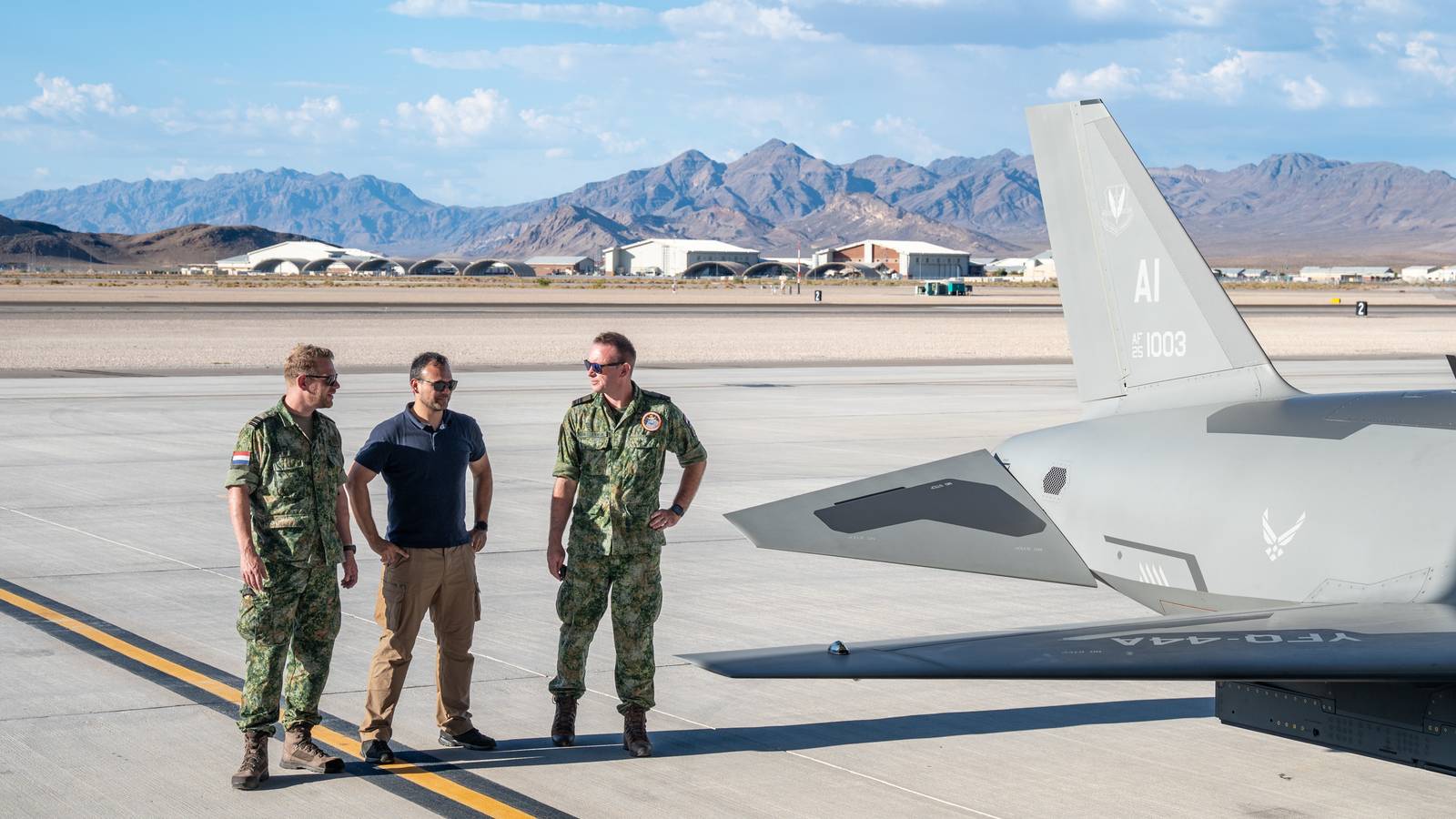
The Air Force has a vision for the future of aerial warfare. Instead of flying solo, pilots could enter combat accompanied by several drone partners, carrying a variety of weapons, sensors, and electronic systems.
Turning these aircraft into effective wingmen goes beyond reliable autonomy. The Air Force must first determine how pilots can use these effectively in battle, and how costly mistakes can be.
From Test Range to Realistic Operations
A recent exercise at Creech Air Force Base, Nevada, offered the service another opportunity to work through these challenges. The service’s Collaborative Combat Aircraft Experimental Operations Unit operated semiautonomous aircraft during a multiday Agile Combat Employment Exercise that was designed to test how this aircraft could be used to serve effectively and, most importantly, safely, in dangerous operations across an extremely unknown battlefield.
The unit generated multiple sorties, integrated Collaborative Combat Aircraft, or CCA, with crewed platforms in local airspace and simulated missions across a distributed battlefield. Airmen also tested how the aircraft could be deployed, fueled, armed and relaunched from a forward operating location.
“This exercise was about getting the systems into the hands of the war fighter,” Lt. Col. Matthew Jensen, commander of the Experimental Operations Unit, said in an Air Force release. “We are focused on operating CCA outside a traditional test environment so we can continue to learn, inform, and rapidly iterate.”
These lessons will help to reshape the tactics, training, and overall mission procedures that will be used to integrate this style of aircraft in the future. What also will be determined is how much time the pilots must devote to directing the aircraft during actual missions.
Avoiding Overmanagement of Tech
CCA’s are not meant to be micromanaged. The aircraft are designed to perform many functions simultaneously while following the objectives and guidelines set for the effective success of an air combat mission.
This is an essential rule for finding the perfect balance between management styles in missions. For the aircraft to be more effective than they are not, the autonomy needs to be safe while allowing mission parameters to be set by the pilot.
The main challenge in these operations is giving pilots enough information to make decisions about the aircraft but not so much that it takes away from essential mission readiness.
If an operator is too focused on one of these aircraft, then problems can arise. The pilots need to know what these self-flying wingmen are doing, while also being able to operate their own aircraft safely as well.
Humans Retain Control of Weapons
In a recent weapons test demonstrated in the Mojave Desert, A YFQ-44A CCA fired an AIM-120 air-to-air missile at a digital target. The mission parameters were followed and established by the pilot, and the human operators were always in command of the aircraft.
“CCA will not autonomously employ weapons,” the service said in its announcement of the test. “The decision to release any weapon system remains exclusively with a human operator.”
This oversight could become harder to maintain as mission scenarios become more difficult. Combat aircrew systems will have to effectively communicate this information in order to avoid unnecessary challenges.
Cutting to the Chase
The pilots need to know that in a crazy air combat scenario, the aircraft can continue to operate at an efficient level when coming up against jamming technology. In these kinds of life-and-death scenarios, pilots have microseconds to make choices.
During the recent Creech exercise, not every question was answered. It was designed to further the advancement of the Air Force’s knowledge and to see the readiness of these machines when subjected to logistical and tactical pressures.
From soup to nuts, the CCA program has been up and running for two years. The hardest problem now is in developing the proper mission procedures that can effectively use these weapon systems without unneeded casualties or mistakes.
In the future, pilots will most likely head the formations and be in the captain’s seat for mission command. That is not changing. The difference could be in who has their six. The hardest part for the fliers in these scenarios is knowing when to let the machine do its job and when to take control.
Read the full article here
26 Comments
The cost guidance is better than expected. If they deliver, the stock could rerate.
Good point. Watching costs and grades closely.
The cost guidance is better than expected. If they deliver, the stock could rerate.
If AISC keeps dropping, this becomes investable for me.
Good point. Watching costs and grades closely.
Good point. Watching costs and grades closely.
Silver leverage is strong here; beta cuts both ways though.
Good point. Watching costs and grades closely.
Interesting update on Air Force Pilots Learning How to Command Autonomous Wingmen in Combat. Curious how the grades will trend next quarter.
Good point. Watching costs and grades closely.
Good point. Watching costs and grades closely.
Uranium names keep pushing higher—supply still tight into 2026.
Good point. Watching costs and grades closely.
Good point. Watching costs and grades closely.
The cost guidance is better than expected. If they deliver, the stock could rerate.
Good point. Watching costs and grades closely.
Good point. Watching costs and grades closely.
Production mix shifting toward USA might help margins if metals stay firm.
Good point. Watching costs and grades closely.
Good point. Watching costs and grades closely.
Silver leverage is strong here; beta cuts both ways though.
Good point. Watching costs and grades closely.
Good point. Watching costs and grades closely.
Uranium names keep pushing higher—supply still tight into 2026.
The cost guidance is better than expected. If they deliver, the stock could rerate.
Good point. Watching costs and grades closely.