


The U.S. Army is attempting one of the most consequential defense industrial turnarounds in modern American history.
After decades of declining weapons inventories, sustainment reserves, and manufacturing capacity, military leaders are racing to rebuild the factories, workforce and technology infrastructure needed to produce weapons faster and sustain the force in future conflicts.
Making that transformation permanent requires a new kind of Army leadership with the skills to manage capital, scale technology and bring many programs and priorities under a single strategy.
And with evolving threats and limited windows to implement lasting change, the ability to lead across the entire enterprise has become increasingly consequential.
Three Mandates, One Army
The Army faces major challenges across three fronts that together present an opportunity to redefine the institution for the next 50 years.
The first mandate is to maintain the conventional military capabilities essential to America’s global power deterrence. Air and missile defense, long-range fires, munitions and ground combat systems remain foundational to the Army’s ability to deter aggression, as recent warfare has reinforced.
The second mandate is to accelerate innovation. Unmanned aircraft, counter-drone technology, electronic warfare and integrated command-and-control systems are changing how forces operate. But developing new technology is only part of the equation. The Army must also integrate emerging capabilities with existing formations and move innovations while they remain operationally relevant.
The third mandate is to modernize America’s defense industrial base. Our readiness depends on our ability to manufacture and maintain the equipment forces need. That requires bolstering smaller manufacturers, securing critical materials, developing skilled workers and scaling production infrastructure.
Although distinct, these priorities are inseparable. The Army cannot sustain weapons without a dependable industrial base or deploy emerging technologies without manufacturing capacity.
Connecting these priorities requires the Army to draw on its extraordinary expertise across acquisition, operations, logistics and technology, ensuring that progress in one area strengthens the institution as a whole.
Enterprise Leaders for This Moment
Different moments in history require different military leaders. Some require a combat veteran, a politician, a technologist, or an executive.
James Forrestal, Secretary of the Navy during WWII, drew on his time as an investment banker to launch a massive wartime industrial mobilization.
Army Secretary Frank Pace Jr., a former federal budget director, used his fiscal expertise to rebuild an Army depleted by post-WWII demobilization during the Korean War.
Navy Secretary John Chafee served in Korea and drew on his firsthand experience to modernize the fleet and prioritize sailor welfare.
Secretary of Defense William Perry, a defense acquisition expert, spearheaded post-Cold War procurement reform, emphasizing commercial technology.
This moment, which combines a world order reset, a technology revolution, and the urgent need for industrial reinvention, requires enterprise leaders–people who can see how different systems come together to sustain a new generation of industrial and defense capability.
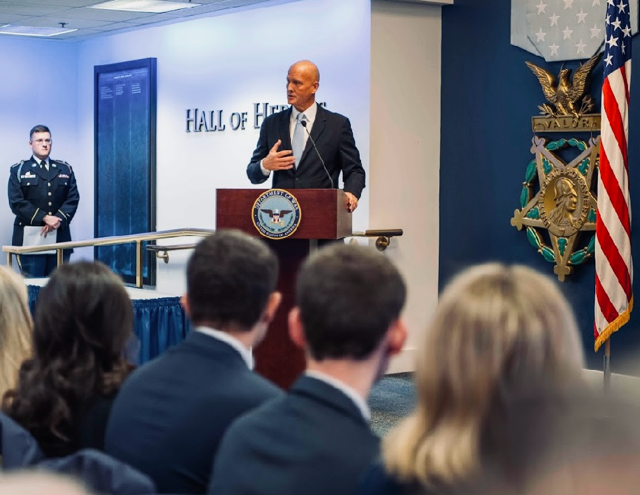
Marc E. Andersen is the enterprise systems thinker leading the sea change inside the Army.
The Army’s CFO and Strategic Capital Chief Investment Officer is leveraging a rare combination of experience as a founder, entrepreneur, venture capital investor and global business leader to cultivate and connect the systems that underpin global power deterrence, key constituent capabilities and industrial modernization.
An Enterprise Leader in Action
Andersen’s formal portfolio responsibilities center on financial management, but his involvement in modernization extends into strategic investment, innovation and industrial capacity.
What distinguishes the enterprise approach illustrated by his work is the connection between financial decisions and operational outcomes.
In May, the Army announced a financial transformation initiative to improve resource allocation, streamline processes and give commanders better information for decisions affecting readiness.
This initiative includes the Fiscal Frontline, a digital environment that integrates financial information from multiple Army systems into one common operating picture. The system helps commanders identify funding shortfalls, monitor expenditures and make more timely resource decisions. Better financial visibility enables the Army to align investments with strategic priorities and direct capital where it can deliver the greatest impact.
The Army has also consolidated budget lines for unmanned aircraft, counter-drone capabilities and electronic warfare, breaking down traditional funding silos that can slow the development and deployment of new technologies.
The same perspective is evident in Andersen’s involvement with the Army’s Strategic Capital Initiative, where he serves as chief investment officer. The initiative seeks to connect military requirements with private investment and commercial expertise, including advanced manufacturing, energy infrastructure, critical minerals and computing infrastructure.
In addition to attracting alternative funding sources, the initiative recognizes that developing military capabilities also depends on industrial capacity and healthy supply chains. Andersen has emphasized the importance of aligning military requirements with commercially viable investments, creating partnerships that benefit both national defense and participating companies.
That approach is already taking shape. At Red River Army Depot in Texas, the Army is working with Hadrian to establish flexible manufacturing to support drone batteries and tactical vehicle repair parts. And at Anniston Army Depot in Alabama, a partnership with Siemens is expanding manufacturing capabilities for unmanned aircraft components and armored vehicles.
The Army is also pursuing domestic critical mineral processing projects to strengthen supply chains supporting munitions, missiles and batteries.
In Andersen’s strategy, a data center isn’t just a better use of land, it is the compute needed to automate production, build virtual munitions testing to prioritize scarce range capacity and, ultimately, field novel munitions faster, strengthening our National Security.
These efforts involve numerous Army leaders, civilian professionals and industry partners. From ground to round, as they say in the Army, Andersen’s role in the broader investment strategy is connecting these stakeholders and initiatives. He’s bringing together warfighters, workforce, capital, and industry around the larger objective of rebuilding an industrial capacity that’s capable of responding to evolving military requirements and withstanding a generation of Super Intelligence driven change.
The Window for Lasting Change Is Limited
One of the greatest challenges facing this transformation is time.
The financial reforms, strategic investments and industrial partnerships Andersen has helped advance represent the beginning of a much longer transformation. Manufacturing capabilities must mature, infrastructure must be developed, and emerging technologies must move from experimentation into sustained production.
The challenge now is ensuring that this momentum continues.
Transformations of this magnitude require more than launching initiatives. They demand sustained leadership, an understanding of how the different efforts connect, and the ability to turn early progress into lasting institutional change.
For the Army, the opportunity is to build on the foundation already being established, maintain the strategic direction behind these efforts and ensure that today’s investments become enduring capabilities for the next generation of soldiers.
Shaping the Institution for the Next 50 Years
While these initiatives remain works in progress, their potential significance is huge.
The long-term opportunity is to make industrial modernization a permanent institutional capability. For Andersen, the Army and all defense leadership, the imperative for this moment in history is to build an enduring foundation for the next chapter of American military power.
Read the full article here
44 Comments
Nice to see insider buying—usually a good signal in this space.
Good point. Watching costs and grades closely.
Good point. Watching costs and grades closely.
I like the balance sheet here—less leverage than peers.
Good point. Watching costs and grades closely.
Interesting update on Army Industrial Base Rebuild Needs Enterprise Leaders. Curious how the grades will trend next quarter.
Silver leverage is strong here; beta cuts both ways though.
Good point. Watching costs and grades closely.
Interesting update on Army Industrial Base Rebuild Needs Enterprise Leaders. Curious how the grades will trend next quarter.
Good point. Watching costs and grades closely.
Silver leverage is strong here; beta cuts both ways though.
I like the balance sheet here—less leverage than peers.
Good point. Watching costs and grades closely.
Exploration results look promising, but permitting will be the key risk.
Good point. Watching costs and grades closely.
I like the balance sheet here—less leverage than peers.
Silver leverage is strong here; beta cuts both ways though.
Good point. Watching costs and grades closely.
Good point. Watching costs and grades closely.
If AISC keeps dropping, this becomes investable for me.
Good point. Watching costs and grades closely.
Good point. Watching costs and grades closely.
Uranium names keep pushing higher—supply still tight into 2026.
Good point. Watching costs and grades closely.
Good point. Watching costs and grades closely.
If AISC keeps dropping, this becomes investable for me.
I like the balance sheet here—less leverage than peers.
Good point. Watching costs and grades closely.
Nice to see insider buying—usually a good signal in this space.
Good point. Watching costs and grades closely.
I like the balance sheet here—less leverage than peers.
If AISC keeps dropping, this becomes investable for me.
Good point. Watching costs and grades closely.
Good point. Watching costs and grades closely.
I like the balance sheet here—less leverage than peers.
Good point. Watching costs and grades closely.
Interesting update on Army Industrial Base Rebuild Needs Enterprise Leaders. Curious how the grades will trend next quarter.
Good point. Watching costs and grades closely.
Exploration results look promising, but permitting will be the key risk.
The cost guidance is better than expected. If they deliver, the stock could rerate.
Good point. Watching costs and grades closely.
Good point. Watching costs and grades closely.
Uranium names keep pushing higher—supply still tight into 2026.
Good point. Watching costs and grades closely.