

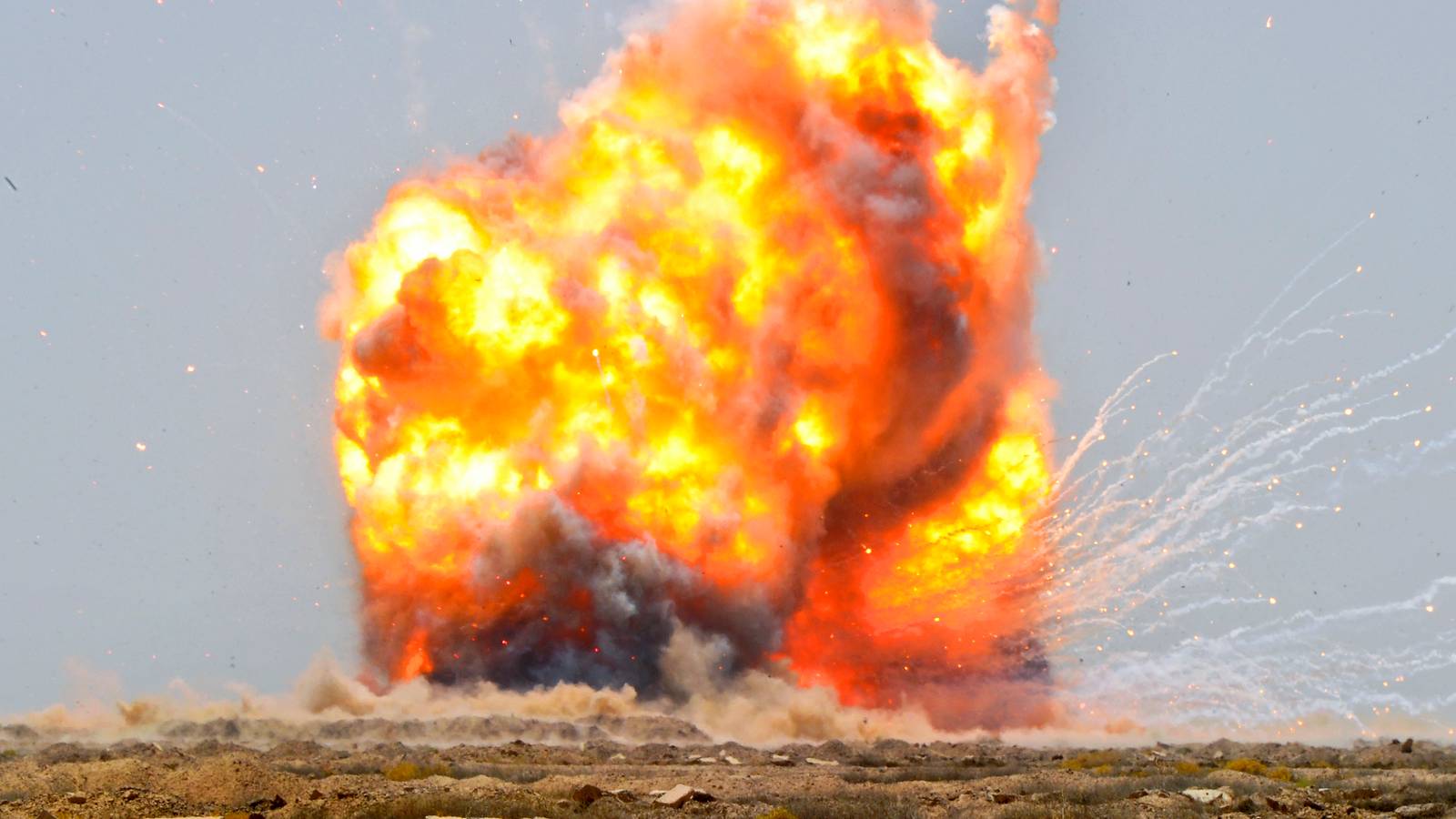
The U.S. Army has postponed its planned detonation of 68 drums of degraded lead azide at the Iowa Army Ammunition Plant until Monday, Nov. 23. Environmental groups are asking a federal appeals court to block the permit that allows it.
Acting Army Secretary Adam Telle on Thursday evening announced the three-day delay, calling Monday the “latest possible moment prior to a forecasted temperature drop” that “would risk further destabilization of the material.” The Army’s postponement notice did not give a start time for Monday.
“Public safety is the Army’s top priority,” Telle said in the service’s online announcement. Telle said the Army would continue working with state and local officials “to distribute accurate, up-to-date information.”
At a test range in northern Sweden, Boeing and Saab tested the Ground Launched Small Diameter Bomb (GLSDB) by adapting the SDB to an artillery system. The GLSDB can reach targets from significantly longer distances, and engage hard-to-reach targets,
The drums contain about 9,500 pounds of lead azide, an explosive compound used in detonators, according to Earthjustice, citing official Army information. Army officials have said the operation at the plant near Middletown will produce a dust plume that “will contain some lead.”
Military.com reached out for comment to the Army and the EPA.
‘Safely destroying it in place is the only responsible option’
On Thursday, the Iowa Environmental Council and Iowa chapter of the Sierra Club petitioned the 8th U.S. Circuit Court of Appeals to review the emergency permit the Environmental Protection Agency issued for the operation. They asked the court to put the permit on hold while it reviews the challenge.
The groups argue that the EPA failed to require the Army to consider safer treatment alternatives, and that the Army failed to give the public adequate notice of its plans.
Army officials have said that moving the material would be too dangerous and that “safely destroying it in place is the only responsible option.”
In issuing the permit, the EPA found that the material’s condition posed an “imminent and substantial endangerment to human health and the environment.”
What the Permit Says About the Maps
Under the EPA permit, those maps must assume that all the lead becomes airborne.
Both agencies’ technical experts “agree that the modeling on which public notifications will be based is not necessarily representative of actual conditions,” the permit says.
It adds that the Army expects the real release to be “less than 100%” because of measures taken to contain the blast, and that the EPA chose the conservative assumption so that public notices “are maximally protective.”
The permit sets two advisory levels based on how much lead dust is expected to settle on surfaces. Where modeled deposition exceeds 5 micrograms per square foot, people who live or work in the area should stay indoors during the potential exposure period if they cannot leave beforehand.
The advisory also calls for closing windows and exterior doors, turning off ventilation or switching it to recirculation, and avoiding travel through the area during that period.
Where modeled deposition exceeds 100 micrograms per square foot, people who live or work in the area should also wet-clean surfaces children may touch.
Weather can stop the operation. The Army’s environmental assessment identifies forecast precipitation, a temperature inversion and surface winds above 15 mph as reasons not to proceed. It also lists thunderstorms among the conditions to avoid.
What Residents Will Know and When
The permit also includes deadlines for what follows the detonation. Within six hours, the Army must publish an updated plume estimate based on the weather recorded during the operation.
Within 24 hours of the operation, the Army must begin soil sampling and wipe sampling of high-touch surfaces at parks, public facilities and private properties where it has been granted access, within the area where the post-detonation model estimates lead dust deposition at or above 100 micrograms per square foot.

An Army representative collected 28 access forms at an October open house in Middletown, the service said at the time.
Lab reports go to the EPA within five days of the Army receiving validated results, along with a proposed cleanup plan.
Within 30 days of completing the operation, the Army must submit a Final Impact Area Report to the EPA summarizing where the model estimates lead traveled and settled.
The permit provisions that require submission of the lab report and the final impact report do not require the Army to release either report to the public.
‘Not notified of the planned detonation’
The Army identified the degraded stockpile in March, according to its environmental assessment, and EPA staff attended a briefing for Army decision-makers in April, the permit says. Nearly 200 people attended the Middletown open house Oct. 15.
A first public advisory with a date came Nov. 15, five days before the original Nov. 20 schedule.
Iowa’s Department of Health and Human Services said it “was only very recently made aware” and that the Army’s maps “did not include what conditions that modeling included.”

Fort Leavenworth Main Gate (Photo by Jessica Brushwood via DVIDS)
Across the Mississippi River, the Illinois Environmental Protection Agency said Nov. 18 that it “was not notified of the planned detonation” by the EPA region that issued the permit, and that “no information on the breadth of methodology” of the Army’s monitoring had been shared with Illinois officials.
Modeling at the time showed possible effects in Mercer County, Illinois, the agency said.
Staying Indoors and Filing a Claim
Health officials in both states advise people in affected areas to stay indoors with windows closed for 24 to 48 hours after the detonation.
They say no safe level of lead exposure has been identified, and that anyone concerned should ask a doctor about a blood lead test.
Residents who believe the detonation damaged their property can use Standard Form 95 to file a tort claim. The Army directs claimants to contact the claims’ office at the installation or medical center closest to where the damage occurred.
If you are unsure where to file, you can mail the completed form to the U.S. Army Claims Service. Sign the form and state the exact dollar amount you are claiming. Keep supporting records such as dated photos, proof of ownership and repair estimates.
Under federal law, residents pursuing a claim against the United States for property damage must generally submit it in writing to the appropriate federal agency within two years of when the claim accrues.
The EPA permit authorizing the operation expires Feb. 11, 2027.
Read the full article here
21 Comments
Nice to see insider buying—usually a good signal in this space.
Good point. Watching costs and grades closely.
If AISC keeps dropping, this becomes investable for me.
Good point. Watching costs and grades closely.
Interesting update on Army Postpones Detonation of 68 Drums of Lead Azide in Iowa to Monday. Here’s Why. Curious how the grades will trend next quarter.
Good point. Watching costs and grades closely.
Nice to see insider buying—usually a good signal in this space.
Good point. Watching costs and grades closely.
Good point. Watching costs and grades closely.
Exploration results look promising, but permitting will be the key risk.
Good point. Watching costs and grades closely.
Silver leverage is strong here; beta cuts both ways though.
Good point. Watching costs and grades closely.
The cost guidance is better than expected. If they deliver, the stock could rerate.
I like the balance sheet here—less leverage than peers.
Nice to see insider buying—usually a good signal in this space.
Good point. Watching costs and grades closely.
Good point. Watching costs and grades closely.
Silver leverage is strong here; beta cuts both ways though.
The cost guidance is better than expected. If they deliver, the stock could rerate.
Good point. Watching costs and grades closely.