

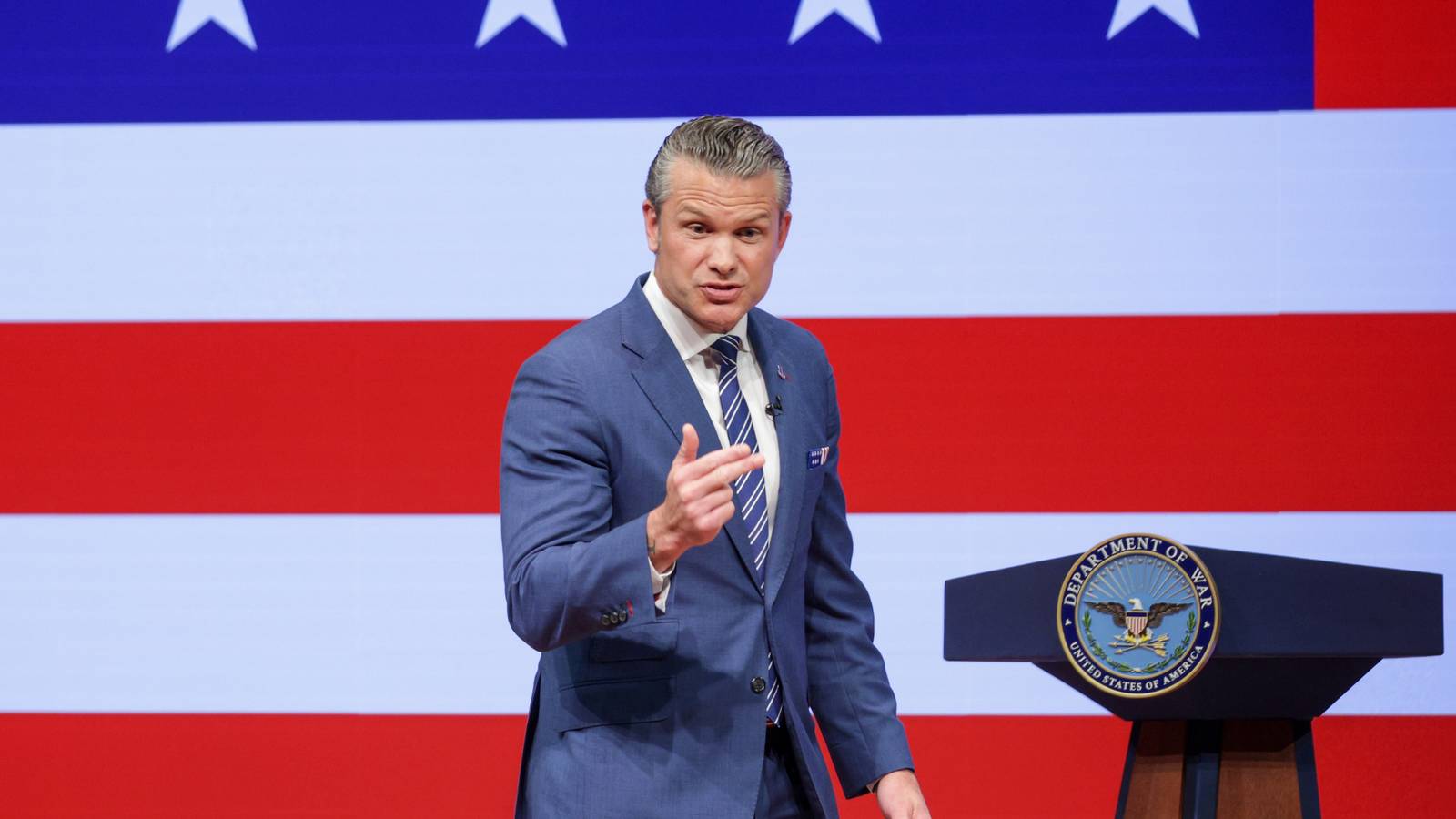
Defense Secretary Pete Hegseth is restructuring the Pentagon’s civilian special operations leadership, reviving the name of a World War II intelligence organization while directing additional funding, personnel and oversight authority to an office that supports some of the military’s most specialized forces.
The changes, outlined in a Nov. 2 memorandum and announced publicly Nov. 12, elevate the assistant secretary responsible for special operations and low-intensity conflict to a position comparable to that of military service secretaries. Hegseth also directed the existing Secretariat for Special Operations to adopt the secondary name Office of Strategic Services.
The reorganization does not establish an entirely new organization or resurrect the intelligence agency that operated during World War II. Instead, it expands an existing Pentagon office, but as with the administration’s adoption of the secondary “Department of War” title for the Department of Defense, permanently changing its statutory name and leadership structure would require congressional approval.
“Resourcing for [special operations forces] remains behind current operational and force posture,” Hegseth wrote in the memorandum.
“It is time for a bold, foundational change.”
What Changes Under the Reorganization
Under 10 U.S.C. § 138, the Pentagon has 20 authorized assistant secretary of defense positions, including one responsible for special operations and low-intensity conflict. That official serves as the defense secretary’s principal civilian adviser on those matters and exercises oversight authority over special operations policy, resources, organization, training and equipment.
Hegseth’s memorandum seeks to strengthen that authority by granting the office greater standing in Pentagon decision-making and formalizing its participation in budget, acquisition and personnel decisions affecting U.S. Special Operations Command.
The office would receive at least $45 million annually in reallocated operations and maintenance funding for its day-to-day operations, according to the memorandum. It would also gain 75 additional civilian positions, including at least five senior executive service positions, and 25 joint-qualified military positions.
The memorandum specifies that civilian personnel costs are not included in the $45 million allocation. It also directs officials to consolidate the office’s leadership and staff within the Pentagon.
Hegseth ordered the assistant secretary’s position elevated within the department’s order of precedence alongside undersecretaries, although the official’s existing statutory rank remains unchanged for now. Hegseth directed officials to seek congressional approval to formally establish an undersecretary of strategic services.
Why Congress Must Approve Permanent Changes
Congress must approve the permanent restructuring because federal law establishes both the assistant secretary’s position and the existing civilian oversight structure.
Hegseth can reorganize personnel, allocate resources and elevate the office’s standing within the Pentagon, but he cannot independently replace a congressionally established assistant secretary position with an undersecretary or permanently change its statutory designation. Those changes require amendments to federal law.

The proposed restructuring builds on congressional efforts to strengthen civilian oversight of special operations. Congress established SOCOM and its dedicated civilian oversight position through the 1986 Nunn-Cohen Amendment to the fiscal 1987 defense authorization act, addressing shortcomings in special operations coordination, readiness and resources.
The fiscal 2017 defense authorization law expanded the assistant secretary’s authority by giving the position responsibilities comparable to those of military service secretaries for overseeing special operations organization, training and equipment.
More recently, Section 907 of the fiscal 2025 National Defense Authorization Act directed the Pentagon to update department policies, guidance and processes to institutionalize the assistant secretary’s oversight role. Hegseth’s memorandum cites that requirement, making the reorganization partly an effort to implement changes Congress had already mandated rather than to establish entirely new powers.
Until Congress acts, the OSS designation functions as a secondary title for administrative and public-facing purposes. The office’s underlying statutory identity remains intact.
Why Revive the Name?
The OSS originated in the Office of the Coordinator of Information, which President Franklin D. Roosevelt established July 11, 1941, with William J. Donovan as its director. The office collected and analyzed intelligence for the president and other federal agencies and conducted foreign information and propaganda activities.
On June 13, 1942, Roosevelt transferred its foreign information functions to the newly established Office of War Information and reorganized the remaining intelligence operations into the Office of Strategic Services, with Donovan continuing as director. During World War II, the OSS conducted espionage, sabotage, intelligence gathering and unconventional warfare against the Axis powers.

According to the National Archives, President Harry Truman abolished the organization effective Oct. 1, 1945, transferring its responsibilities to the State and War departments. Its intelligence functions eventually contributed to the establishment of the Central Intelligence Agency in 1947.
In its Nov. 12 news release, the Pentagon described the decision to revive the OSS name as a tribute to the military’s special operations heritage. Hegseth reinforced that connection in a Nov. 12 post on X, declaring, “The OSS is back.” The designation invokes the wartime organization’s intelligence and unconventional warfare legacy, although the reorganization does not restore its original functions or establish a new intelligence agency.
Will the Changes Improve Special Operations Oversight?
Former officials and special operations experts are divided over whether additional resources and a more influential civilian leadership position will strengthen oversight.
Retired Army Special Forces officer David Maxwell told Defense One that strengthening the office could improve its ability to assess equipment requirements, examine investments and resolve support problems. However, he said tensions between Congress and the Pentagon could prevent passage of the legislation needed to make the changes permanent.

Michael Lumpkin, who served as assistant secretary of defense for special operations and low-intensity conflict from 2013 to 2016, told Defense One that adopting the OSS name could eventually broaden the office’s responsibilities beyond its existing mission, potentially weakening its focus on SOCOM.
The changes also introduce additional spending commitments. The $45 million annual allocation comes from existing Pentagon resources rather than a separately identified new appropriation, and the personnel expansion adds costs.
The decision to revive the OSS name could introduce additional administrative expenses, including revisions to signage, stationery, websites and official documents. In a January 2026 report, the Congressional Budget Office estimated that the much broader Department of War rebranding could cost up to $125 million, depending on implementation. Although those figures do not apply to the OSS designation, the Pentagon has not publicly identified a separate cost estimate for renaming the special operations office.
Hegseth ordered officials to carry out most administrative measures within 30 days of the Nov. 2 memorandum and to transfer the 75 civilian positions within 60 days.
The Pentagon can begin implementing many of these measures under existing executive authority, but the permanent leadership restructuring remains dependent on Congress.
Read the full article here
30 Comments
Interesting update on Hegseth Revives WWII OSS Name, Gives Special Operations Office More Power. Curious how the grades will trend next quarter.
Good point. Watching costs and grades closely.
Good point. Watching costs and grades closely.
Silver leverage is strong here; beta cuts both ways though.
Good point. Watching costs and grades closely.
Good point. Watching costs and grades closely.
The cost guidance is better than expected. If they deliver, the stock could rerate.
Good point. Watching costs and grades closely.
Good point. Watching costs and grades closely.
Exploration results look promising, but permitting will be the key risk.
Good point. Watching costs and grades closely.
Good point. Watching costs and grades closely.
Production mix shifting toward USA might help margins if metals stay firm.
Good point. Watching costs and grades closely.
The cost guidance is better than expected. If they deliver, the stock could rerate.
Good point. Watching costs and grades closely.
Good point. Watching costs and grades closely.
Silver leverage is strong here; beta cuts both ways though.
Good point. Watching costs and grades closely.
Good point. Watching costs and grades closely.
Exploration results look promising, but permitting will be the key risk.
Good point. Watching costs and grades closely.
The cost guidance is better than expected. If they deliver, the stock could rerate.
Good point. Watching costs and grades closely.
The cost guidance is better than expected. If they deliver, the stock could rerate.
Good point. Watching costs and grades closely.
Good point. Watching costs and grades closely.
Uranium names keep pushing higher—supply still tight into 2026.
Good point. Watching costs and grades closely.
Good point. Watching costs and grades closely.