

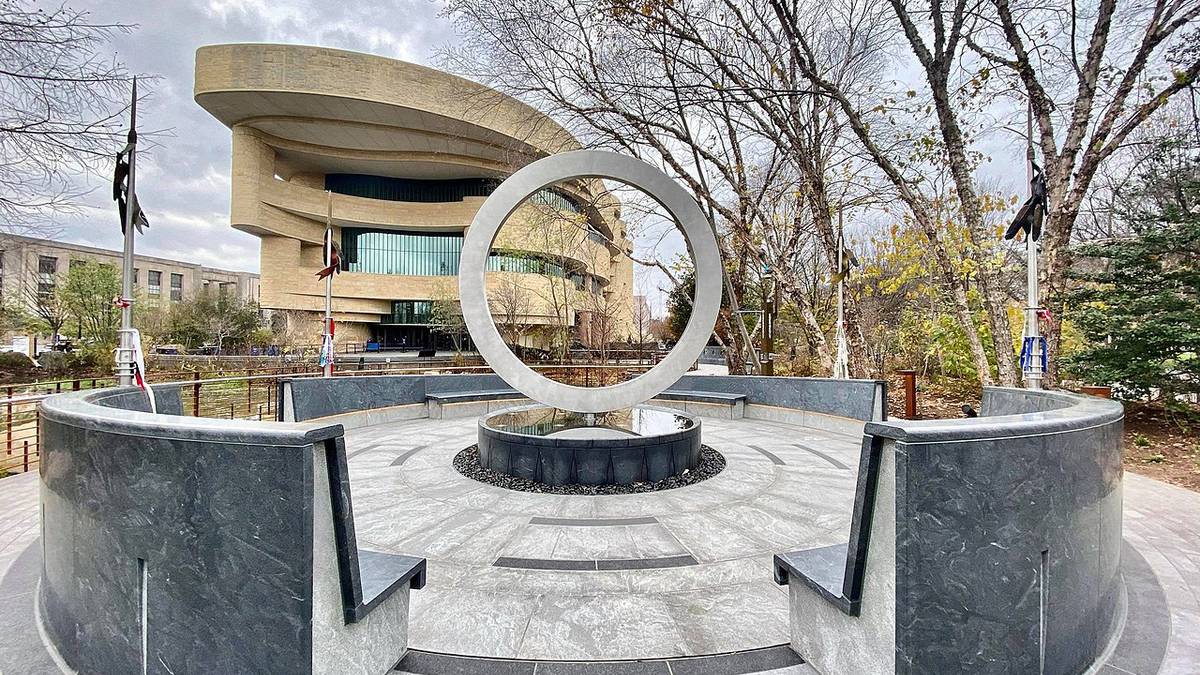
On the grounds of the Smithsonian’s National Museum of the American Indian in Washington, D.C., a stainless-steel circle stands on a carved stone drum, with water flowing outward from its center. It is the National Native American Veterans Memorial, the country’s national tribute to Native Americans who have served in the U.S. armed forces.
The memorial opened Nov. 11, 2020, and was dedicated with a procession and ceremony on the National Mall on Nov. 11, 2022. Native people have served in the U.S. military since the American Revolution, and they serve at a higher per-capita rate than any other population group, according to the Smithsonian.
Here’s how the memorial came to be and what to know before visiting.
Two Decades in the Making
Congress first authorized the memorial in the Native American Veterans’ Memorial Establishment Act of 1994. The law called the museum an ideal location and said a memorial would give all Americans “the opportunity to learn of the proud and courageous tradition of service of Native Americans in the Armed Forces.”
The 1994 law placed the memorial inside the museum, and the project stalled for years. In 2013, Congress passed the Native American Veterans’ Memorial Amendments Act, signed Dec. 26, 2013, which allowed the memorial to be built on the museum’s grounds and gave the museum more room to design it and raise money.
Sen. Brian Schatz, D-Hawaii, who introduced the Senate version, said on the Senate floor that the memorial had “languished for almost 20 years” since the original law, according to the Congressional Record.
No federal money was used to build it. Funding came from individuals, organizations and Native nations, according to the museum.
The Oklahoma National Guard has created a feature celebrating diverse cultures, traditions and history. “A Native Guard” highlights Native Americans within the Oklahoma National Guard for Native American Heritage Month.
A Marine Veteran’s Design
The museum held a two-stage international design competition, and in June 2018 the jury unanimously chose “Warriors’ Circle of Honor” by Harvey Pratt from more than 120 submissions.
Pratt is a member of the Cheyenne and Arapaho Tribes of Oklahoma and is recognized as a Southern Cheyenne Peace Chief, the Cheyenne Nation’s highest honor, according to the museum. He served as a Marine from 1962 to 1965 in Air Rescue and Security at Da Nang Air Base, Vietnam. A self-taught artist from El Reno, Oklahoma, he is also a retired forensic artist.
Ground broke Sept. 21, 2019, and the memorial opened the following year.
“I can think of no finer example of service to the United States and the promise it holds,” Kevin Gover, then the museum’s director, said when the design was announced.
What Visitors See
The memorial sits east of the museum, at the edge of a hardwood forest overlooking a freshwater wetland. Its design draws on fire, water, earth and wind, according to the museum:
- A large vertical stainless-steel circle rests on a low, carved stone drum at the center of a circular gathering space.
- Water flows continuously from the center of the drum.
- Four vertical lances stand where visitors can tie prayer cloths.
- Benches provide space for gathering and reflection, and the seals of the five branches of the armed forces are on a nearby wall.
- A fire can be lit at the base of the circle on ceremonial occasions. The museum lights it on Veterans Day, Memorial Day and other days honoring Native veterans, and it lit the flame again this Nov. 11.
Leaving a Prayer Cloth
Prayer cloths are used by many Native people as a symbol of their spirituality, the museum told Military.com. Some contain tobacco and are tied as a bundle; others are strips of cloth.
Visitors adding a cloth are asked not to touch or remove ones already tied to the lances. The museum doesn’t keep or catalog offerings. They are disposed of respectfully, including by following Native cultural practices for organic offerings, and none are photographed or documented, the museum said.
The museum also asks visitors not to bring items they want to donate to the memorial.
How to Visit
The memorial is free and open every day, 24 hours a day, and no tickets are needed. The water feature runs year-round, the museum said. Staff clear snow and ice after winter storms, but the museum asks visitors to be careful when entering the memorial in icy conditions.
Other things to know, according to the museum:
- The museum building is open from 10 a.m. to 5:30 p.m. daily, except Dec. 25.
- Guided tours aren’t currently offered, and private visits can’t be scheduled. Ceremonies are allowed, but the museum can’t guarantee privacy because the memorial is public.
- Weapons are prohibited on Smithsonian property. Ceremonial items that could be considered weapons are checked on arrival, and sharp points or blades must be covered.
- The museum’s wheelchairs can’t be used outdoors at the memorial, but wheelchairs and scooters can be rented from local vendors.
The museum marked Veterans Day this year with a full day of programs on Nov. 7 and lit the memorial’s flame on Nov. 11.
Want to Learn More About Military Life?
Whether you’re thinking of joining the military, looking for post-military careers or keeping up with military life and benefits, Military.com has you covered. Subscribe to Military.com to have military news, updates and resources delivered directly to your inbox.
Read the full article here
25 Comments
Silver leverage is strong here; beta cuts both ways though.
Good point. Watching costs and grades closely.
If AISC keeps dropping, this becomes investable for me.
Good point. Watching costs and grades closely.
Interesting update on How the National Native American Veterans Memorial Came to Be and How to Visit. Curious how the grades will trend next quarter.
Interesting update on How the National Native American Veterans Memorial Came to Be and How to Visit. Curious how the grades will trend next quarter.
Good point. Watching costs and grades closely.
Good point. Watching costs and grades closely.
Production mix shifting toward USA might help margins if metals stay firm.
Silver leverage is strong here; beta cuts both ways though.
Good point. Watching costs and grades closely.
Good point. Watching costs and grades closely.
Interesting update on How the National Native American Veterans Memorial Came to Be and How to Visit. Curious how the grades will trend next quarter.
Good point. Watching costs and grades closely.
Good point. Watching costs and grades closely.
Production mix shifting toward USA might help margins if metals stay firm.
Good point. Watching costs and grades closely.
Nice to see insider buying—usually a good signal in this space.
Good point. Watching costs and grades closely.
Good point. Watching costs and grades closely.
If AISC keeps dropping, this becomes investable for me.
Good point. Watching costs and grades closely.
Good point. Watching costs and grades closely.
Nice to see insider buying—usually a good signal in this space.
If AISC keeps dropping, this becomes investable for me.