

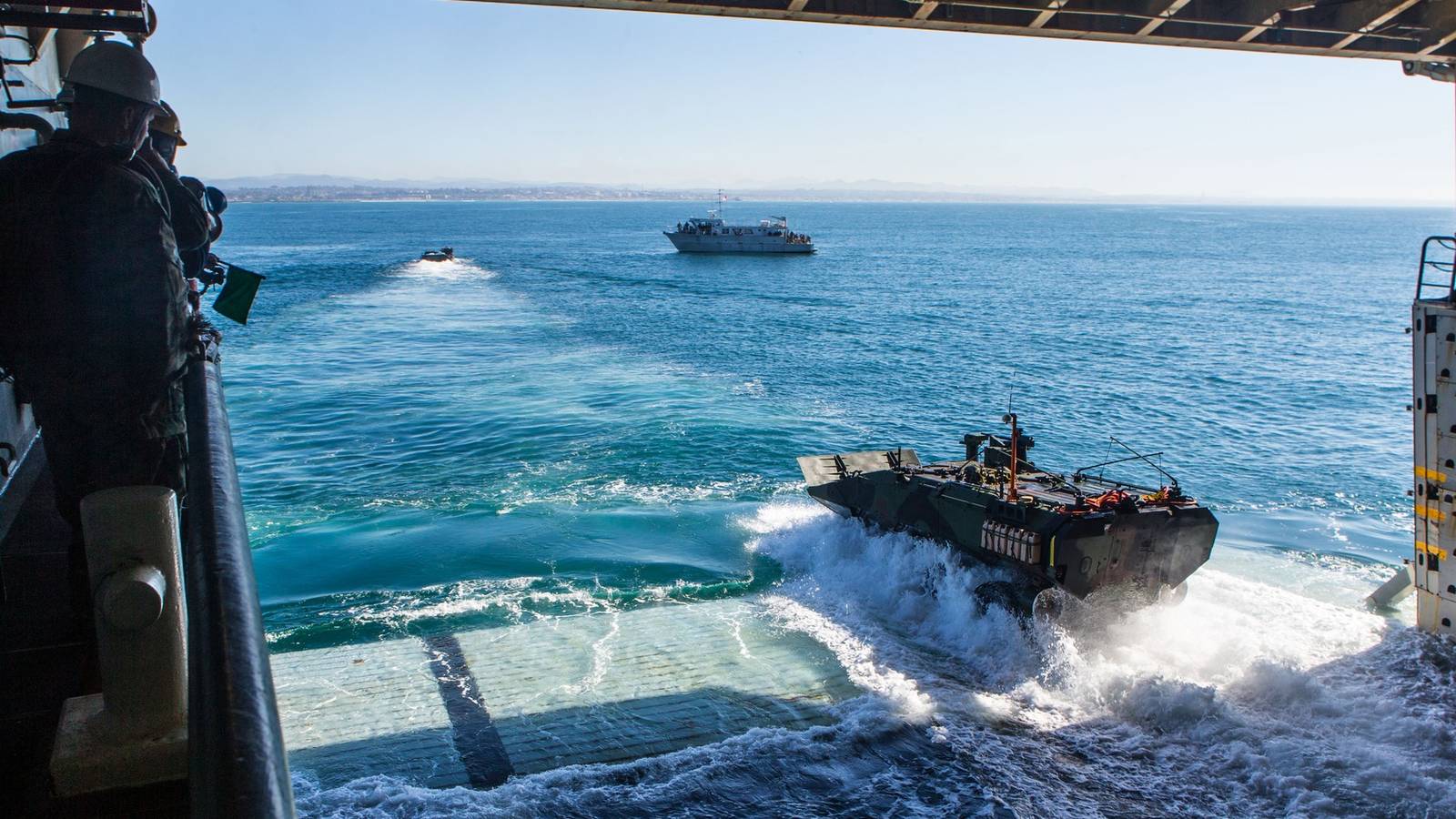
The Marine Corps just bought the recovery trucks that keep the rest of the Amphibious Combat Vehicle fleet in the fight.
A Sept. 30 contract notice awarded BAE Systems Land & Armaments LP of Sterling Heights, Michigan, a $230,100,000 firm-fixed-price modification to contract M67854-16-C-0006.
The mod exercises options for 32 full-rate production Amphibious Combat Vehicle recovery mission role variants, plus associated production, fielding, support costs and spares. Fiscal 2026 procurement (Marine Corps) funds cover the full amount at award and will not expire at the end of the current fiscal year.
Work is split across York, Pennsylvania (60 percent); Aiken, South Carolina (15 percent); San Jose, California (15 percent); Sterling Heights, Michigan (5 percent); and Stafford, Virginia (5 percent), with an expected completion date of November 2028.
Marine Corps Systems Command in Quantico is the contracting activity. If all options on the underlying contract are exercised, its total value reaches $4,096,198,614.
What An ACV-R Is For
The ACV-R is the wrecker and recovery member of the ACV family. Personnel carriers, 30 mm gun variants and command variants can push ashore, swim the surf and roll inland.
When one of them throws a track, floods a compartment or takes combat damage on a beach or an expeditionary advanced base, somebody has to pull it out, winch it clear or stabilize it so the rest of the section keeps moving.
Organic recovery is not a luxury in Force Design concepts that scatter small teams across islands and littorals. Towing a disabled amphibious vehicle back to a rear-area depot is often not an option.
An ACV-R that swims and drives with the same formation is how a company keeps combat power without waiting on a separate logistics chain that may not be there.
Recovery variants also matter for training safety and for the mundane work of getting a stuck vehicle off a training beach before the tide turns.
The same hull that supports a combat recovery can keep a company’s training schedule from collapsing after a soft-sand immobilization.
The Last Variant In the Family
The personnel carrier (ACV-P), the 30 mm gun variant (ACV-30), the command variant (ACV-C) and the recovery variant (ACV-R) make up the four mission-role variants the Corps has been buying under the long-running ACV contract. Ordering FRP ACV-Rs closes that family set. Until the recovery hulls arrive in numbers, battalions are fielding a family with a missing tooth.
Marines have already been training and deploying with earlier ACV hulls, including surf work at Camp Pendleton and Pacific embarkations with Marine expeditionary units, after early waterborne restrictions following rollover incidents.
Military.com’s Force Design update put amphibious combat vehicles in the same modernization picture as lighter trucks and littoral fires. This buy is the recovery piece of that family, not a new vehicle type invented last month.
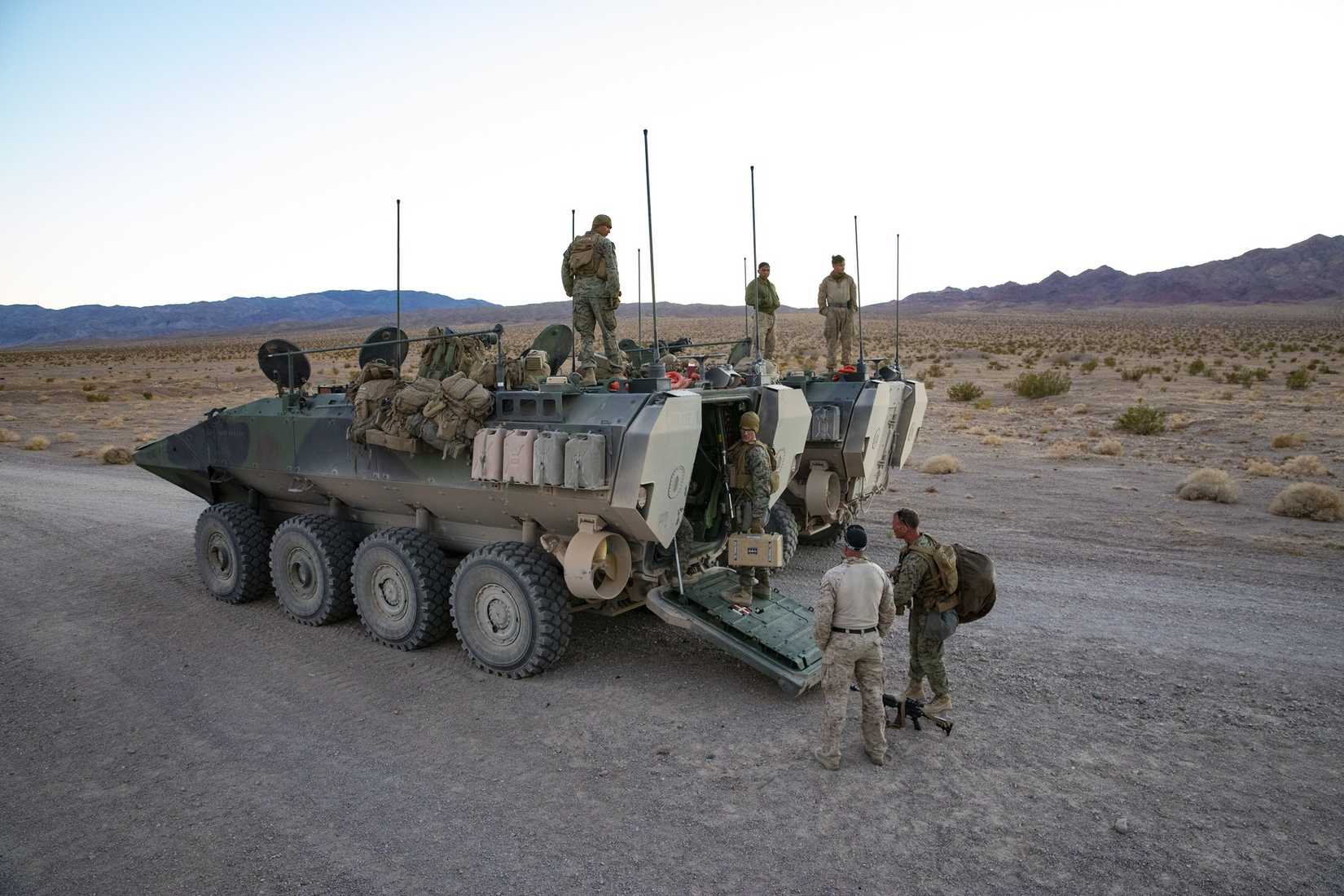
U.S. Marines with Co. D, 3rd Assault Amphibian Battalion and 2nd Battalion, 7th Marine Regiment, 1st Marine Division begin unloading an Amphibious Combat Vehicle (ACV) at the start of Marine Air Ground Task Force Warfighting Exercise (MWX) 2-21 at Marine Corps Air Ground Combat Center, Twentynine Palms, Calif., Feb. 14, 2021. (U.S. Marine Corps photo by Sergeant Courtney G. White)
Why Recovery Matters for EABO
Expeditionary Advanced Base Operations assume Marines will operate from austere sites, often without a deep maintenance rear. A disabled ACV on a narrow beach or a damaged ramp is a mobility problem and a signature problem.
Leaving it in place advertises the position. Abandoning it wastes a scarce hull. Pulling it with organic recovery keeps the formation intact and reduces reliance on Navy well-deck cycles or contracted heavy equipment that may not be available under fire.
BAE has been the production lead for the ACV family under the 2016 contract. The Sept. 30 mod is an option exercise on that vehicle, not a clean-sheet competition.
Quantity is fixed in the notice at 32 FRP recovery variants. Fielding and spare packages travel with the hulls under the same dollars. That packaging is significant as a wrecker without its kits and training support is little more than a photo prop.
What It Means for Marines
For assault amphibian battalions and the MEUs that embark them, 32 recovery hulls will not appear overnight. Deliveries run toward late 2028. In the meantime, units will keep stretching older recovery workarounds and whatever ACV-R prototypes or early hulls they already have.
Ground vehicle modernization keeps showing up at trade shows and in fielding announcements, but the practical takeaway here is simpler. The Corps is finishing the ACV family it said it would buy, and it is spending real FY26 money to do it. When the recovery variants arrive, the formation that swims ashore with personnel, gun and command ACVs will finally have a matching wrecker that can swim with them. That is the difference between a vehicle family on a briefing slide and one that can recover its own losses in the surf zone.
Read the full article here
28 Comments
Silver leverage is strong here; beta cuts both ways though.
Good point. Watching costs and grades closely.
Good point. Watching costs and grades closely.
Nice to see insider buying—usually a good signal in this space.
Uranium names keep pushing higher—supply still tight into 2026.
Good point. Watching costs and grades closely.
Exploration results look promising, but permitting will be the key risk.
Good point. Watching costs and grades closely.
Good point. Watching costs and grades closely.
Uranium names keep pushing higher—supply still tight into 2026.
Good point. Watching costs and grades closely.
I like the balance sheet here—less leverage than peers.
Good point. Watching costs and grades closely.
Good point. Watching costs and grades closely.
Silver leverage is strong here; beta cuts both ways though.
Good point. Watching costs and grades closely.
Exploration results look promising, but permitting will be the key risk.
Good point. Watching costs and grades closely.
Good point. Watching costs and grades closely.
If AISC keeps dropping, this becomes investable for me.
Exploration results look promising, but permitting will be the key risk.
Good point. Watching costs and grades closely.
Good point. Watching costs and grades closely.
Interesting update on Marine Corps Orders 32 ACV Recovery Vehicles in $230 Million Deal. Curious how the grades will trend next quarter.
Good point. Watching costs and grades closely.
If AISC keeps dropping, this becomes investable for me.
Good point. Watching costs and grades closely.
Good point. Watching costs and grades closely.