

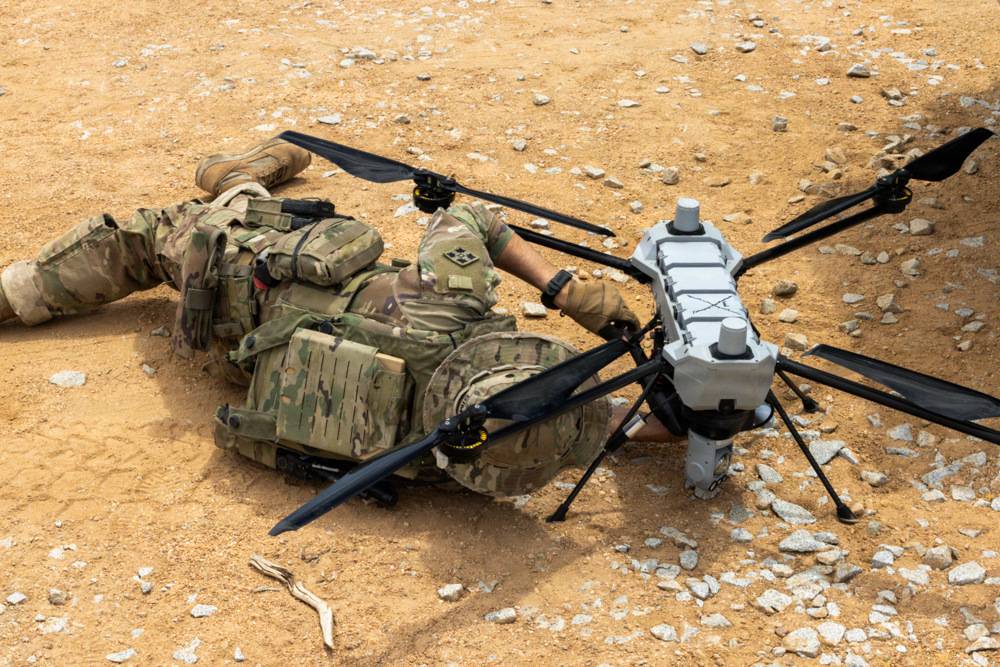
In the U.S. military’s ever-changing quest to be warfare-ready and protective of America’s national security, countering hostile drones both domestically and abroad is a critical frontier.
In 2026, the Congressional Budget Office (CBO) published a titled “Options to Counter Small Unmanned Aircraft Systems.” It assessed the increasing threat of small drones and the costs required to defend U.S. military installations around the world.
Cameron Chell, CEO of Draganfly Inc., a company that plans, builds and supplies drones to governments in hotspots around the world, tells Military.com, the U.S. needs a lineup of specialized, adaptable, high-tech counter-drones to fight autonomously in the skies.
“The U.S. military needs various ways to intercept drones, various technologies to combat an ever-changing hostile landscape,” Chell said, in an interview with Military.com. “Just as we’re increasing our drone technology and making better, smarter, more sophisticated drones, so are our enemies, so are hostile actors.”
CBO Report Details U.S. Drone Warfare Options
In the CBO report, the federal government emphasized that no single tool can stop all threats, including the use of commercial quadcopters or even larger attack drones. Instead, the report said an effective counteroffensive requires multiple technologies.
Here’s the short list:
• Radar and Radio Frequency Detection to identify and track incoming aircraft.
• Kinetic Interceptors to physically destroy hostile drones.
• Non-Kinetic and Electronic Warfare or Directed Energy Systems to disrupt or blind drone sensors.
Chell said his company considers the type of mission involved and the desired outcome when planning a counter-drone offensive.
“To successfully carry out a mission, we have to consider the type of drone needed,” he said. “Does the drone need to carry a heavy payload? Does it need to sit still for a long period of time and then activate? Does it need to fly low? Does it need to fly at night? Those are all the considerations we make as part of the plan.”
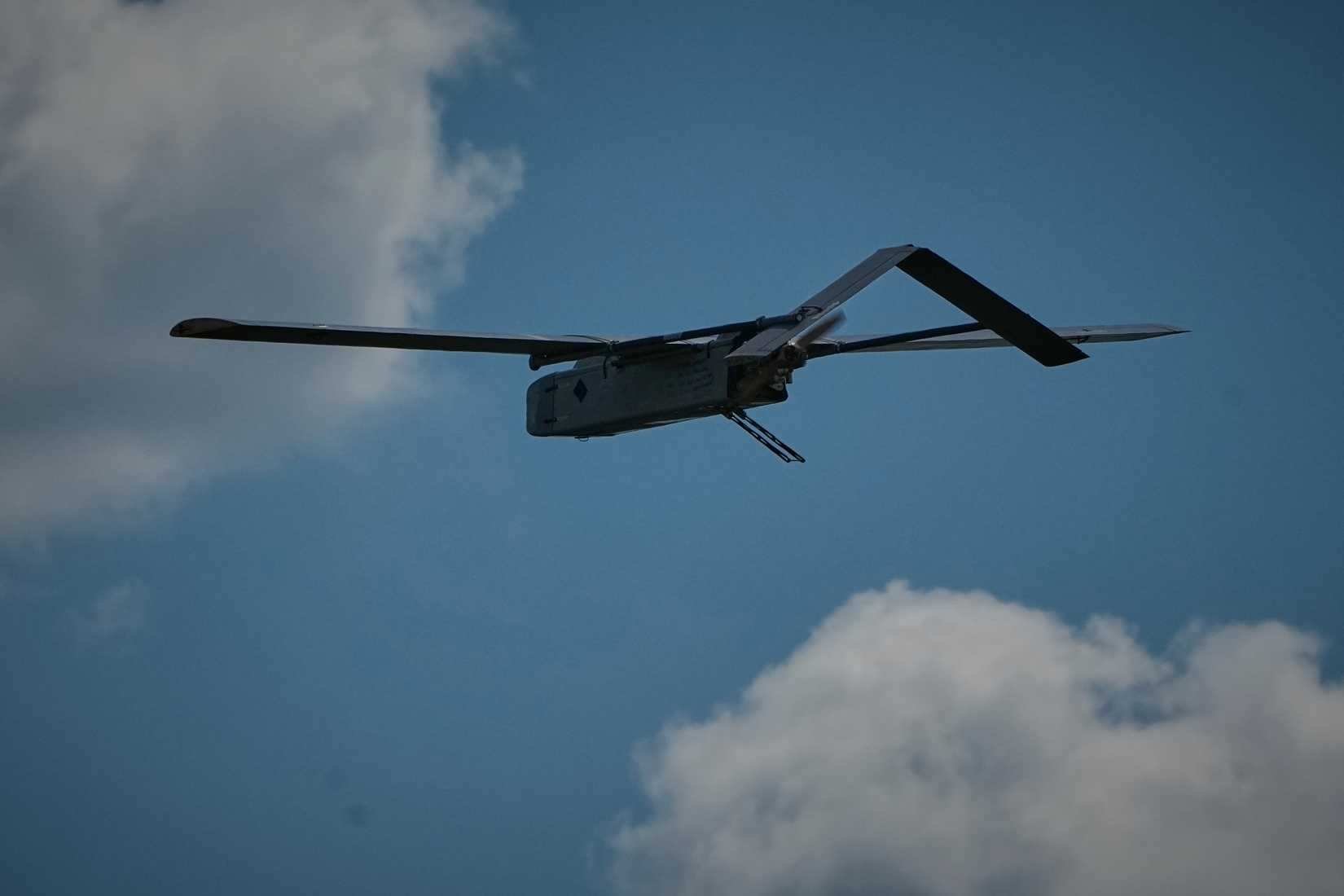
The war in Ukraine has offered lessons in drone warfare for the U.S. Army including the use of disposable drones. (AP Photo/Efrem Lukatsky, File). Pictured here is a Ukrainian FP-1 long-range attack drone is launched at an undisclosed location in Ukraine, Sunday, Aug. 16, 2026. (AP Photo/Efrem Lukatsky, File)
Chell said it’s not just the U.S. getting smart about drone warfare. So are other countries around the world, especially those in war-torn regions where human casualties are mounting. Drones are considered a safer and often less expensive way to fight.
But Chell cautions not all drones are created equal.
“If the goal is to completely destroy an offending drone altogether, a drone-to-drone interceptor is one technique that’s used. If the mission is to disable it, get it to fall out of the sky so that you can commandeer the technology, study it, learn from it, then electronic warfare such as radio signal jamming is another technique that might be used,” he explained. “So it really just depends.”
No Single Solution to Fighting Hostile Drones
The CBO report noted the U.S. is using a combination of different drone detection methods and defensive technologies, rather than relying on a single solution.
The report names the U.S. Army’s Indirect Fire Protection Capability (IFPC) High-Powered Microwave System (HPMS) as a microwave-powered weapon currently in use. It emits electromagnetic energy to disrupt or disable multiple small drones at a time.
Coyote interceptor drones are also being used as radar-guided interceptors that act like missiles designed to disable hostile drones physically.
There are also vehicle-mounted machine guns with automated targeting known as BLADE, or the Ballistic Low Altitude Drone Engagement system. It combines automated detection and tracking with a gun-based response.

U.S. Marines assigned to 2nd Low Altitude Air Defense Battalion (LAAD), conclude firing the FIM-92 Stinger missile launcher after hitting a drone during a live fire exercise at Marine Corps Base Camp Lejeune, N.C., June 8, 2016. (U.S. Marine Corps Photo by Lance Corporal Anthony J. Brosilow)
Another option is radio-frequency detection and electronic warfare. These measures use radio-frequency signals that confuse drones and their operators mid-flight, rendering them useless.
There’s also the Navy’s Optical Dazzling Interdictor (ODIN), which uses a laser to interfere with the optical sensors of unmanned aircraft, disrupting a drone’s ability to see and navigate on its own.
Finally, drone-on-drone interception is also used as an alternative to firing a missile or jamming a signal. A counter drone known as the Bumblebee V2 is designed to collide directly with hostile drones, destroying them both.
“If I had my choice, if I wanted a good, solid, reliable interceptor drone that could generally work in various ways and circumstances, it would be an interceptor drone or a drone-to-drone interceptor,” Chell said. “Using that versus a jamming signal or a radio frequency disruptor would be ideal because electronic warfare can easily fail. Hostile drones could be constantly cycling through different frequencies, making it harder to detect, and therefore harder to jam the signal.”

But various drone technologies can be a hefty expense. The CBO report said outfitting a typical military installation with a comprehensive, layered counter-drone defense system would cost approximately $74 million upfront, with a total funding projection at $7.4 billion. Annual upkeep costs are estimated at $5 million per year for each installation.
Chell said the details of the CBO report make it clear that the U.S. is serious about drone warfare and is willing to spend the money necessary.
“Having various ways to intercept drones, various levels of technology, makes us better and more equipped to handle whatever comes,” he said. “And it’s not just the U.S., but governments around the world are investing in the same technology.”
Read the full article here
27 Comments
The cost guidance is better than expected. If they deliver, the stock could rerate.
Good point. Watching costs and grades closely.
The cost guidance is better than expected. If they deliver, the stock could rerate.
Good point. Watching costs and grades closely.
Good point. Watching costs and grades closely.
Silver leverage is strong here; beta cuts both ways though.
Good point. Watching costs and grades closely.
Good point. Watching costs and grades closely.
Nice to see insider buying—usually a good signal in this space.
Good point. Watching costs and grades closely.
I like the balance sheet here—less leverage than peers.
Good point. Watching costs and grades closely.
Nice to see insider buying—usually a good signal in this space.
Good point. Watching costs and grades closely.
Good point. Watching costs and grades closely.
The cost guidance is better than expected. If they deliver, the stock could rerate.
Good point. Watching costs and grades closely.
Good point. Watching costs and grades closely.
The cost guidance is better than expected. If they deliver, the stock could rerate.
Good point. Watching costs and grades closely.
Good point. Watching costs and grades closely.
I like the balance sheet here—less leverage than peers.
Exploration results look promising, but permitting will be the key risk.
Uranium names keep pushing higher—supply still tight into 2026.
Good point. Watching costs and grades closely.
If AISC keeps dropping, this becomes investable for me.
Production mix shifting toward USA might help margins if metals stay firm.