

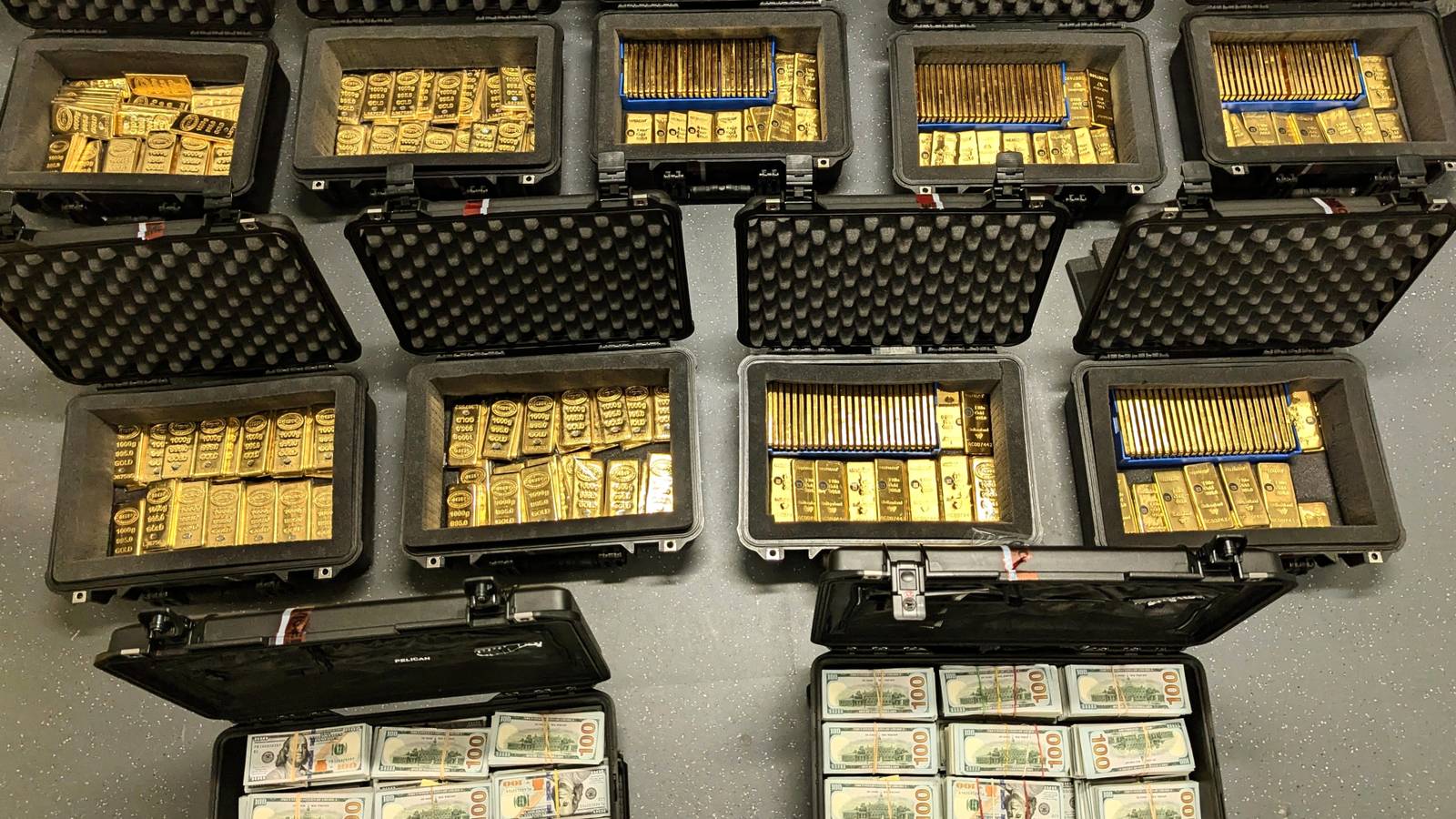
A Navy veteran and former CIA officer pleaded guilty Tuesday to a fraud scheme involving 298 gold bars stacked inside his home that prosecutors said cost the U.S. government about $194 million.
David Rush, 49, of Ashburn, Va., pleaded guilty to a single count of wire fraud in federal court in Alexandria and faces up to 20 years in prison. His sentencing is set for Jan. 28, 2027.
Rush agreed to forfeit the gold, the cash, the Florida properties, more than 30 watches and two 2026 BMW Alpina SUVs—one of them worth about $172,000. The CIA said it referred the matter to the FBI after an internal investigation identified potential crimes.
The Justice Department said its investigation is continuing, and Director of National Intelligence Jay Clayton has asked the intelligence community’s inspector general to open a separate inquiry.
Rush later admitted to exposing a secret U.S. intelligence source to a foreign government official, according to NBC News.
Gold Bars and Florida Mansions
Rush held a senior executive-level position with a top-secret clearance. Prosecutors said he used that access to invent government programs that did not exist.
He fabricated a classified Special Access Program, a type of tightly restricted government effort, to justify moving roughly $145 million in federal funds through a shell company and into luxury real estate, according to court records.
Rush used that money to acquire four luxury properties in Palm Beach and Hobe Sound, Fla., which he intended to resell for profit.
He also created a separate fake program to justify acquiring gold, telling contractors he was working on a top-secret project that required delivering high-value commodities.

Between December 2025 and February 2026, a contractor delivered 298 gold bars to his office in Loudoun County, Va., where he kept them in a safe.
When FBI agents searched his Ashburn home on May 19, they recovered the 298 gold bars, about $2.1 million in cash, more than 104,000 euros, and more than 30 luxury watches, many of them Rolexes. The gold alone had cost the government about $46 million.
In announcing the plea, CIA Director John Ratcliffe said Rush “abused his position and betrayed the public trust and should be held fully accountable.”
A Combat Record He Invented
Rush did serve in the military, but not in the way he told his colleagues.
He presented himself as a combat veteran and military pilot who held a bachelor’s degree from a university in South Carolina, and a doctorate from a school in New York, according to prosecutors.
None of it was true. He never graduated from those universities and was never a pilot.

He served in the U.S. Navy and was honorably discharged from the Reserves in February 2015.
Prosecutors said the fabricated background, combined with his legitimate and successful work, helped him rise to the senior position that gave him authority to approve multimillion-dollar expenditures.
Exposing a Secret Source
Prosecutors never charged the most serious conduct in the case as a crime.
Rush, according to NBC News, admitted that he had exposed a secret U.S. intelligence source to a foreign government official.

Fortune, citing the court documents, reported that he gave a foreign official information about a clandestine human source in late 2025.
Military.com reviewed the charging document and the plea agreement but not the statement of facts that reportedly describes the disclosure, which the Justice Department did not mention in its public announcement of the plea.
The Counterintelligence and Export Control Section of the Justice Department’s National Security Division handled the case, prosecuting and resolving it.
Rush’s plea agreement bars him from any contact with a foreign government and imposes special national-security restrictions on his confinement and on any future writing about his work.
Read the full article here
32 Comments
The cost guidance is better than expected. If they deliver, the stock could rerate.
Good point. Watching costs and grades closely.
If AISC keeps dropping, this becomes investable for me.
Silver leverage is strong here; beta cuts both ways though.
Good point. Watching costs and grades closely.
Good point. Watching costs and grades closely.
Uranium names keep pushing higher—supply still tight into 2026.
Good point. Watching costs and grades closely.
If AISC keeps dropping, this becomes investable for me.
Uranium names keep pushing higher—supply still tight into 2026.
I like the balance sheet here—less leverage than peers.
Good point. Watching costs and grades closely.
Good point. Watching costs and grades closely.
Nice to see insider buying—usually a good signal in this space.
I like the balance sheet here—less leverage than peers.
Good point. Watching costs and grades closely.
Silver leverage is strong here; beta cuts both ways though.
Good point. Watching costs and grades closely.
Good point. Watching costs and grades closely.
I like the balance sheet here—less leverage than peers.
Good point. Watching costs and grades closely.
Good point. Watching costs and grades closely.
Uranium names keep pushing higher—supply still tight into 2026.
Good point. Watching costs and grades closely.
Good point. Watching costs and grades closely.
If AISC keeps dropping, this becomes investable for me.
Silver leverage is strong here; beta cuts both ways though.
The cost guidance is better than expected. If they deliver, the stock could rerate.
Good point. Watching costs and grades closely.
Good point. Watching costs and grades closely.
If AISC keeps dropping, this becomes investable for me.
Good point. Watching costs and grades closely.