


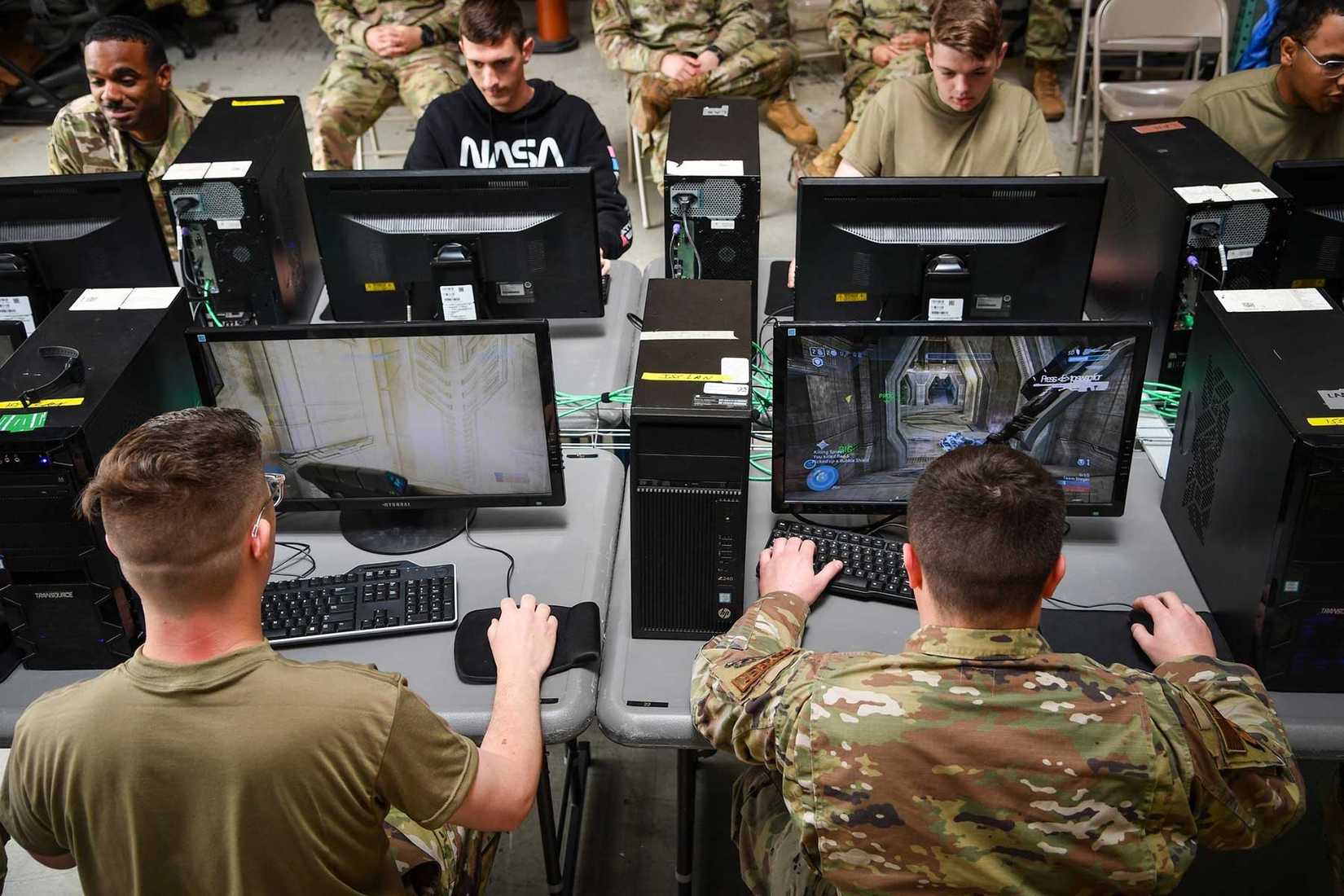
Sony’s plan to stop producing physical discs for new PlayStation games starting in 2028 could mean more than the end of a plastic case on a shelf. For service members who game in barracks, on ships, overseas or during deployment, it may have even more negative impact.
The move comes as the video game industry continues to shift toward digital purchases, and as some of the biggest titles in gaming are already testing how far players are willing to go in moving away from discs. Grand Theft Auto VI, one of the most anticipated games in years and one of the industry’s biggest-ever franchises, has also become part of the physical-media debate after reports that its physical retail version would not include a traditional disc and would instead rely on a digital code.
For troops and military families, the question is less nostalgic than practical: What happens when new games require reliable internet, account access, storage space and digital storefronts that may not always be easy to use from a barracks room, shipboard lounge, overseas installation or remote duty station?
Military.com reached out to Sony Interactive Entertainment, Microsoft and Navy MWR for comment. None responded before publication.
PlayStation Says New Games Will Go Digital Only
Sony Interactive Entertainment said in a July 1 PlayStation Blog post that physical game disc production for all new games released on PlayStation consoles will end starting in January 2028.
After that, new games will be available through the PlayStation Store and at retailers in digital-only formats, the company said.
Games that have already been released, or are scheduled to be released on disc before January 2028, will not be affected, according to Sony.
The company described the move as a response to consumer habits, saying the broader entertainment industry and PlayStation players have continued shifting from discs to digital access.
That may be true across the industry, but it does not answer every access question for troops. A civilian gamer with high-speed home internet can usually download a new release overnight. A sailor sharing limited shipboard bandwidth, an airman in a dorm with unreliable Wi-Fi, or a military family stationed overseas, may have a different experience.
Large downloads can take hours or days. Patches, storage limits, account logins, regional storefront settings and network restrictions can make a digital-only game harder to access in places where internet service is limited or closely managed.
Modern discs are not perfect. Many still require updates, installations or online checks.
But physical games have offered service members something digital licenses usually do not. They are able to buy games used, lend them to a friend, mail them home, gift or trade them in, or pack them before a permanent change-of-station move.
The Exchange Is Already Shrinking Physical Game Shelves
The Army & Air Force Exchange Service said it is already adjusting to the decline of physical games.
Spokesperson Christopher J. Ward told Military.com that the Exchange carries a “focused assortment” of PlayStation 5 games, mainly new releases, but that sales of physical games have declined for years as players have moved to digital downloads.

“The Exchange is evolving accordingly by reducing assortments of physical games and ensuring that shelf space is optimized with products aligned to current shopping trends,” Ward said.
The Exchange already sells digital card options and will continue to evaluate whether to expand digital offerings as customer preferences and the gaming industry change, Ward added.
Asked whether the shift could affect military families or service members who rely on used games, resale, gifts or physical purchases while stationed overseas or deployed, Ward said the effects are expected to be minimal because the transition has been slow.
“The Exchange monitors and follows industry trends while prioritizing the needs of service members and their families,” Ward said.
That answer suggests military retail is following the industry’s direction rather than trying to hold the line on discs. The shelf space is already changing.
GTA VI and Xbox Show the Industry Is Moving Fast
The concern is not limited to PlayStation.
Grand Theft Auto VI, scheduled for release later this year, has drawn attention because its boxed retail version reportedly will include a download code rather than a playable disc. For a game expected to dominate consoles, barracks rooms and day-room TVs, that matters.

If one of the biggest games of the decade can treat a box as packaging for a code, smaller publishers may have even less reason to keep pressing discs.
The broader industry reset became harder to ignore this week after a post on X from Xbox CEO Asha Sharma went viral, drawing more than 14 million views. In the post, Sharma shared what she described as an email sent to Xbox employees announcing “the most significant restructure in XBOX history.”
In the message, Sharma said Xbox would reduce its team by about 3,200 employees during fiscal 2027, including roughly 1,600 immediate role eliminations, and that four studios would leave Xbox for new management.
She wrote that Xbox’s business “is not healthy,” citing lower margins, slower-than-expected growth in Game Pass and multi-platform efforts, in addition to what she described as “the most severe hardware crisis” in the industry’s history.
Reuters reported that Microsoft is cutting 4,800 jobs overall, including 3,200 in gaming, as part of a larger overhaul of Xbox. The Associated Press reported that the cuts include 1,600 immediate Xbox layoffs, with another 1,600 expected during the fiscal year.
The restructuring is not the same as killing discs. But it points to the same pressure running through the console business: Hardware is expensive, game development costs are high, subscriptions have not solved every problem, and platform holders are looking for more control over distribution, pricing and recurring revenue.
The Backlash Is About Ownership, Not Nostalgia
The response from players has been loud.
A Change.org petition urging Sony to keep making physical PlayStation games had passed 172,000 signatures this week, according to Tom’s Hardware. Windows Central said 71% of respondents in its reader poll said they were not ready to give up physical games.
The objections are not only about collecting boxes. Players and retailers have raised concerns about ownership, game preservation, used-game stores, lending, resale and whether digital purchases can disappear if licenses change or storefronts close.
For military players, those concerns can feel more immediate. A disc does not solve every problem, but it can make gaming less dependent on a storefront, a login screen, or a network connection behaving at the right time.
Digital access can be convenient. It can also be brittle. When a new game exists only as a download, the player needs enough bandwidth, enough storage, the right account access and a working digital marketplace. That may be routine at home. It can be a headache on deployment.
The Exchange expects the effects to be minimal because the transition has been gradual. For many troops, that may prove true.
For others, especially those gaming far from home on unreliable internet, the end of the disc could still be felt—one stalled download bar at a time.
Read the full article here
42 Comments
Nice to see insider buying—usually a good signal in this space.
Good point. Watching costs and grades closely.
Good point. Watching costs and grades closely.
Exploration results look promising, but permitting will be the key risk.
Good point. Watching costs and grades closely.
Exploration results look promising, but permitting will be the key risk.
Good point. Watching costs and grades closely.
Good point. Watching costs and grades closely.
Production mix shifting toward USA might help margins if metals stay firm.
Good point. Watching costs and grades closely.
Good point. Watching costs and grades closely.
Production mix shifting toward USA might help margins if metals stay firm.
Good point. Watching costs and grades closely.
Uranium names keep pushing higher—supply still tight into 2026.
Nice to see insider buying—usually a good signal in this space.
Good point. Watching costs and grades closely.
I like the balance sheet here—less leverage than peers.
Interesting update on PlayStation’s Digital-Only Shift: Challenges for Deployed Troops. Curious how the grades will trend next quarter.
Good point. Watching costs and grades closely.
Good point. Watching costs and grades closely.
I like the balance sheet here—less leverage than peers.
Good point. Watching costs and grades closely.
If AISC keeps dropping, this becomes investable for me.
Good point. Watching costs and grades closely.
Exploration results look promising, but permitting will be the key risk.
Good point. Watching costs and grades closely.
Production mix shifting toward USA might help margins if metals stay firm.
Good point. Watching costs and grades closely.
Production mix shifting toward USA might help margins if metals stay firm.
Good point. Watching costs and grades closely.
Nice to see insider buying—usually a good signal in this space.
Good point. Watching costs and grades closely.
Interesting update on PlayStation’s Digital-Only Shift: Challenges for Deployed Troops. Curious how the grades will trend next quarter.
Good point. Watching costs and grades closely.
Good point. Watching costs and grades closely.
Nice to see insider buying—usually a good signal in this space.
Interesting update on PlayStation’s Digital-Only Shift: Challenges for Deployed Troops. Curious how the grades will trend next quarter.
Good point. Watching costs and grades closely.
Good point. Watching costs and grades closely.
Exploration results look promising, but permitting will be the key risk.
Good point. Watching costs and grades closely.
Good point. Watching costs and grades closely.