

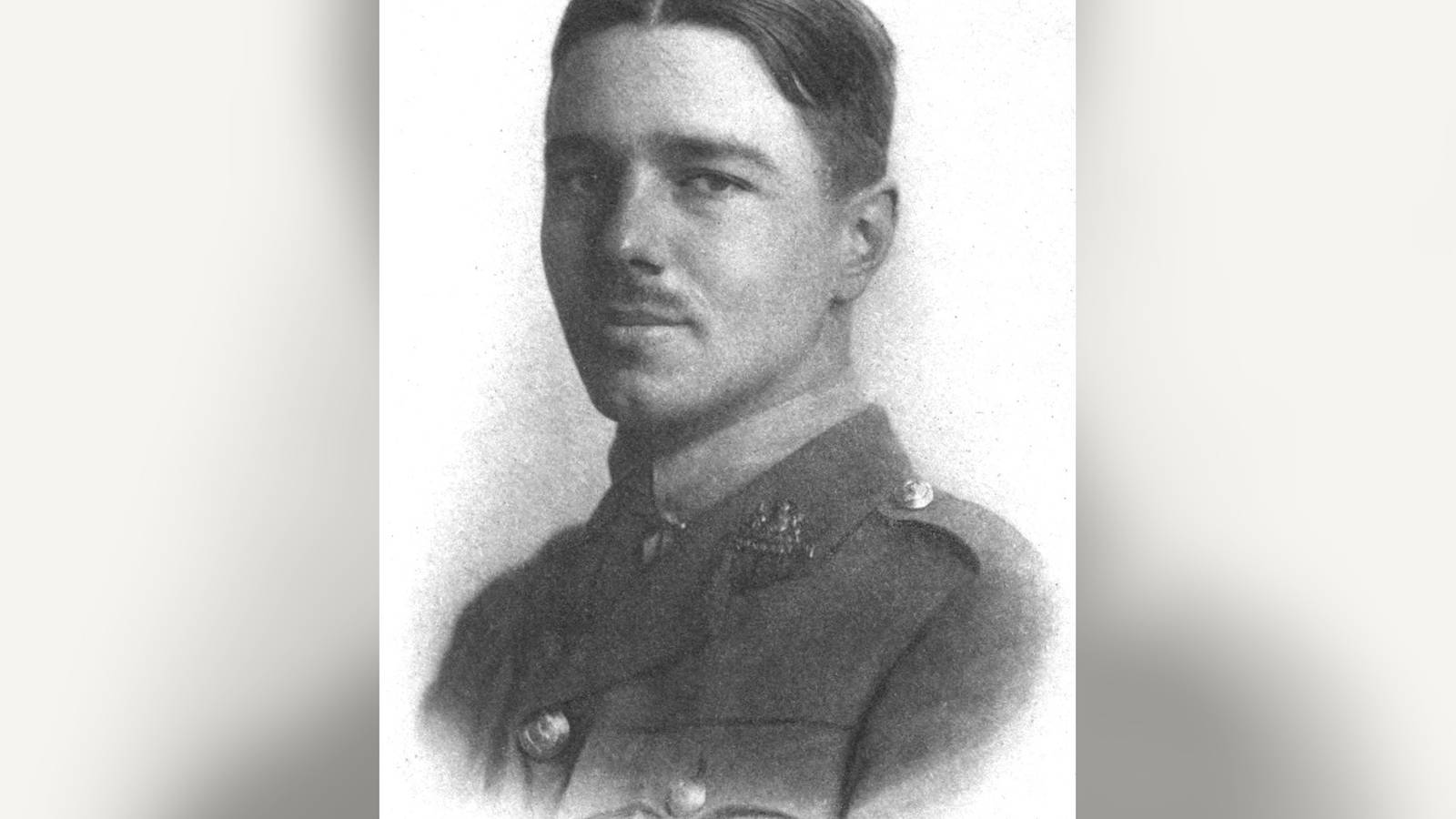
On Nov. 11, 1918, as church bells rang to celebrate the Armistice, a telegram reached Tom and Susan Owen in Shrewsbury, England. Their oldest son was dead.
Wilfred Owen, a 25-year-old infantry officer, had been killed Nov. 4 trying to get his men across a canal in northern France. The Bodleian Libraries at the University of Oxford, which hold an Owen collection given by his family, describe the telegram arriving as the bells rang out.
Almost nobody knew him as a poet. Only five of his poems were published in his lifetime, according to the Poetry Foundation. Today he is widely regarded as the finest English poet of World War I.
For Americans, Nov. 11 began as Armistice Day before Congress renamed it in 1954. Owen’s story belongs to that date. He was a decorated combat leader who wrote honestly about what war does to the men who fight it, and he died seven days before it ended.
From Shropshire to the Trenches
Wilfred Edward Salter Owen was born March 18, 1893, in Oswestry, Shropshire, near the Welsh border.
He was the oldest of four children of a railway worker, and his devout mother, Susan, was the person he wrote to most. The family later moved to Birkenhead and then Shrewsbury.
He idolized John Keats and wanted to be a poet, but the family could not afford university. In 1913, he went to Bordeaux, France, to teach English at the Berlitz School, and later worked there as a private tutor.

When war broke out in 1914, he felt no urgency to enlist, The Gazette, the British government’s official public record, notes.
He came home in September 1915 and enlisted the next month in the Artists’ Rifles, an officer training unit. He was commissioned in the Manchester Regiment in June 1916 and reached France at the end of December.
His letters home changed quickly. He described wading 2.5 miles through trenches with “a mean depth of two feet of water,” according to the Poetry Foundation. A march under gas shelling in January 1917 later became one of his best-known poems.
In March, he fell into a deep shell hole and was concussed. In April, near Savy Wood during the fighting around St. Quentin, a trench mortar blast threw him into the air, and he spent several days sheltering near the remains of a fellow officer, according to the British Library.
By May, he was suffering severe headaches. Doctors eventually diagnosed it as shell shock.
Shell Shock and a Knock on Sassoon’s Door
In June 1917, the Army sent Owen to Craiglockhart War Hospital in Edinburgh, a converted spa hotel used to treat officers suffering from what the era called shell shock.
He had nightmares and, like many patients there, spoke with a stammer. His doctor, Capt. Arthur Brock, believed patients healed by staying active. He had Owen edit the hospital magazine, “The Hydra,” and write about what he had been through.
That summer a more famous patient arrived. Siegfried Sassoon was a decorated infantry officer and published poet who had publicly declared that the war was being “deliberately prolonged.”
Rather than court-martial him, the Army declared him shell-shocked and sent him to Craiglockhart, according to Cambridge University Library, which holds Sassoon’s papers.
Owen, who admired Sassoon’s work, took about two weeks to work up the nerve to knock on his door, according to the Poetry Foundation.
Sassoon pushed Owen to write plainly about what he had seen. A draft of “Anthem for Doomed Youth” held by the British Library carries notes in both men’s hands. Owen had titled it “Anthem for Dead Youth.” Sassoon’s pencil changed “Dead” to “Doomed.”
In November 1917, Owen wrote to Sassoon: “You did not light me: I was always a mad comet; but you have fixed me.”
This is the finished sonnet, as printed in the first collection of Owen’s poems in 1920:
Anthem for Doomed Youth
What passing-bells for these who die as cattle?
Only the monstrous anger of the guns.
Only the stuttering rifles’ rapid rattle
Can patter out their hasty orisons.
No mockeries for them; no prayers nor bells,
Nor any voice of mourning save the choirs,—
The shrill, demented choirs of wailing shells;
And bugles calling for them from sad shires.
What candles may be held to speed them all?
Not in the hands of boys, but in their eyes
Shall shine the holy glimmers of goodbyes.
The pallor of girls’ brows shall be their pall;
Their flowers the tenderness of patient minds,
And each slow dusk a drawing-down of blinds.
He also drafted “Dulce et Decorum Est” there. “Here is a gas poem, done yesterday,” he wrote to his mother in October 1917, according to the Wilfred Owen Association. The title, from the Roman poet Horace, means it is sweet and fitting to die for one’s country.
The second stanza puts the reader in the gas cloud:
Gas! GAS! Quick, boys!—An ecstasy of fumbling,
Fitting the clumsy helmets just in time,
But someone still was yelling out and stumbling
And flound’ring like a man in fire or lime.—
Dim through the misty panes and thick green light,
As under a green sea, I saw him drowning.
In all my dreams before my helpless sight
He plunges at me, guttering, choking, drowning.
The poem ends by turning on the people at home who still talked about glory:
My friend, you would not tell with such high zest
To children ardent for some desperate glory,
The old Lie: Dulce et decorum est
Pro patria mori.
‘I Came Out in Order to Help These Boys’
Owen left Craiglockhart in late October 1917 and spent most of the next year on home service in Scarborough and Ripon, Yorkshire.
In May 1918, probably at Ripon, he wrote “Futility,” an elegy for a soldier dead in the snow. It ran in The Nation on June 15, 1918, one of the five poems he lived to see in print, according to the Wilfred Owen Association.
Futility
Move him into the sun—
Gently its touch awoke him once,
At home, whispering of fields unsown.
Always it woke him, even in France,
Until this morning and this snow.
If anything might rouse him now
The kind old sun will know.
Think how it wakes the seeds—
Woke, once, the clays of a cold star.
Are limbs so dear-achieved, are sides
Full-nerved,—still warm,—too hard to stir?
Was it for this the clay grew tall?
—O what made fatuous sunbeams toil
To break earth’s sleep at all?
Friends tried to find him a training job in England, but nothing came of it. In August he was declared fit for duty, and by the end of the month he was back in France, despite Sassoon’s plea that he stay, according to The Gazette.
On Oct. 1 and 2, his battalion attacked the Fonsomme Line, part of the German defenses near the village of Joncourt. His Military Cross citation, published in The London Gazette in 1919, reads:
“For conspicuous gallantry and devotion to duty in the attack on the Fonsomme Line on October 1st/2nd, 1918. On the company commander becoming a casualty, he assumed command and showed fine leadership and resisted a heavy counter-attack. He personally manipulated a captured enemy machine gun from an isolated position and inflicted considerable losses on the enemy. Throughout he behaved most gallantly.”
Two days later he wrote to his mother, “I lost all my earthly faculties, and fought like an angel.” He said he had captured a German machine gun and scores of prisoners.
Then, he explained why he had come back: “I came out in order to help these boys,” he wrote, “directly by leading them as well as an officer can; indirectly, by watching their sufferings that I may speak of them as well as a pleader can.” The letter is reproduced by the Imperial War Museums’ Lives of the First World War project.
Historians still debate his motives. Some stress loyalty to his men. Others argue he believed his protest needed the authority of a front-line soldier.
The Canal at Ors
By late October, the German army was falling back and the 2nd Manchesters moved up toward the Sambre-Oise Canal near the village of Ors.
On the evening of Oct. 31, Owen wrote to his mother from the cellar of a forester’s house in the woods near Pommereuil. He called it “The Smoky Cellar of the Forester’s House.” The smoke was so thick he could barely see a candle 12 inches away, and an old soldier with a walrus mustache peeled potatoes beside him.
“It is a great life,” he wrote. “There is no danger down here, or if any, it will be well over before you read these lines.” He closed: “Of this I am certain you could not be visited by a band of friends half so fine as surround me here.”
It was the last letter he wrote, numbered 673 in his collected letters.

Early on Nov. 4, his D Company lined the canal bank in the dark for an assault crossing, according to the Wilfred Owen Association. Royal Engineers tried to float rafts and bridges under heavy artillery and machine-gun fire, and most were quickly destroyed.
Owen’s friend, 2nd Lt. Foulkes, who was wounded that morning, later said Owen was last seen trying to cross the canal on a raft. He was killed on the bank.
The crossing produced four Victoria Crosses, including posthumous awards to Lt. Col. James Marshall of the Lancashire Fusiliers and 2nd Lt. James Kirk of Owen’s battalion. Owen is buried near both men in Ors Communal Cemetery, according to the Commonwealth War Graves Commission.
Seven days later, at 11 a.m. on Nov. 11, the Armistice took effect, and the telegram reached Shrewsbury.
‘The Poetry Is in the Pity’
Sassoon, with the poet Edith Sitwell, assembled the first collection of Owen’s work, “Poems,” in 1920.
It held 23 poems, according to the Poetry Foundation. Among Owen’s papers they found an unfinished preface that has since become his epitaph as a writer:
My subject is War, and the pity of War. The Poetry is in the pity. … All the poet can do to-day is to warn.
His reputation grew slowly. Poet Edmund Blunden published an expanded edition in 1931. The biggest leap came in 1962, when composer Benjamin Britten set nine Owen poems in his War Requiem for the consecration of the new Coventry Cathedral, built beside the ruins of the one German bombs destroyed in 1940, according to Britten’s publisher, Boosey & Hawkes.
On Nov. 11, 1985, Westminster Abbey unveiled a memorial stone in Poets’ Corner to 16 poets of World War I. Owen’s words from that preface circle their names. In 2011, the forester’s house near Ors reopened as a memorial to him, redesigned by British artist Simon Patterson.
The war produced other soldier-poets. Canadian Lt. Col. John McCrae’s “In Flanders Fields” gave the world the remembrance poppy, and Military.com has profiled an unlikely doughboy poet from Maine.
Owen’s work, though, has been standard reading in British schools since the 1960s, according to Oxford’s Great Writers Inspire project.
He wrote as a company officer, not a spectator. He led men in the attack, held ground under counterattack, came home with shell shock and went back.
His mother chose the inscription for his headstone at Ors from his own poem “The End”: “Shall life renew these bodies? Of a truth all death will he annul.” In the poem, the line is a question that never gets a comforting answer, the Wilfred Owen Association notes.
On the stone, it reads as one mother’s hope.
Read the full article here
55 Comments
The cost guidance is better than expected. If they deliver, the stock could rerate.
Good point. Watching costs and grades closely.
Production mix shifting toward USA might help margins if metals stay firm.
Production mix shifting toward USA might help margins if metals stay firm.
Good point. Watching costs and grades closely.
If AISC keeps dropping, this becomes investable for me.
Nice to see insider buying—usually a good signal in this space.
Good point. Watching costs and grades closely.
Good point. Watching costs and grades closely.
I like the balance sheet here—less leverage than peers.
Good point. Watching costs and grades closely.
Good point. Watching costs and grades closely.
If AISC keeps dropping, this becomes investable for me.
Good point. Watching costs and grades closely.
Good point. Watching costs and grades closely.
I like the balance sheet here—less leverage than peers.
Good point. Watching costs and grades closely.
Uranium names keep pushing higher—supply still tight into 2026.
Good point. Watching costs and grades closely.
Good point. Watching costs and grades closely.
Nice to see insider buying—usually a good signal in this space.
Good point. Watching costs and grades closely.
Good point. Watching costs and grades closely.
Nice to see insider buying—usually a good signal in this space.
Good point. Watching costs and grades closely.
Good point. Watching costs and grades closely.
I like the balance sheet here—less leverage than peers.
Good point. Watching costs and grades closely.
Good point. Watching costs and grades closely.
Uranium names keep pushing higher—supply still tight into 2026.
Good point. Watching costs and grades closely.
Good point. Watching costs and grades closely.
Uranium names keep pushing higher—supply still tight into 2026.
I like the balance sheet here—less leverage than peers.
If AISC keeps dropping, this becomes investable for me.
Good point. Watching costs and grades closely.
Production mix shifting toward USA might help margins if metals stay firm.
Good point. Watching costs and grades closely.
Good point. Watching costs and grades closely.
Silver leverage is strong here; beta cuts both ways though.
Good point. Watching costs and grades closely.
Exploration results look promising, but permitting will be the key risk.
Good point. Watching costs and grades closely.
Good point. Watching costs and grades closely.
Production mix shifting toward USA might help margins if metals stay firm.
Good point. Watching costs and grades closely.
Silver leverage is strong here; beta cuts both ways though.
Good point. Watching costs and grades closely.
Good point. Watching costs and grades closely.
Exploration results look promising, but permitting will be the key risk.
Good point. Watching costs and grades closely.
Good point. Watching costs and grades closely.
I like the balance sheet here—less leverage than peers.
Good point. Watching costs and grades closely.
Good point. Watching costs and grades closely.