

The U.S. has identified the remains of six soldiers who died during the Korean War, ending decades of mystery.
On Monday, the Defense POW/MIA Accounting Agency announced that it had accounted for the deaths of several soldiers from the Army, including two teenagers who died in the conflict over 70 years ago.
Nearly 1.8 million U.S. service members served in the Korean War, which began when North Korea, with indirect support from Communist China and the Soviet Union, fought against South Korea, which in turn was supported by the U.S.
The conflict ended in July 1953. In total, roughly 5 million soldiers and civilians, in addition to 36,500 Americans, lost their lives during the war.
Today, approximately 7,400 Americans remain unaccounted for, including hundreds buried as unknowns in Hawaii whose remains are still being analyzed by the Defense POW/MIA Accounting Agency.
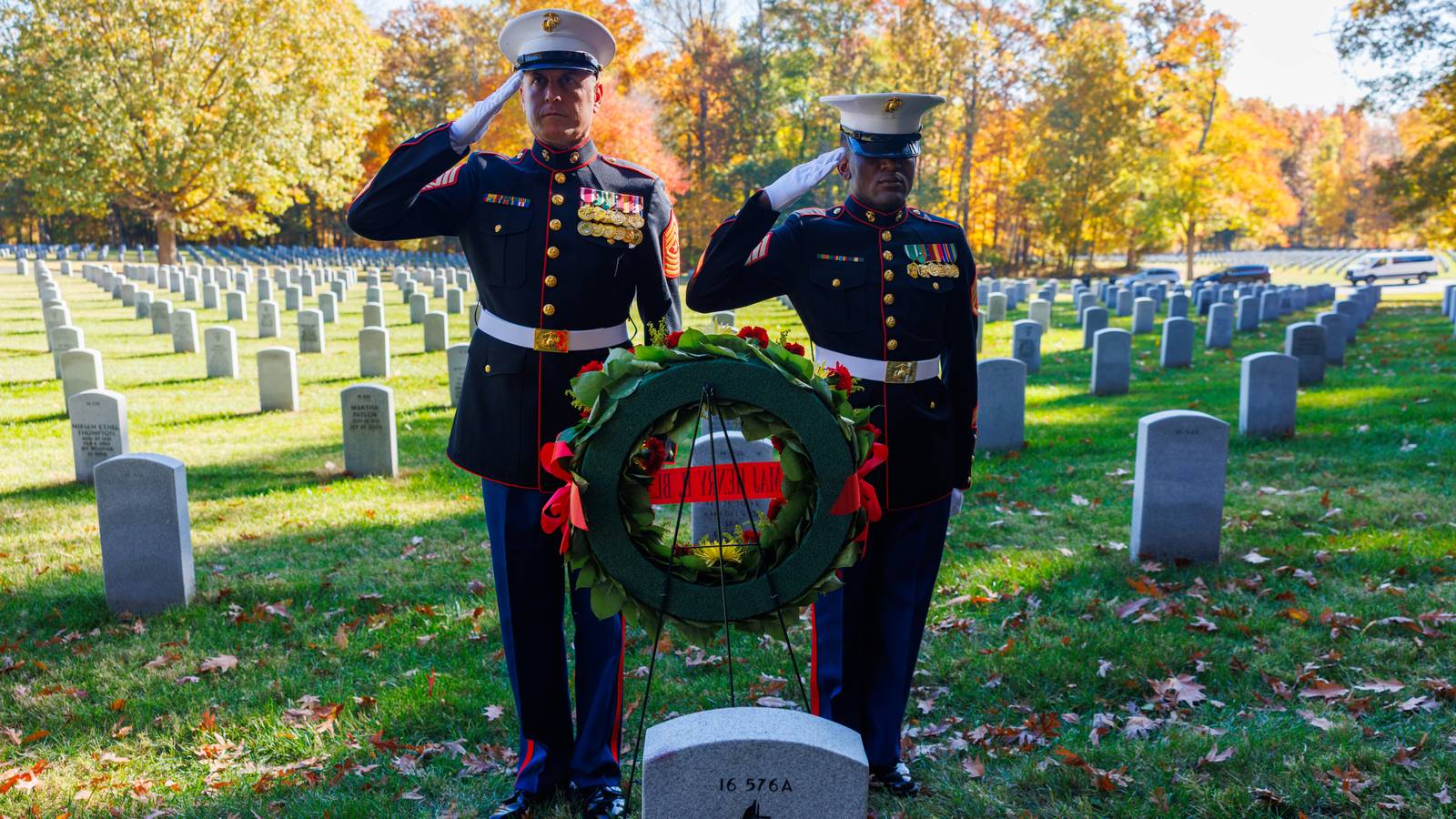
Returning and identifying these fallen troops delivers closure to grieving families and ensures every hero receives a proper burial with full military honors, reaffirming the nation’s enduring commitment to those who serve in the military.
However, the analyzing process involves examining dental records, archival information and DNA analysis, possibly taking decades for resolutions.
The Identified Soldiers
One of the soldiers identified by the Defense POW/MIA Accounting Agency was U.S. Army Cpl. Jackie Lee Thurman, an 18-year-old who was a member of Battery B, 99th Field Artillery Battalion, 1st Cavalry Division.
Thurman, 18, was a forward observer near Waegwan, South Korea, which came under heavy enemy fire, the agency said. The military reported him missing in action and his remains were declared unrecoverable in January 1956.
But in November 2022, the agency analyzed remains found near Kumhwa-dong in South Korea. This past May, they identified those remains as belonging to Thurman.
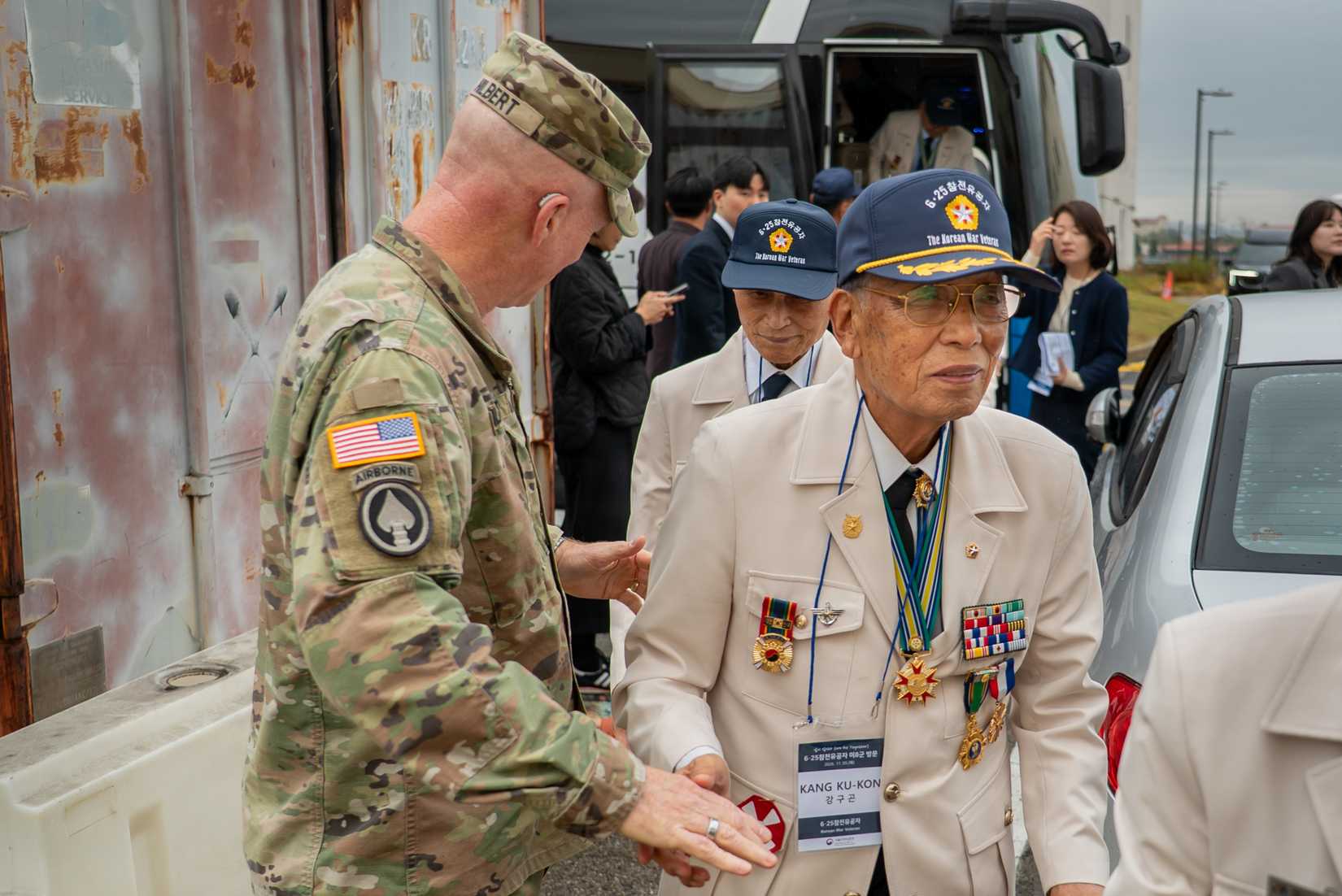
U.S. Army Lt. Gen. Joseph Hilbert, commanding general of Eighth Army, left, greets Kang Ku-kon, a Republic of Korea Korean War veteran, during a visit by the Republic of Korea minister of patriots and veterans affairs and members of the Korean War Veterans Association at Camp Humphreys, South Korea, Nov. 5, 2026.(U.S. Army photo by Pfc. Mingeun Oh)
The agency also identified U.S. Army 1st Lt. Raymond Banker Gilbert, who was reported missing during the battle of the Ch’ongch’on River in North Korea.
The 23-year-old member of B Battery, 503rd Field Artillery Battalion, 2nd Infantry Division, was taken as a prisoner of war, witnesses said at the time. After the war, his and other remains were sent to the U.S. Gilbert’s remains were analyzed in 2024 and identified in June.
The Chinese People’s Volunteer Army at the Chosin Reservoir in North Korea ambushed soldiers including U.S. Army Cpl. William R. Laughlin Jr., a 21-year-old member of Company D, 1st Battalion, 32nd Infantry Regiment, 7th Infantry Division, attached to the 31st Regimental Combat Team, the agency added.
The military assumed he was dead after a 17-day battle that ensued and reported him missing in action on Dec. 2, 1950.
Remains sent back to the U.S. in July 2022 were later identified, in September 2026, as belonging to Laughlin.
The Army presumed that U.S. Army Sgt. Joseph A. Platzkoester, a member of Company H, 2nd Battalion, 38th Infantry Regiment, 2nd Infantry Division, was dead after last seeing him during an ambush in South Korea in 1953.
This past May, the agency analyzed remains found in 1951 and matched them to the 28-year-old soldier.
Also in May, the agency identified 21-year-old U.S. Army Cpl. Andrew R. Tischler, who was assigned to Company F, 2nd Battalion, 15th Infantry Regiment, 3rd Infantry Division, and was reported missing in action near Taewol Village in South Korea.
Finally, in August, the agency accounted for 18-year-old U.S. Army Cpl. Richard N. Lennox, 18.
Enemy forces attacked the member of Company C, 1st Battalion, 7th Infantry Regiment, 3rd Infantry Division and his unit in November 1950. Authorities reported him missing in action after enemies captured him and marched him to a prisoner-of-war camp in Changsong.
The military has engraved each missing soldier’s name on the Walls of the Missing at the National Memorial Cemetery of the Pacific. They will place rosettes alongside their names.
Read the full article here
46 Comments
The cost guidance is better than expected. If they deliver, the stock could rerate.
Good point. Watching costs and grades closely.
Exploration results look promising, but permitting will be the key risk.
Good point. Watching costs and grades closely.
Silver leverage is strong here; beta cuts both ways though.
Exploration results look promising, but permitting will be the key risk.
Exploration results look promising, but permitting will be the key risk.
Good point. Watching costs and grades closely.
Exploration results look promising, but permitting will be the key risk.
Good point. Watching costs and grades closely.
Good point. Watching costs and grades closely.
Uranium names keep pushing higher—supply still tight into 2026.
I like the balance sheet here—less leverage than peers.
I like the balance sheet here—less leverage than peers.
Good point. Watching costs and grades closely.
Good point. Watching costs and grades closely.
Production mix shifting toward USA might help margins if metals stay firm.
Production mix shifting toward USA might help margins if metals stay firm.
Good point. Watching costs and grades closely.
Silver leverage is strong here; beta cuts both ways though.
Good point. Watching costs and grades closely.
Interesting update on US Identifies 6 Soldiers Killed in Korean War After Decades of Mystery. Curious how the grades will trend next quarter.
Good point. Watching costs and grades closely.
Uranium names keep pushing higher—supply still tight into 2026.
Interesting update on US Identifies 6 Soldiers Killed in Korean War After Decades of Mystery. Curious how the grades will trend next quarter.
Good point. Watching costs and grades closely.
Uranium names keep pushing higher—supply still tight into 2026.
Good point. Watching costs and grades closely.
Good point. Watching costs and grades closely.
If AISC keeps dropping, this becomes investable for me.
Good point. Watching costs and grades closely.
Good point. Watching costs and grades closely.
If AISC keeps dropping, this becomes investable for me.
Good point. Watching costs and grades closely.
Exploration results look promising, but permitting will be the key risk.
Uranium names keep pushing higher—supply still tight into 2026.
The cost guidance is better than expected. If they deliver, the stock could rerate.
Good point. Watching costs and grades closely.
I like the balance sheet here—less leverage than peers.
Good point. Watching costs and grades closely.
Good point. Watching costs and grades closely.
The cost guidance is better than expected. If they deliver, the stock could rerate.
Good point. Watching costs and grades closely.
Exploration results look promising, but permitting will be the key risk.
Good point. Watching costs and grades closely.
Good point. Watching costs and grades closely.