

Shipbuilding in the U.S. can be compared to watching paint dry, literally. The industry is reporting a severe shortage of surface prep and coating workers, adding to a painfully slow American shipbuilding process. How slow?
The global management consulting firm McKinsey & Company estimates that the U.S. shipbuilding sector will need 200,000 to 250,000 more skilled workers this decade, and the shortage is only expected to worsen. McKinsey reports 27% of the maritime workforce is already 55 or older.
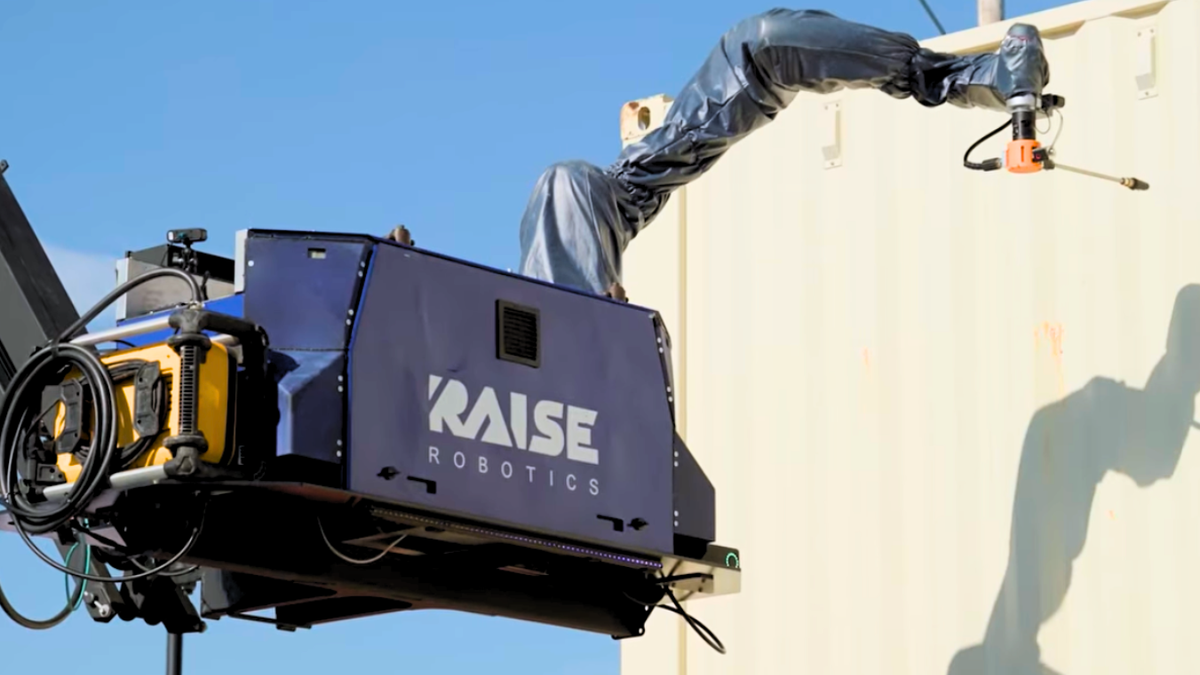
The San Franciso-based technology company, Raise Robotics Inc., believes it has a solution: an autonomous robotic system mounted on a Genie boom lift.
Chief Technology Officer Rishabh Aggarwal, in an interview with Military.com, said the combination puts a robot 65 feet into the air to handle high-risk surface work like painting, in a safe, accurate and timely way, and for a fraction of the projected cost.
“Painting is the 2nd most costly and time-consuming aspect of shipbuilding, and that’s largely an unknown fact,” Aggarwal, a lead designer of the robot, said. “The robot saves not just the application time, but it mostly eliminates the reworking of the paint if the paint is done incorrectly.”
How Integrated Robotic Shipbuilding Works
Aggarwal said the robot gets mounted on a scissor lift, allowing it to go up and down as it’s painting a very tall surface. Other advantages include safety, cost savings, and accuracy.
“These paints that are being used are very expensive. Creating a product that does it autonomously not only expedites the shipbuilding process, but it provides a lot of economic viability as well,” he said. “Also, the paints used for coating the ships are some of the most hazardous paints out there. They’re highly flammable in nature. They are toxic and have high VOC counts that severely reduce air quality.”
“So that is where the robot saves not just the application time, but it mostly eliminates the reworking of the paint if the paint is done incorrectly,” Aggarwal said.
Similar painting technology is already being used on major projects for Apple, St. Jude Hospital, and the Dallas Cowboys. In shipbuilding, the robotics solution is gaining momentum only after the ouster of U.S. Navy Secretary John Phelan in April over reports that President Donald Trump wanted a change, citing slow shipbuilding and conflicts in his administration, including with Defense Secretary Pete Hegseth.

“He’s a very good man,” Trump said of Phelan at the time. “I really liked him, but he had some conflict, not necessarily with Pete. He’s a hard charger, and he had some conflicts with some other people, mostly as to building and buying new ships. I’m very aggressive in the new shipbuilding.”
Shortage of Shipbuilding Workers Continues
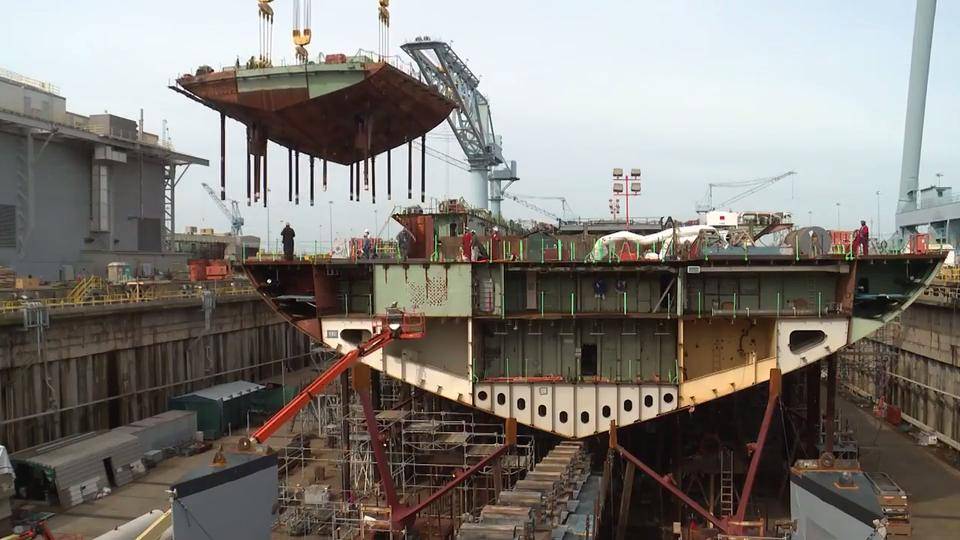
Attracting new workers in the shipbuilding industry may be the biggest hurdle. According to McKinsey, the U.S. builds about 0.2% of the world’s commercial ships today. In the 1970s, it was 5%. Aggarwal said the worker shortage tied to the danger involved is a major factor.
“Currently, in some of the shipyards in the U.S., one commercial ship is being built per year, while it’s one ship per week being built in many countries in Europe,” Aggarwal said. “People don’t want to do very arduous blue-collar jobs. Secondary to that is the danger associated with the job, and the amount of manpower needed for it.”
Aggarwal said the Raise Robotics system promotes safety by replacing the need for human shipbuilders in an almost one-to-one ratio.
“One robot would be able to do the work of around one to two people when operating, and it can operate continuously for a longer period of time compared to one or 2 people doing the same work,” Aggarwal explained. “There is also a lower switchover cost in executing the same task, because the robot can scale up and down, based on timing and other companies’ needs.”
Scaling up and down also relates to cost. While Aggarwal wouldn’t give an exact price tag for a Raise Robotics system, he said companies make different arrangements to meet their needs.
“There is no specific pricing. A robot could be bought outright, or it could be rented monthly,” he said. “That generally depends on the volume that the customer wants and the terms, including who does the service and maintenance. All of those points are based on the negotiation.”
Still, the price of shipbuilding may be a fraction of the future cost if the industry continues its slow pace.
“Slow shipbuilding increases our reliance on other countries to do the shipbuilding, so it is a problem,” Aggarwal said. “We think robotics is an answer.”
Read the full article here
37 Comments
If AISC keeps dropping, this becomes investable for me.
Good point. Watching costs and grades closely.
Good point. Watching costs and grades closely.
Production mix shifting toward USA might help margins if metals stay firm.
Good point. Watching costs and grades closely.
Uranium names keep pushing higher—supply still tight into 2026.
The cost guidance is better than expected. If they deliver, the stock could rerate.
If AISC keeps dropping, this becomes investable for me.
Good point. Watching costs and grades closely.
Good point. Watching costs and grades closely.
Interesting update on US Shipbuilding Worker Shortage: Can Robotics Help?. Curious how the grades will trend next quarter.
Nice to see insider buying—usually a good signal in this space.
Good point. Watching costs and grades closely.
Silver leverage is strong here; beta cuts both ways though.
Exploration results look promising, but permitting will be the key risk.
Good point. Watching costs and grades closely.
Good point. Watching costs and grades closely.
The cost guidance is better than expected. If they deliver, the stock could rerate.
The cost guidance is better than expected. If they deliver, the stock could rerate.
If AISC keeps dropping, this becomes investable for me.
Good point. Watching costs and grades closely.
Good point. Watching costs and grades closely.
Interesting update on US Shipbuilding Worker Shortage: Can Robotics Help?. Curious how the grades will trend next quarter.
The cost guidance is better than expected. If they deliver, the stock could rerate.
Good point. Watching costs and grades closely.
Nice to see insider buying—usually a good signal in this space.
Good point. Watching costs and grades closely.
Good point. Watching costs and grades closely.
If AISC keeps dropping, this becomes investable for me.
Production mix shifting toward USA might help margins if metals stay firm.
Nice to see insider buying—usually a good signal in this space.
Good point. Watching costs and grades closely.
Uranium names keep pushing higher—supply still tight into 2026.
Good point. Watching costs and grades closely.
Good point. Watching costs and grades closely.
Nice to see insider buying—usually a good signal in this space.
The cost guidance is better than expected. If they deliver, the stock could rerate.