

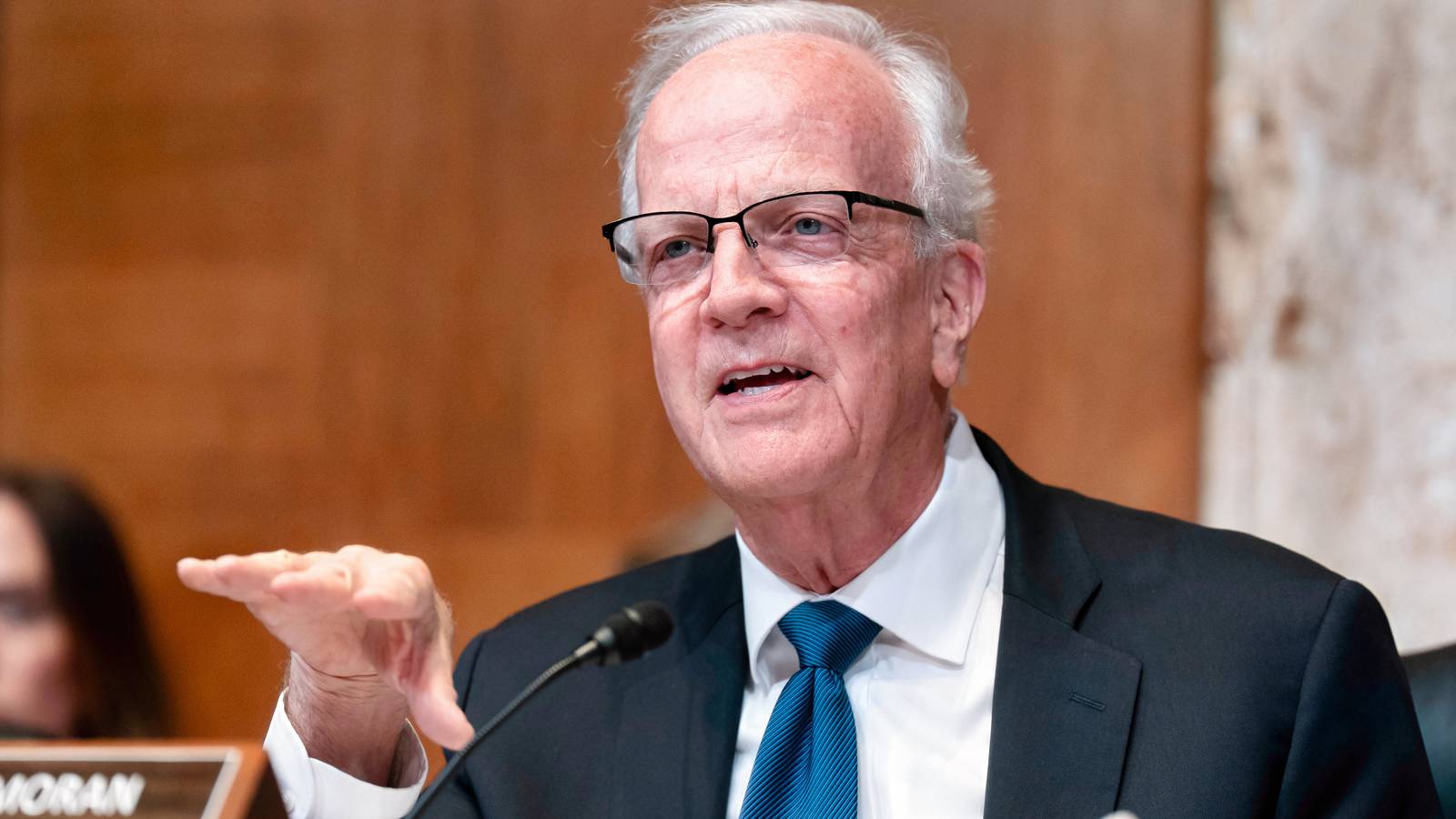
Exclusive: Sen. Jerry Moran tells Military.com why he believes the Take Care of America’s Veterans Act has been widely misunderstood, and why he says current veterans would not lose benefits under the proposal.
Since its induction in June, much of the debaten surrounding Congress’ proposed Take Care of America’s Veterans Act has focused on what critics say it could take away.
Supporters argue the bigger story is what the legislation would provide.
The sweeping proposal combines more than 60 veterans’ bills into a single package that would expand benefits for combat-disabled retirees, surviving spouses, caregivers, Guard and Reserve members, veterans using community care, and millions of other current and future veterans and military families.
At the center of the debate is a controversial funding mechanism tied to future changes in how the Department of Veterans Affairs evaluates disability claims for tinnitus and obstructive sleep apnea.
But in an exclusive interview with Military.com, Senate Veterans’ Affairs Committee Chairman Sen. Jerry Moran said one of the biggest misconceptions is that the legislation would reduce benefits for veterans already receiving compensation.
It takes no benefit away from anyone who is receiving those benefits, Moran said.
Instead, Moran said, Congress is attempting to ensure that money expected to become available through VA regulatory changes already under consideration remains dedicated to veterans rather than disappearing into the broader federal budget.
“My goal is to pass legislation,” Moran told Military.com. “This is not designed to be politics.”
The Biggest Misunderstanding
Much of the criticism surrounding the legislation has focused on proposed changes involving disability ratings for tinnitus and obstructive sleep apnea.
Some critics and veterans have interpreted those provisions as Congress cutting disability benefits to pay for new programs.
Moran argues that isn’t what the legislation does.
According to Moran, the VA had already announced plans to update the disability rating criteria for both conditions before Congress drafted the bill.
The department previously told Congress it intended to finalize updated disability rating regulations by the end of fiscal year 2026. However, the proposed changes to tinnitus and sleep apnea ratings had not taken effect as of late October.
“The VA testified in the House Veterans Affairs Committee in January of this year that they were going to implement the rule by the end of the fiscal year,” Moran said.
Those proposed regulatory changes originated years ago and span multiple presidential administrations as the VA has worked to modernize portions of its disability rating schedule to reflect advances in medical science and treatment.
Moran said Congress viewed those anticipated changes as an opportunity.
“If we don’t get out ahead of that business,” he said, “the reduction in spending…will not be used for veterans.”
Instead, lawmakers proposed directing much of those projected savings toward expanding veterans’ programs through the Take Care of America’s Veterans Act.
“I see it as an opportunity to find a path forward that is a win-win,” Moran said.
 No Current Veteran Would Lose Benefits
Moran repeatedly emphasized what he considers the most important fact for veterans currently receiving compensation.
Under the legislation’s protections for existing disability ratings, veterans already receiving compensation for tinnitus or obstructive sleep apnea would not have those payments reduced solely because of the proposed rating schedule changes.
“Any changes that occur as a result of this legislation are prospective,” Moran said. “It takes no benefit away from anyone who is receiving those benefits for those two conditions.”
Veterans already receiving disability compensation would continue receiving those benefits.
The legislation also would not eliminate health care for either condition.
Rather, if the VA proceeds with its planned regulatory updates, future claims would be evaluated under revised medical criteria that reflect current science and treatment methods.
“It doesn’t do away with the benefit itself,” Moran explained. “It only alters the percentage and how you are tested.”
He added that veterans would also have a grace period to file claims under the existing rules before any changes take effect.
The legislation’s proposed October 1, 2026, applicability date has passed without the package becoming law, leaving the timing of any future changes unresolved.
Why Congress Combined More Than 60 Bills
The proposal represents one of the largest veterans legislative packages assembled in years.
Its centerpiece is the Major Richard Star Act, legislation that would allow certain combat-injured medically retired service members to receive both military retired pay and VA disability compensation.
Although the bill has enjoyed bipartisan support for years, it has repeatedly stalled because lawmakers could not identify an acceptable way to pay for it under federal budget rules.
Moran said that challenge led lawmakers to think more broadly.
“Most of us in Congress…would like to see it become law,” he said. “We started looking for ways in which we could advance the cause.”
Rather than pursuing one bill at a time, lawmakers combined more than 60 bipartisan veterans’ measures into one package.
Among them are:
- The Major Richard Star Act
- The Love Lives On Act, expanding survivor benefits for spouses who remarry
- The Veterans ACCESS Act, strengthening community care
- The Sharri Briley and Eric Edmundson Veterans Benefits Expansion Act
- Expanded caregiver support
- Education and GI Bill improvements
- Mental health initiatives
- VA modernization reforms
- Survivor and dependency benefit improvements
Many of those bills have already passed committee or accumulated broad bipartisan support but have never reached the president’s desk.
Keeping Veterans’ Dollars with Veterans
Moran said the legislation is designed around a simple principle.
If the VA proceeds with regulatory changes that reduce future spending, Congress should dedicate those savings to veterans rather than allowing the money to become available for unrelated government priorities.
This is an intentional way to take advantage of cuts that, in fact, are really going to happen anyway, Moran said, and then repurposing them for veteran benefits that currently don’t exist.
He summarized the philosophy behind the legislation in a single sentence.
“It’s veterans helping veterans, in a sense.”
Supporters argue that the approach allows Congress to enact decades of bipartisan veterans legislation while complying with federal PAYGO requirements requiring new mandatory spending to be offset.
Without legislation, Moran said, the savings generated by VA regulatory changes would simply reduce federal spending elsewhere instead of funding new veterans programs.
Benefits for Veterans of Every Generation
Another criticism Moran rejected is that the legislation favors one generation of veterans over another.
“This isn’t a generational transfer,” he said.
While the Richard Star Act primarily benefits medically retired combat veterans, other provisions focus on surviving spouses, military caregivers, Guard and Reserve members, veterans seeking community care, students using GI Bill benefits and military families.
“It’s intended…to be beneficial to many, many veterans and their families,” Moran said.
Support for the package has come from several veterans and military organizations, including the Tragedy Assistance Program for Survivors, which has praised provisions such as the Love Lives On Act for expanding support to surviving military spouses.
What Comes Next
The Take Care of America’s Veterans Act remains unfinished business in Congress. The House considered the legislation on July 16, but proceedings were postponed without a final passage vote, leaving the package awaiting further action.
House Clerk+1
The delay also leaves unresolved questions about the proposed changes to disability ratings for tinnitus and obstructive sleep apnea, which have generated significant concern among veterans and advocacy organizations.
For Moran, who has served on the House and Senate Veterans’ Affairs Committees for nearly three decades, the legislation represents an opportunity that may not come again soon.
I see this as one of the major pieces of beneficial legislation for veterans and their families that will pass Congress, he said. The goal here is just to take an opportunity … and use it for the benefit of those who serve our country.
The debate over the legislation continues, particularly over whether projected savings from changes affecting future disability claims should be used to fund expanded benefits for other veterans and their families.
“If we don’t get out ahead of that business,” Moran said of the VA’s planned regulatory changes, “the reduction in spending…will not be used for veterans.”
For supporters of the legislation, that remains a central question: if those savings materialize, should they stay with veterans?
Read the full article here
25 Comments
Nice to see insider buying—usually a good signal in this space.
The cost guidance is better than expected. If they deliver, the stock could rerate.
Good point. Watching costs and grades closely.
If AISC keeps dropping, this becomes investable for me.
Good point. Watching costs and grades closely.
Production mix shifting toward USA might help margins if metals stay firm.
Good point. Watching costs and grades closely.
Good point. Watching costs and grades closely.
Uranium names keep pushing higher—supply still tight into 2026.
Good point. Watching costs and grades closely.
Good point. Watching costs and grades closely.
The cost guidance is better than expected. If they deliver, the stock could rerate.
Good point. Watching costs and grades closely.
Good point. Watching costs and grades closely.
Interesting update on What Congress’ Veterans Benefits Package Really Does. Curious how the grades will trend next quarter.
Good point. Watching costs and grades closely.
Good point. Watching costs and grades closely.
Uranium names keep pushing higher—supply still tight into 2026.
Good point. Watching costs and grades closely.
Good point. Watching costs and grades closely.
Exploration results look promising, but permitting will be the key risk.
Good point. Watching costs and grades closely.
The cost guidance is better than expected. If they deliver, the stock could rerate.
Good point. Watching costs and grades closely.
Good point. Watching costs and grades closely.