

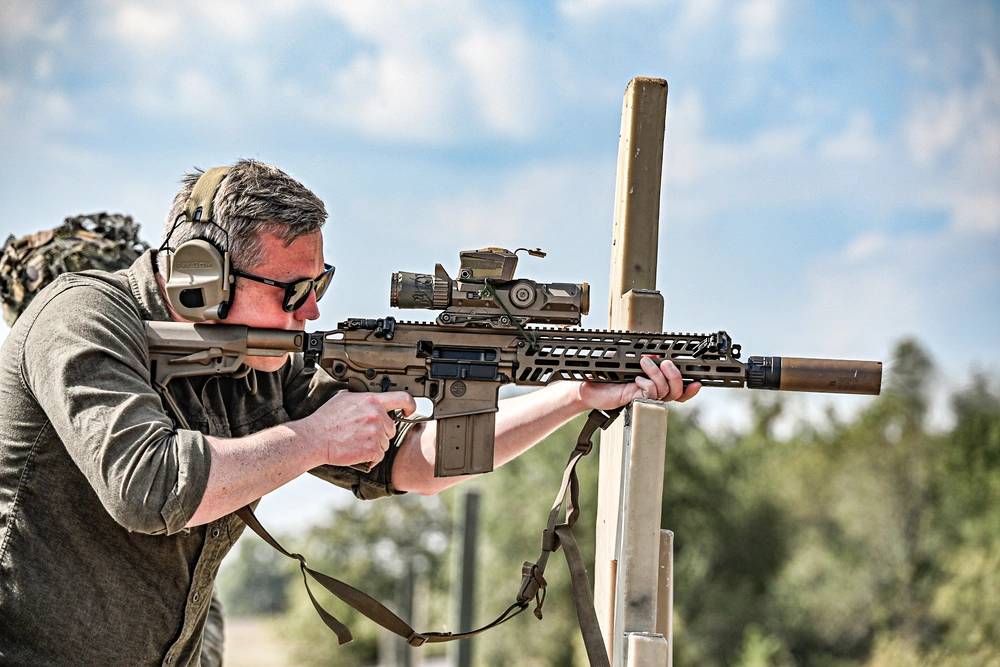
The U.S. Army is preparing to field a shorter, more maneuverable version of its new M7 rifle, a carbine SIG Sauer began building before the Army ever asked for one.
Now, with nearly 15,000 of the newer M8 carbines included in its fiscal 2027 budget request, the military is moving toward the next evolution of a weapon designed to give infantry soldiers greater lethality on the battlefield.
But what makes the M8’s development particularly noteworthy isn’t simply the speed of the transition. It’s how SIG Sauer anticipated the Army’s needs, invested in technology before receiving formal requirements and worked directly with soldiers to refine the weapon.
In an interview with Military.com during the Association of the United States Army’s annual meeting in Washington, D.C., Jason St. John, SIG Sauer’s senior director of the Defense Strategies Group, revealed that the company was already developing a shorter carbine before the Army selected the M7 in 2022.
That approach is part of a broader innovation strategy that has taken SIG Sauer beyond traditional firearms and into drones, remote weapon systems, advanced optics and other emerging military technologies.
For the Army, the M8 offers more than a new rifle. Its development provides a look at how military equipment can potentially move from concept to soldiers’ hands faster than traditional acquisition programs allow.
The M8 Was Already in Development
The Army awarded SIG Sauer its Next Generation Squad Weapon contract in April 2022, selecting the company’s rifle and automatic weapon systems to eventually replace the M4 carbine and M249 Squad Automatic Weapon in designated close-combat formations.
The M7 and M250 use 6.8mm ammunition, designed to improve performance against emerging battlefield threats.
The M7 began reaching soldiers in 2024. But SIG Sauer was already anticipating that some troops would need a shorter, more maneuverable version.
Even while and prior to NGSW being decided, we had already worked toward a carbine, St. John told Military.com.
He explained that the company expected specialized military units to seek a shorter weapon, even before the Army formally requested one. Rather than waiting for that requirement, SIG Sauer began developing the capability alongside the M7, investing its own resources without a guaranteed contract.
By the time the Army began evaluating the M8, SIG Sauer had already completed much of the engineering. St. John said developing a carbine from scratch could have required months of additional work, potentially more than a year, simply to produce a prototype.
Instead, SIG Sauer already had a largely developed design that could be refined through Army testing and soldier feedback. “That effort was going on well before notification from the Army at risk,” he said.
The distinction matters. The M8 was not simply a response to shortcomings identified after the M7 entered service. It was the result of parallel development that anticipated how soldiers’ requirements might evolve.
Soldiers Helped Shape the Final Weapon
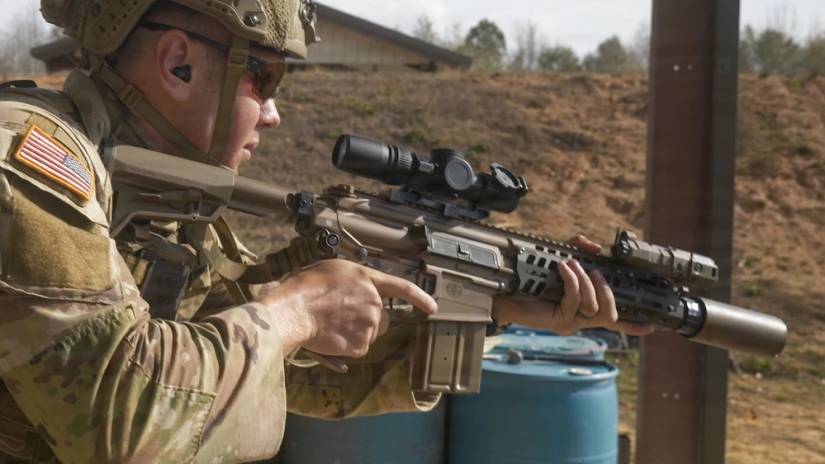
Although SIG Sauer anticipated the need for a shorter rifle, St. John emphasized that soldiers played an important role in determining what the M8 would ultimately become.
The Army conducted multiple evaluation events involving personnel with different levels of experience, from newer soldiers to senior noncommissioned officers and specialized units.
St. John described individual events involving approximately 40 to 60 soldiers, with SIG Sauer engineers and product managers present to observe and receive feedback.
Rather than relying exclusively on reports passed through multiple organizational levels, the company’s technical personnel could hear directly from the people evaluating the weapons.
They give us an opportunity to get that feedback in the moment in real time, and as direct and unfiltered as it can be, St. John said.
That feedback was not always positive. “When someone tells you X sucks, you know, that hurts a little if you love it and your baby,” he said, describing how engineers sometimes react to criticism of their designs.
But that direct feedback was important to the development process. St. John said the final M8 configuration drew on three sources: SIG Sauer’s internal development work; direct feedback from soldiers during evaluation events; and information the Army’s program office collected from weapons already in service.
The Army ultimately determined which proposed changes would be incorporated. The intended result is a shorter, more maneuverable weapon that retains the capabilities associated with the Army’s transition to 6.8mm ammunition.
A Different Approach to Military Acquisition
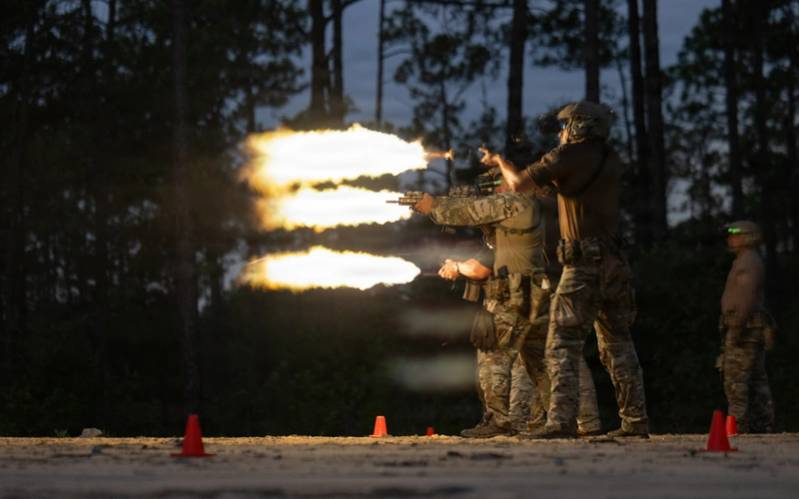
The M8’s development also raises a broader question about how quickly the military can develop and field new equipment. Major defense programs can take years to move from requirements through testing, procurement and fielding.
St. John said the Army’s Next Generation Squad Weapon program has demonstrated a particularly effective approach.
I’m not sure that I’ve seen a program go as efficiently and fast from the beginning as NGSW, he told Military.com.
He credited a process that allowed competing manufacturers to develop prototypes, gave the Army opportunities to evaluate those systems, and continued refining the selected weapons after the initial contract decision.
Importantly, St. John said the program’s speed and responsiveness were not the result of a recent change in presidential administrations or Army leadership.
Instead, he described an approach that had remained consistent since the program began, even as different officials assumed responsibility for overseeing it.
The relationship between the Army and SIG Sauer allowed engineers to participate in evaluation activities and receive information that could be incorporated into subsequent designs.
That collaboration, combined with development work SIG Sauer had already completed, reduced the amount of additional engineering required.
St. John’s assessment reflects the manufacturer’s perspective, but the process offers a potential example of how earlier industry investment, continuous soldier feedback and closer collaboration could help other military programs move more quickly.
Innovation Beyond the Rifle
The same willingness to invest ahead of military requirements is also pushing SIG Sauer into technologies far beyond traditional firearms.
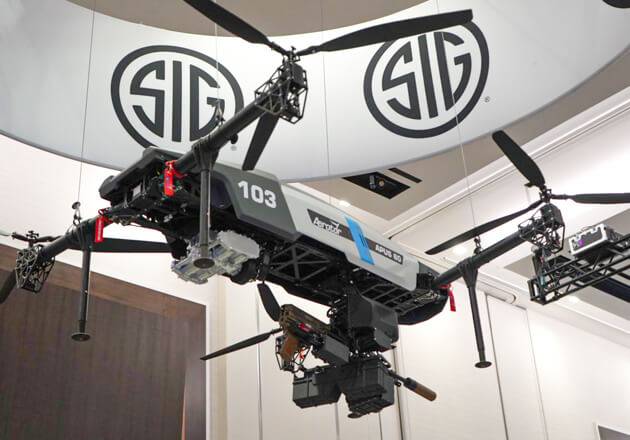
During the Military.com interview, St. John and Tory Mazzola, SIG Sauer’s vice president of global communications, described the company’s expansion into unmanned aircraft, remote weapon stations, advanced optics and other defense systems.
Mazzola pointed to the company’s acquisition of General Robotics and its growing portfolio of drone capabilities, including systems designed for reconnaissance and surveillance.
For a company long associated with pistols and rifles, the expansion reflects a broader strategy of anticipating future military requirements rather than waiting for formal contracts.
That strategy was visible at AUSA, where SIG Sauer highlighted developments in counter-drone technology and unmanned systems. SIG Sauer’s AUSA announcements included: an expansion of its North Carolina unmanned-systems operations, with more manufacturing space and workforce capacity; the XRAY9-CUAS, an optic designed to help operators engage moving drones; a live-fire demonstration with Israel Aerospace Industries of the Fire Storm 250, an unmanned aircraft equipped with a remotely operated machine gun.
St. John said some technologies the company developed years earlier never became successful products in their original form but are now informing new applications, including counter-drone capabilities.
He also emphasized that developing advanced technology is only part of the challenge. Manufacturers must be able to produce that technology in quantities sufficient to meet military demand.
There’s a lot of people that can develop amazing things, but bringing millions of them a year to the market is a very challenging thing, St. John said.
That distinction connects SIG Sauer’s expansion into emerging technologies with its experience producing weapons for the Army.
The M8 illustrates one application of the company’s approach: anticipating a requirement, investing ahead of time, incorporating feedback and preparing to manufacture at scale. Whether that model can be replicated across newer technologies remains to be seen.
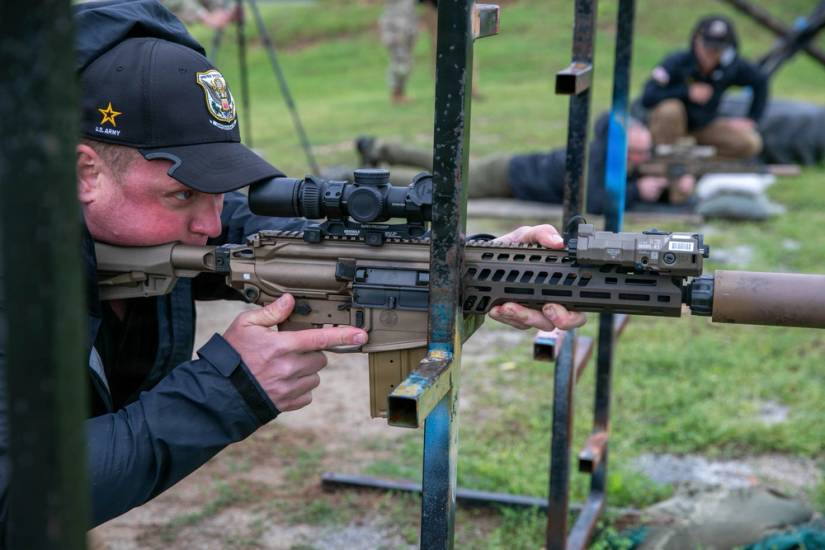
Nearly 15,000 M8 Rifles Requested
The Army’s fiscal 2027 budget request includes 14,944 M8 carbines, along with 2,795 M250 automatic rifles. Notably, the request does not include additional M7 rifles, reflecting the Army’s planned procurement emphasis on the shorter weapon.
The Army expects to begin fielding the M8 at Fort Bragg, North Carolina, in December 2026, but it has not said how many weapons will arrive in that first delivery.
The nearly 15,000 rifles represent a fiscal-year procurement request, not the number expected to arrive in December. The transition also raises questions about the future of M7 rifles already delivered to the Army.
The new procurement plans do not, by themselves, establish that all existing M7s will be withdrawn or replaced. For SIG Sauer, development continues even as the Army prepares to field the new weapon.
St. John said the company is still testing the M8, evaluating components and looking for opportunities to improve manufacturing efficiency and production capacity. Those efforts do not necessarily mean the Army will adopt every proposed change, but they illustrate a development approach in which work continues beyond a weapon’s initial acceptance.
Investing Before the Army Makes Its Decision
SIG Sauer’s willingness to invest ahead of military requirements extends beyond the M8 itself.
St. John revealed that the company began investing in its Rochester, New Hampshire, ammunition manufacturing facility approximately three years before the Army selected SIG Sauer for the Next Generation Squad Weapon contract.
The company anticipated that producing the program’s specialized 6.8mm ammunition would require manufacturing capabilities beyond those then available to support the requirement.
SIG Sauer made that investment without knowing whether it would win the contract. St. John described it as a substantial financial risk, but one the company considered necessary to be ready if selected.
Mazzola emphasized that the company’s approach involves not only developing new technology but also preparing to manufacture it at scale.
That capability becomes particularly important when a successful prototype must transition into thousands of weapons destined for military units.
For the Army, the M8 represents another step in modernizing the individual soldier’s weapon. For SIG Sauer, it reflects years of investment, ongoing testing and close cooperation with the military.
But the larger significance may be the development process itself. The M8 was not created overnight, nor was it simply a reaction to the M7. Its rapid progression was possible in part because development had already begun before the Army formally needed the weapon.
As the Army prepares to field the M8 and seeks funding for nearly 15,000 more, that approach offers a potential lesson extending well beyond rifles: the ability to anticipate battlefield needs, incorporate soldier feedback and manufacture new technology at scale may be just as important as the technology itself.
Read the full article here
36 Comments
If AISC keeps dropping, this becomes investable for me.
Good point. Watching costs and grades closely.
I like the balance sheet here—less leverage than peers.
Good point. Watching costs and grades closely.
Good point. Watching costs and grades closely.
Nice to see insider buying—usually a good signal in this space.
Good point. Watching costs and grades closely.
Interesting update on What SIG Sauer Changed From the M7. Curious how the grades will trend next quarter.
Good point. Watching costs and grades closely.
Interesting update on What SIG Sauer Changed From the M7. Curious how the grades will trend next quarter.
Production mix shifting toward USA might help margins if metals stay firm.
I like the balance sheet here—less leverage than peers.
Good point. Watching costs and grades closely.
Good point. Watching costs and grades closely.
Uranium names keep pushing higher—supply still tight into 2026.
Good point. Watching costs and grades closely.
Uranium names keep pushing higher—supply still tight into 2026.
Silver leverage is strong here; beta cuts both ways though.
Good point. Watching costs and grades closely.
The cost guidance is better than expected. If they deliver, the stock could rerate.
Good point. Watching costs and grades closely.
Uranium names keep pushing higher—supply still tight into 2026.
I like the balance sheet here—less leverage than peers.
Good point. Watching costs and grades closely.
Good point. Watching costs and grades closely.
Uranium names keep pushing higher—supply still tight into 2026.
Good point. Watching costs and grades closely.
Interesting update on What SIG Sauer Changed From the M7. Curious how the grades will trend next quarter.
Good point. Watching costs and grades closely.
Good point. Watching costs and grades closely.
Production mix shifting toward USA might help margins if metals stay firm.
Good point. Watching costs and grades closely.
Good point. Watching costs and grades closely.
Exploration results look promising, but permitting will be the key risk.
Good point. Watching costs and grades closely.
Good point. Watching costs and grades closely.