


Marines who think they can outplan a computer have until Nov. 14 to apply for the chance to prove it.
Marine Corps University announced the FIGHT CLUB Humans vs. Machine “Mindgame Tournament” in MARADMIN 494/26, signed Oct. 14. Applications are due by 11:59 p.m. Eastern on Nov. 14, and the message is clear that late applications will not be accepted. Play begins Dec. 1 and runs through April 1, 2027.
The tournament is run by the wargaming team at MCU’s Brute Krulak Center for Innovation and Future Warfare, the same organization that runs the Commandant’s Cup qualifiers. This time, the opponent on the other side of the screen is a machine.
What the MARADMIN Says
Players will fight two modern scenarios in Command Professional Edition, a digital simulation of air, naval and strategic operations used by militaries for analysis and training. One scenario pits a carrier strike group against another carrier strike group. The other is a drone swarm fight.
The opposing force is built by Strategy Robot, a Pittsburgh company that describes its products as computational game theory for planning against intelligent adversaries. The MARADMIN makes a point of saying this is not the scripted computer opponent most gamers know.
“Rather than following a predetermined playbook, the AI continuously assesses the battlespace, anticipates opponent actions, and adjusts its strategy as the game unfolds,” the message states.
MCU calls the event “a pathway event towards integrating Super Intelligence into wargaming by leveraging an autonomous agent to act as a highly trained adversary in digital wargames versus humans.”
The rules are simple. Players can play the AI as many times as they want during the tournament window, as long as a software license is available. To count in the final standings, each player must finish at least five games in each scenario.
The final score is the average of a player’s five best carrier strike group games plus the average of their five best drone swarm games.
Prizes go to the top three players overall and to the top three Marines.
Who Can Apply
The tournament is open to active and reserve members of the Marine Corps and the joint force, government civilians and contractors associated with the Department of War, and allied military organizations. Applicants need a valid government or military email address.
Unlike the open registration for the Commandant’s Cup qualifiers, this event requires an application. MCU says the complexity of the scenarios is the reason. Applicants should describe their wargaming experience, why they want to play and how it will help their professional development.
Experience with Command: Modern Operations, the commercial version of the software, or Command Professional Edition is preferred, but MCU says applicants willing to learn may also apply.
Applications are submitted through the MCU Wargaming page at usmcu.edu. Tutorial sessions and practice time will be offered in the weeks before kickoff.
Play is online through MCU’s Wargaming Cloud, accessed from outside the Marine Corps Enterprise Network on a personal computer. MCU says it works best on a laptop or desktop, not a tablet. Licenses are limited, so some players will have to wait for one to be checked back in.
An AI That Grades Your Homework
The opponent is only half of the AI story. Throughout the tournament, players will also have access to an after-action review tool built on a large language model.
According to the MARADMIN, players will be able to examine their decisions, “interact conversationally with game data,” and look for patterns, strengths and weaknesses in their own play.
Anyone who has sat through a hotwash knows how rarely an individual gets feedback tailored to his own decisions. A tool that lets a user ask the data why his carrier group lost its screen in game three could fill that gap.
An arcade-style scoreboard will show standings throughout the competition.
MCU’s stated intent goes beyond bragging rights. The tournament is meant to showcase competitive wargaming as a way to develop and assess tactical and operational decision-making, and to “explore the potential of AI to enhance wargaming, player development, and performance analysis.”
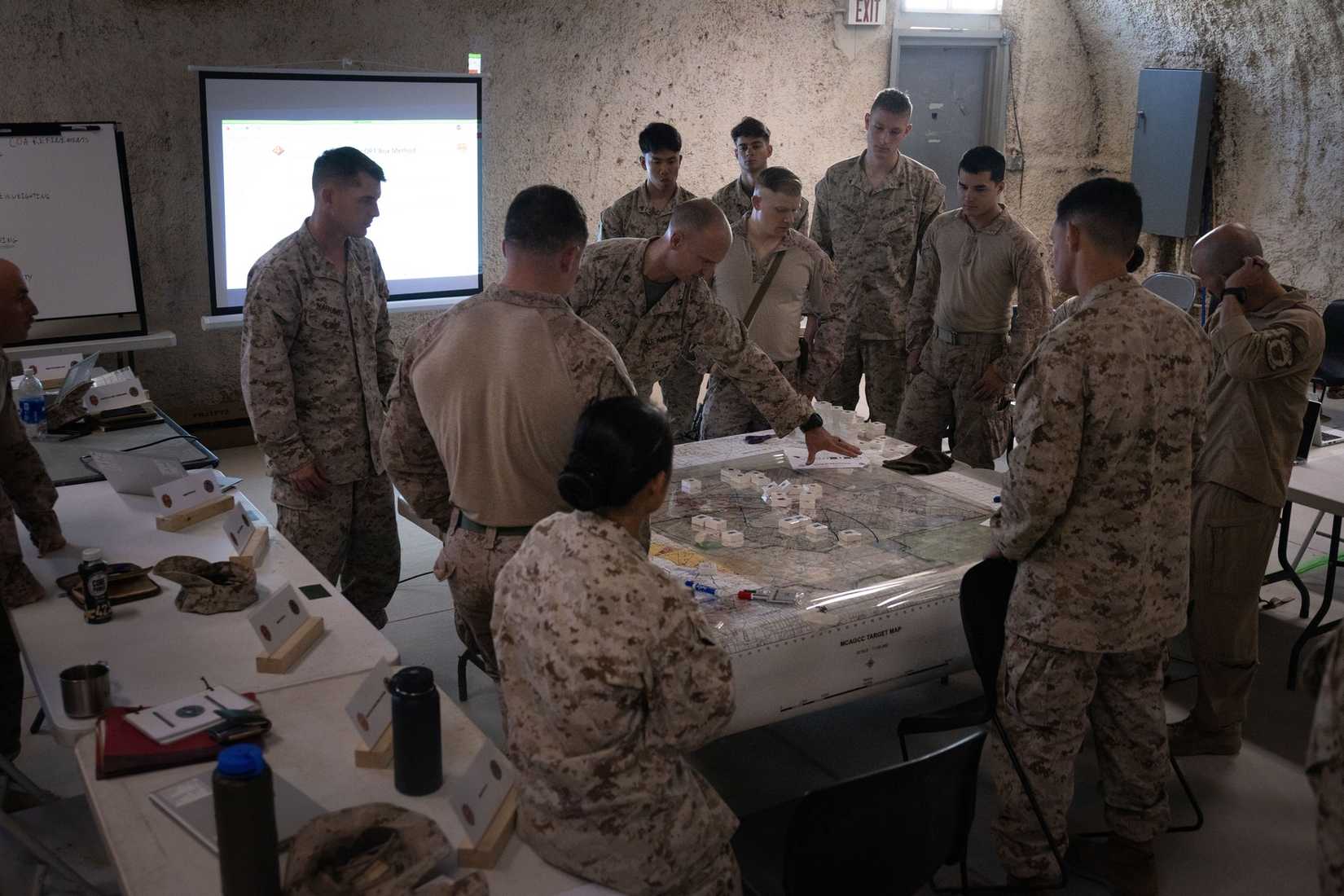
Where Fight Club Fits
Fight Club is MCU’s extracurricular wargaming program, built around the idea that decision-making is a skill Marines can practice like marksmanship. Military.com covered how the Corps is using wargaming to build cognitive warfighting skills last year, including the Neller Center for Wargaming and Analysis at Quantico and the Top Tactics tournament.
The program’s biggest event is the Road to the Commandant’s Cup. Under MARADMIN 308/26, this year’s qualifiers run four rounds from September through March, moving from Napoleon at War to Company Commander WWII, a Company Commander Modern scenario with a Marine Expeditionary Unit in the Western Pacific, and Littoral Commander.
The top players are grouped by command and invited to the finals at Modern Day Marine in Washington, D.C., April 12-15, 2027.
In those events, Marines play other people. The Humans vs. Machine tournament keeps the same Wargaming Cloud and the same emphasis on repetitions, with an opponent that never tires and is built to adapt.
Marine doctrine treats war as a contest against a thinking enemy, and a computer that reasons about what you are likely to do is closer to that problem than one that follows a script.
The larger Super Intelligence Push
The tournament lands in the middle of a busy fall for super intelligence in the Marine Corps. The Corps’ Ground Combat Element 2040 plan, published in August, expects AI and autonomous systems to carry more of the headquarters and logistics load by the early 2030s, and the service is training Marines now.
Under MARADMIN 214/26, every active-duty and reserve Marine, officer and enlisted, must finish the Basic AI Course through the Marine Corps Electronic Learning Environment by Dec. 31. MARADMIN 467/26, released in late September and updated by MARADMIN 472/26, lists other AI and data training available to Marines and civilians, from MCeLE and Joint Knowledge Online courses to Navy Community College certificates.
For Marines who want to go deeper, MARADMIN 471/26 opened nominations for the 2027-1 Marine Corps Artificial Intelligence Fellowship with the Naval Postgraduate School.
It is a five-month, project-based program, and every applicant must bring a command-endorsed, unclassified AI use case to work on. Applications are due Oct. 30.
MCU has also been building its joint warfighting curriculum. MARADMIN 463/25 established the university’s Joint All-Domain Operations education program, including a JADO Advanced Studies Program for selected Command and Staff College resident students and a fleet support pilot for students at Camp Pendleton, Camp Lejeune and Quantico.
That message cites joint education policy that calls for “role-based wargaming and interactive joint planning exercises,” which is the same kind of learning Fight Club offers on a voluntary basis.
The Mindgame Tournament’s carrier and drone swarm scenarios sit squarely in that naval and joint space, and give any eligible Marine a low-risk way to see how well the new tools think and how well he thinks against them.
How To Apply
Applications are due by 11:59 p.m. Eastern on Nov. 14 through the MCU Wargaming page at https://www.usmcu.edu/Academic-Programs/Wargaming/. Selected players will get instructions on Wargaming Cloud access, schedules, scenarios and Command PE orientation before the Dec. 1 start.
Read the full article here
46 Comments
Nice to see insider buying—usually a good signal in this space.
Production mix shifting toward USA might help margins if metals stay firm.
Good point. Watching costs and grades closely.
Nice to see insider buying—usually a good signal in this space.
Nice to see insider buying—usually a good signal in this space.
Good point. Watching costs and grades closely.
Good point. Watching costs and grades closely.
Exploration results look promising, but permitting will be the key risk.
Good point. Watching costs and grades closely.
Good point. Watching costs and grades closely.
Nice to see insider buying—usually a good signal in this space.
Good point. Watching costs and grades closely.
Good point. Watching costs and grades closely.
I like the balance sheet here—less leverage than peers.
Production mix shifting toward USA might help margins if metals stay firm.
Good point. Watching costs and grades closely.
I like the balance sheet here—less leverage than peers.
If AISC keeps dropping, this becomes investable for me.
I like the balance sheet here—less leverage than peers.
Good point. Watching costs and grades closely.
Good point. Watching costs and grades closely.
If AISC keeps dropping, this becomes investable for me.
Good point. Watching costs and grades closely.
Good point. Watching costs and grades closely.
I like the balance sheet here—less leverage than peers.
Good point. Watching costs and grades closely.
Good point. Watching costs and grades closely.
Nice to see insider buying—usually a good signal in this space.
Good point. Watching costs and grades closely.
Good point. Watching costs and grades closely.
Uranium names keep pushing higher—supply still tight into 2026.
Good point. Watching costs and grades closely.
Interesting update on Marine Corps Challenges Troops to Beat a Machine at War. Curious how the grades will trend next quarter.
I like the balance sheet here—less leverage than peers.
I like the balance sheet here—less leverage than peers.
Good point. Watching costs and grades closely.
Nice to see insider buying—usually a good signal in this space.
Silver leverage is strong here; beta cuts both ways though.
Good point. Watching costs and grades closely.
Good point. Watching costs and grades closely.
Production mix shifting toward USA might help margins if metals stay firm.
Silver leverage is strong here; beta cuts both ways though.
Good point. Watching costs and grades closely.
Good point. Watching costs and grades closely.
Uranium names keep pushing higher—supply still tight into 2026.
Good point. Watching costs and grades closely.