

A senior U.S. Army soldier assigned to a NATO headquarters in England was arrested Tuesday on suspicion of espionage offenses that British police say relate to Russia, according to the Metropolitan Police and U.S. and NATO officials cited by multiple U.S. news networks.
The unnamed 41-year-old was detained near Gloucester in an investigation by counterterrorism police working with the FBI and the U.S. military, the Metropolitan Police said in a statement.
A member of the U.S. Army assigned to a NATO unit was arrested in England on suspicion of espionage related to Russia, counterterrorism police and other officials said.
Police have not named him, the statement said. Brig. Gen. Sean Stinchon, commanding general of U.S. Army Counterintelligence Command, described him in the police statement as a “senior soldier, entrusted with sensitive information.”
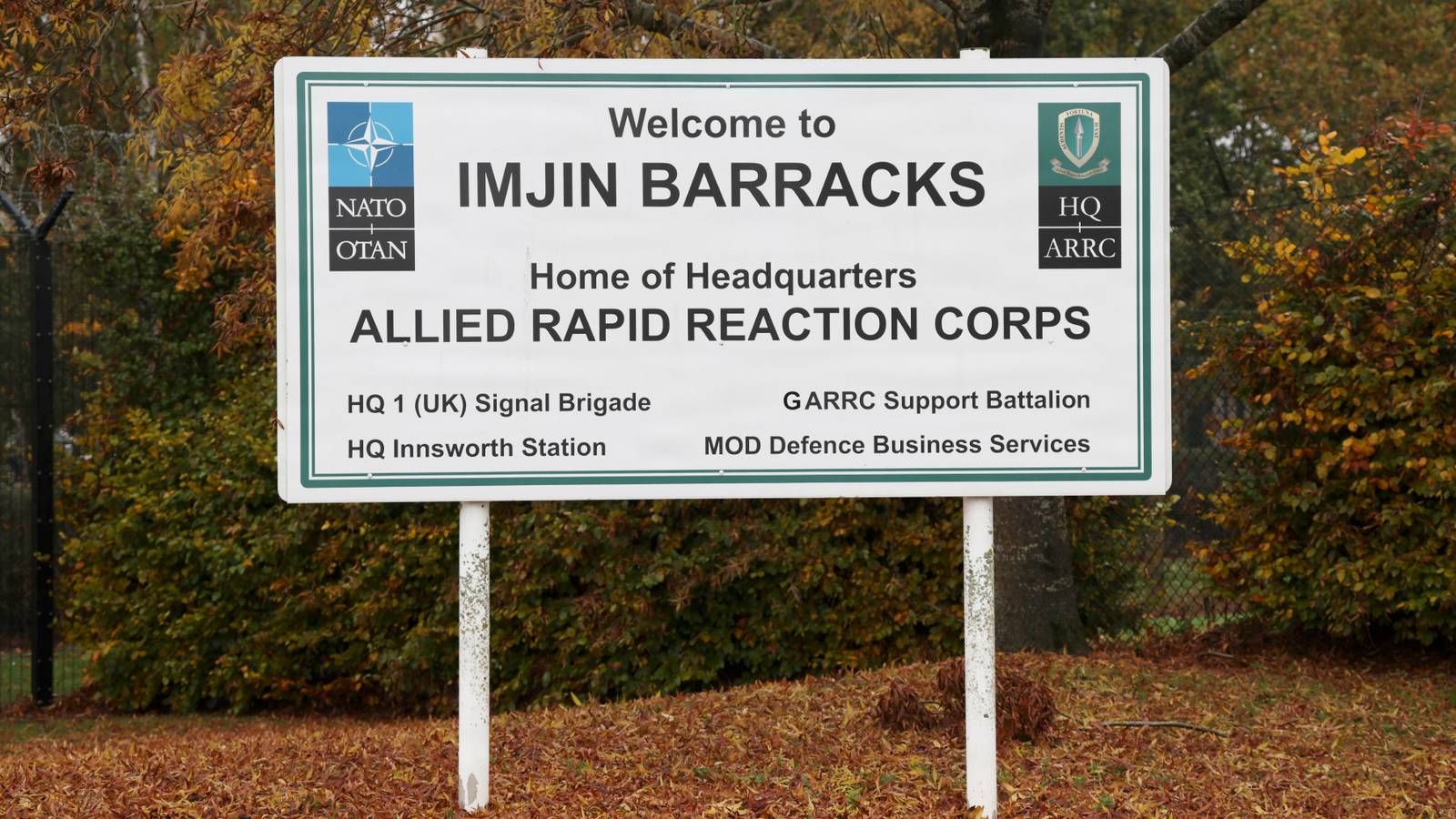
A U.S. official told CNN he is a “field grade Army officer,” a category that covers majors, lieutenant colonels and colonels. A senior NATO official told CNN he “was assigned to the Allied Rapid Reaction Corps.”
A U.S. official told CBS News he was based at Imjin Barracks, the corps’ headquarters.
British police need a court’s approval to hold a suspect longer than 48 hours without charge, up to a maximum of 14 days from arrest, according to a Home Office notice on detention rights.
Both Britain and the United States have a legal claim to try him under the treaty governing NATO troops stationed in allied countries.
Russia had “nothing to do with” the detention, Kremlin spokesperson Dmitry Peskov told reporters Wednesday in Moscow, CBS News reported.
What Happens at the Headquarters
Imjin Barracks in Gloucestershire houses a three-star NATO headquarters with more than 400 permanent staff from more than 20 nations, according to the British Army.
That headquarters can deploy as a corps headquarters, a Land Force Component Command, or a joint task force headquarters. The British Army says it moved to England from Germany in 2010.

A small contingent of U.S. intelligence soldiers is stationed there and processes some of NATO’s intelligence, ABC News reported.
No official has of press time said publicly what the soldier’s job was, what information he could reach, or whether any NATO material was compromised.
Police said only that officers are searching two locations in Gloucestershire and that he remains in custody at a London police station.
What British Law Covers
The Metropolitan Police said he was arrested on suspicion of offenses under sections 1 and 3 of the National Security Act 2023.
Section 1 makes it a crime to obtain, copy, record or keep protected information, as well as to disclose it, when the person knows or should know the purpose would harm the United Kingdom and a foreign power is involved, according to the text of the act.
Its maximum penalty is life in prison, the act states. Under that wording, obtaining or keeping the material can be enough.
Section 3 covers conduct intended to materially assist a foreign intelligence service, or conduct a person should know is likely to, and it carries up to 14 years in prison, according to the act.
Prosecutors do not have to identify a particular intelligence service, the act says.
“The country to which the allegations relate is Russia,” police said in their statement.
An arrest on suspicion is not a charge under British procedure, and his name is expected to be released if British authorities formally charge him, per ABC News.
Both Countries Have Claims
Both British authorities and the U.S. Army are expected to bring charges, a source told ABC News.
Under American military law, Article 103a of the Uniform Code of Military Justice covers espionage by anyone subject to the code, including attempts.
Punishment is set by a court-martial, and the death penalty is available when the information concerns categories such as war plans, nuclear weapons or communications intelligence, according to the statute.
Article VII(7)(a) of the NATO Status of Forces Agreement prohibits American military authorities from carrying out a death sentence in Britain if British law does not provide for that punishment in a similar case. Britain does not provide capital punishment for espionage.

Who goes first is governed by the NATO Status of Forces Agreement. Under Article VII of that treaty, the country that sent the troops has the primary right to prosecute offenses “solely against the property or security of that State,” and the host country has the primary right over all others.
Espionage is listed in the treaty among offenses against a state’s security.
Under Article VII(8) of the NATO SOFA, a service member acquitted or convicted of an offense generally cannot be tried again for the same offense by the other country within the same territory, provided any conviction has resulted in a sentence being served or completed, or a pardon.
The treaty still allows the service member’s own military to pursue disciplinary charges arising from the same conduct.
Which rule applies here turns on whose secrets were allegedly involved—American, British or NATO’s. That remains unknown.
A Wider Alarm in Britain
Police said the investigation “is not linked to any other ongoing Counterterrorism Policing investigations.”
That separates it from a suspected plot against RAF Fairford, where the Justice Department on Tuesday charged three people it described as Iran-backed operatives, CBS News reported.
Even so, the arrest comes amid repeated warnings about Russia. Sir Ken McCallum, the head of MI5, last month accused Russia of “escalating their attempts at hybrid warfare.”
He called it “aggressor No. 1” among threats to the United Kingdom, according to CBS News.
U.S. European Command launched a theater-wide vigilance campaign on Nov. 2 built on the phrase “See Something, Do Something,” according to a command release.
“Maintaining our strategic advantage requires a daily partnership with our military and local communities,” Gen. Alexus Grynkewich, the command’s leader, said in that release. No official has linked the campaign to the arrest.
“The allegations are serious, and our investigation is very much ongoing,” Deputy Assistant Commissioner Vicki Evans, senior national coordinator for Counterterrorism Policing, said in the statement.
FBI Director Kash Patel said in the same statement that “this FBI has no tolerance for anyone who breaks their oath to the United States.”
Stinchon called the case a reminder that “insider threats are real and persistent” and urged anyone who sees something suspicious to report it to a local counterintelligence office, according to the statement.
Read the full article here
36 Comments
The cost guidance is better than expected. If they deliver, the stock could rerate.
The cost guidance is better than expected. If they deliver, the stock could rerate.
Good point. Watching costs and grades closely.
Good point. Watching costs and grades closely.
Uranium names keep pushing higher—supply still tight into 2026.
Good point. Watching costs and grades closely.
Good point. Watching costs and grades closely.
Production mix shifting toward USA might help margins if metals stay firm.
Good point. Watching costs and grades closely.
Good point. Watching costs and grades closely.
Uranium names keep pushing higher—supply still tight into 2026.
Good point. Watching costs and grades closely.
Interesting update on Senior US Soldier Based at NATO Headquarters Arrested on Suspicion of Helping Russia. Curious how the grades will trend next quarter.
The cost guidance is better than expected. If they deliver, the stock could rerate.
Production mix shifting toward USA might help margins if metals stay firm.
Exploration results look promising, but permitting will be the key risk.
Good point. Watching costs and grades closely.
Good point. Watching costs and grades closely.
Nice to see insider buying—usually a good signal in this space.
Good point. Watching costs and grades closely.
Interesting update on Senior US Soldier Based at NATO Headquarters Arrested on Suspicion of Helping Russia. Curious how the grades will trend next quarter.
Good point. Watching costs and grades closely.
Exploration results look promising, but permitting will be the key risk.
Uranium names keep pushing higher—supply still tight into 2026.
Good point. Watching costs and grades closely.
If AISC keeps dropping, this becomes investable for me.
Good point. Watching costs and grades closely.
Good point. Watching costs and grades closely.
Silver leverage is strong here; beta cuts both ways though.
Good point. Watching costs and grades closely.
Uranium names keep pushing higher—supply still tight into 2026.
Good point. Watching costs and grades closely.
The cost guidance is better than expected. If they deliver, the stock could rerate.
Good point. Watching costs and grades closely.
Good point. Watching costs and grades closely.
The cost guidance is better than expected. If they deliver, the stock could rerate.