

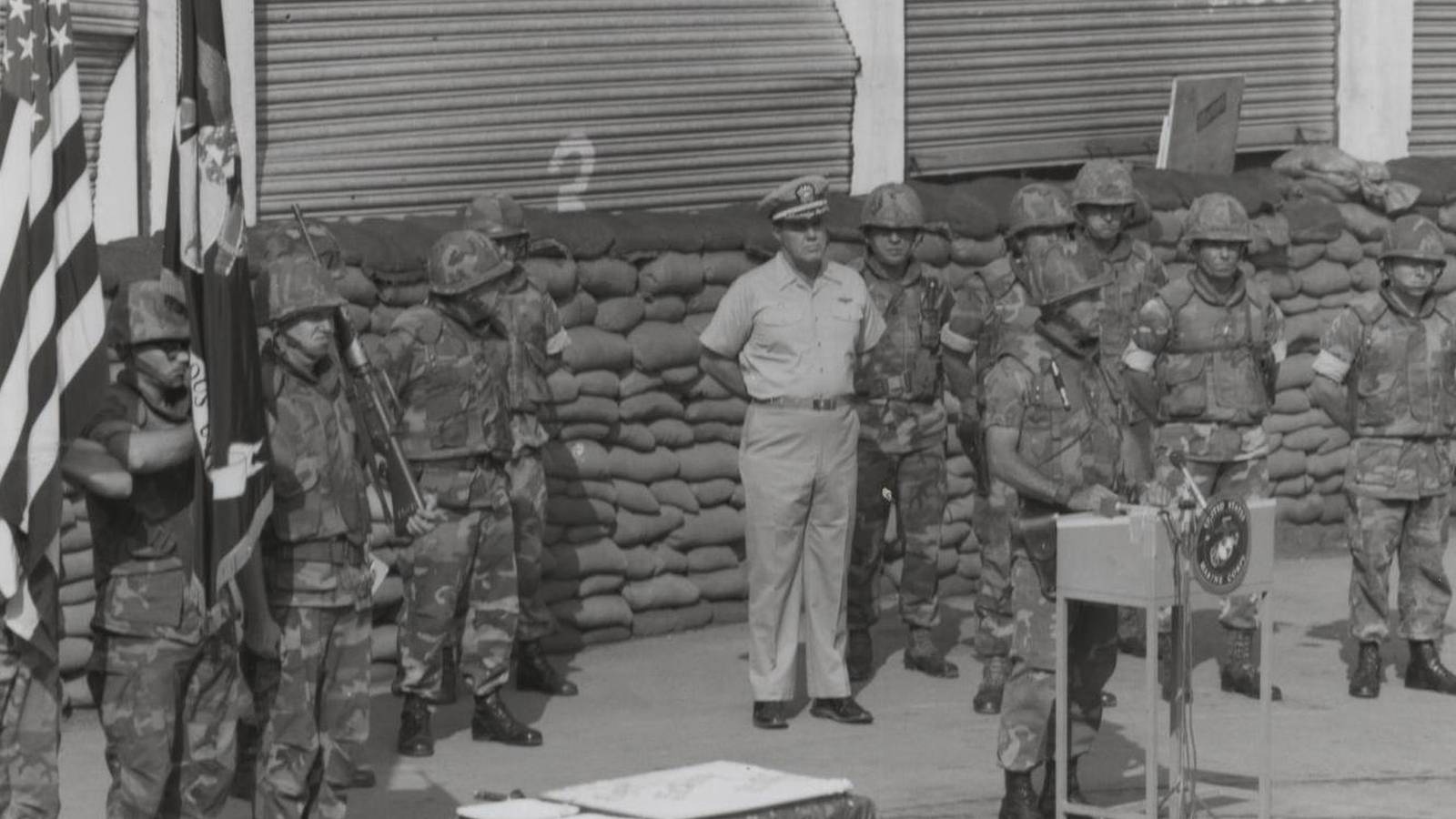
The Marines who gathered at the 24th Marine Amphibious Unit headquarters in Beirut on Nov. 10, 1983, wore helmets and flak jackets to their own birthday party.
In an official Marine Corps photograph of the ceremony, they stand in formation in front of shuttered garage doors and a wall of sandbags stacked shoulder-high with the colors posted in front.
A small table draped in camouflage holds the cake. Col. Timothy J. Geraghty, the unit’s commander, speaks from a lectern with the eagle, globe and anchor on its face.
Eighteen days earlier, a suicide bomber had driven a truck into the lobby of the building that housed his Battalion Landing Team 1/8 at Beirut International Airport.
The blast killed 241 American service members: 220 Marines, 18 sailors and three soldiers. It was the Corps’ deadliest single day since Iwo Jima, according to the National Museum of the Marine Corps. The Marines in Beirut cut the cake anyway.
As the Corps prepares to celebrate its 251st birthday, the story of that ceremony is a small one in the official record, but it says a lot about what Nov. 10 means to Marines and why they keep it, even in the worst places and at the worst times.
A ‘Low-Key, But Traditional’ Birthday
The official Marine Corps history of the deployment, “U.S. Marines in Lebanon, 1982-1984,” gives the ceremony only a few lines. “The Marine Corps Birthday was celebrated in Beirut on 10 November with a cake-cutting ceremony held at the MAU headquarters,” the history reads. It then quotes Geraghty’s situation report from that week:
Our birthday celebration was low-key, but traditional, and from our watch, 24th MAU added another page to the history of Marines in Lebanon.
The weeks around that page were anything but quiet. According to the official history, the unit held an “emotion-filled memorial service” for the dead on Nov. 4.
On Nov. 7, every unit on the perimeter came under intense fire that lasted six hours and ended only when a downpour of rain and hail rolled in.
Early on Nov. 8, Geraghty pulled Company A back from its isolated position at the Lebanese University because he could no longer support it there.
The perimeter itself had been rebuilt around the threat of another truck bomb. Marines dug an anti-vehicle ditch and berm around the command post, blocked entrances with 5-ton trucks and gates made of railroad track, and armed every interior post with light anti-tank weapons.
The FBI later concluded that the bomb that collapsed the battalion headquarters had the force of more than 12,000 pounds of TNT, the official history notes.
On the birthday itself, Geraghty received a message from President Ronald Reagan. “Even as we grieve for your sacrifice, we take pride in your excellence as Marines on this, the 208th Birthday of the Corps,”
Reagan wrote, according to the official history. “Please know we are thinking of you and look forward to welcoming you home.”
The same day, an ocean away, the last flight carrying remains from Beirut landed at Dover Air Force Base, Delaware, United Press International reported.
The commandant had written his birthday message, read at ceremonies around the world that day, before the bombing, UPI noted. UPI also reported that Headquarters Marine Corps had directed units worldwide to observe the birthday “in the traditional manner” that year.
In Beirut, the 24th MAU did exactly that, then went back to its bunkers. It turned over to the 22nd MAU on Nov. 19. For readers who want the full story of the attack itself, Military.com has covered the 1983 Beirut barracks bombing in depth.
Why Marines Cut the Cake No Matter What
The ceremony in Beirut followed a script every Marine knows. In 1921, Maj. Gen. Commandant John A. Lejeune issued Marine Corps Order No. 47, which summarized the Corps’ history and directed that it be read to every command on Nov. 10.
Lejeune’s order is still read at every ceremony. The cake came later.
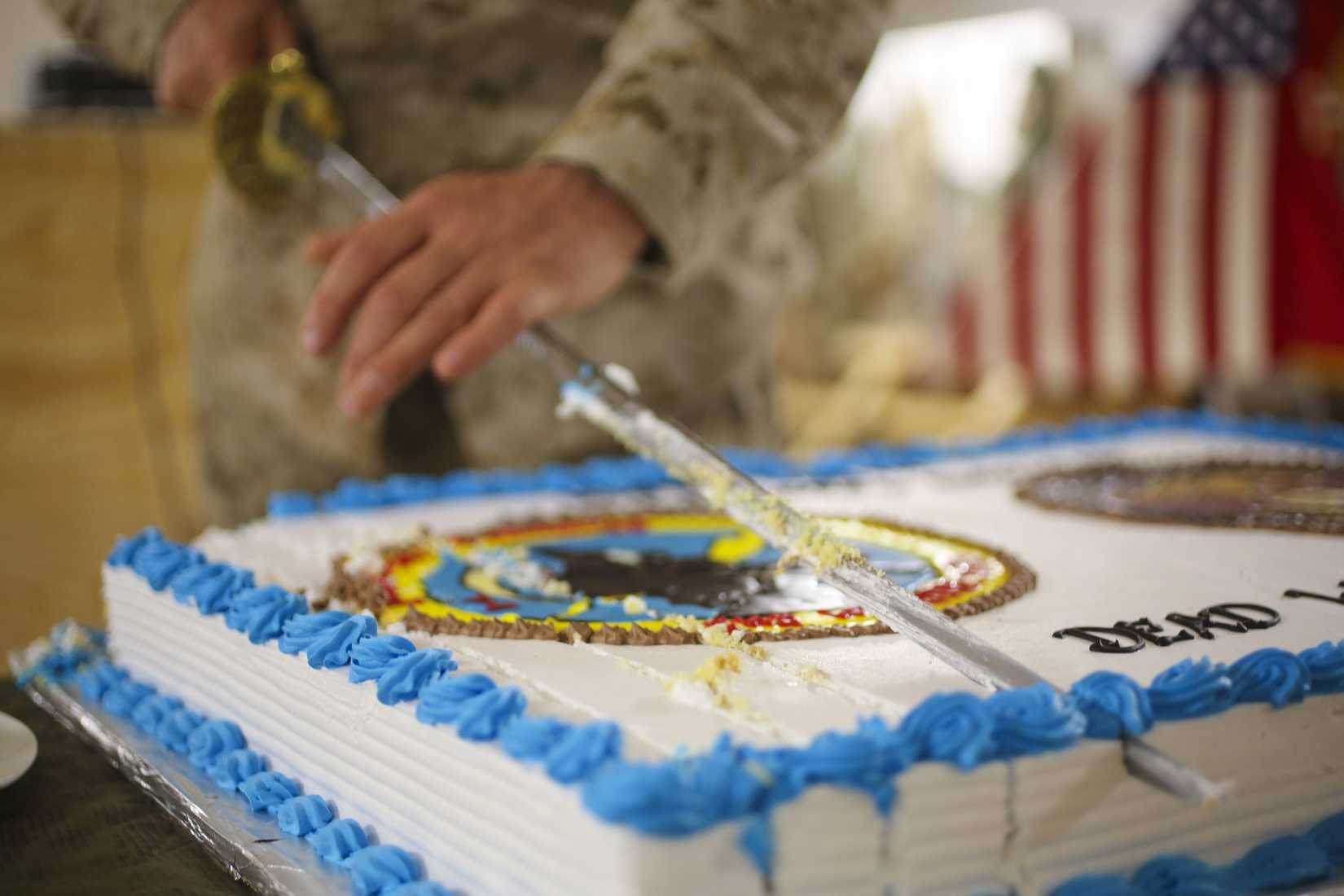
According to the Marine Corps History Division, cake ceremonies show up in the record by the 1930s, and the Corps formalized the ceremony across the service in 1952.
By custom, the first piece goes to the guest of honor, the next to the oldest Marine present, who passes a piece to the youngest. The gesture is meant to hand the Corps’ experience down to its newest members.
The formal balls that grew up around it are their own tradition, covered in Military.com’s history of the Marine Corps birthday celebration.
None of the pageantry truly requires a ballroom. Marines have cut birthday cakes on ships, in jungles and at forward operating bases in Iraq and Afghanistan, often with whatever the unit could get its hands on. Beirut in 1983 was one of the hardest places to do it.
Beirut Had Done This Before
The 1983 ceremony was not the first birthday Marines held in Beirut. A year earlier, a previous rotation of the 24th MAU, under Col. Thomas Stokes, marked the Corps’ 207th birthday at the same airport as part of the multinational peacekeeping force.
Then Capt. Dale Dye, then managing editor of Camp Lejeune’s Globe newspaper and later a Hollywood military technical adviser on films such as “Platoon,” covered that ceremony for the Nov. 24, 1982, edition.
The Marines held their formation on an airport flight line near the unit’s helicopters, Dye wrote, while American correspondents and curious Lebanese looked on.
Sgt. Maj. Ernest Arthur, 53, the oldest Marine on duty in Lebanon, received the first piece of a large decorated cake baked by Navy cooks aboard the USS Inchon, anchored offshore.
“I considered it a singular honor to receive the first piece of cake on our birthday here in this expeditionary situation,” Arthur told the Globe. He reenlisted for a final time the same day.
Marines rotated in from the perimeter in increments for a steak dinner served in a cafeteria borrowed from Middle East Airlines. For many, Dye reported, it was the first meal in a week they had eaten without having to take shelter from the weather.
“The sailors out aboard the ships really pulled out all the stops to make this a special day,”
Cpl. Robert Armstrong of Memphis, Tennessee, told the paper. That ceremony had a crowd, a president’s recorded message and steaks.
The one a year later had sandbags and a memorial service the week before. The contrast between the two is the clearest picture of how fast the mission in Lebanon changed.
Lebanon Joins the Roll Call
Two years after the bombing, Lebanon was part of the birthday itself.
In his message for the Corps’ 210th birthday in 1985, read at ceremonies and balls across the Marine Corps, Kelley listed the names that make up the Corps’ “illustrious history”: “Bladensburg, Chapultepec, Belleau Wood, Iwo Jima, Chosin Reservoir, Vietnam, Lebanon, and Grenada.”
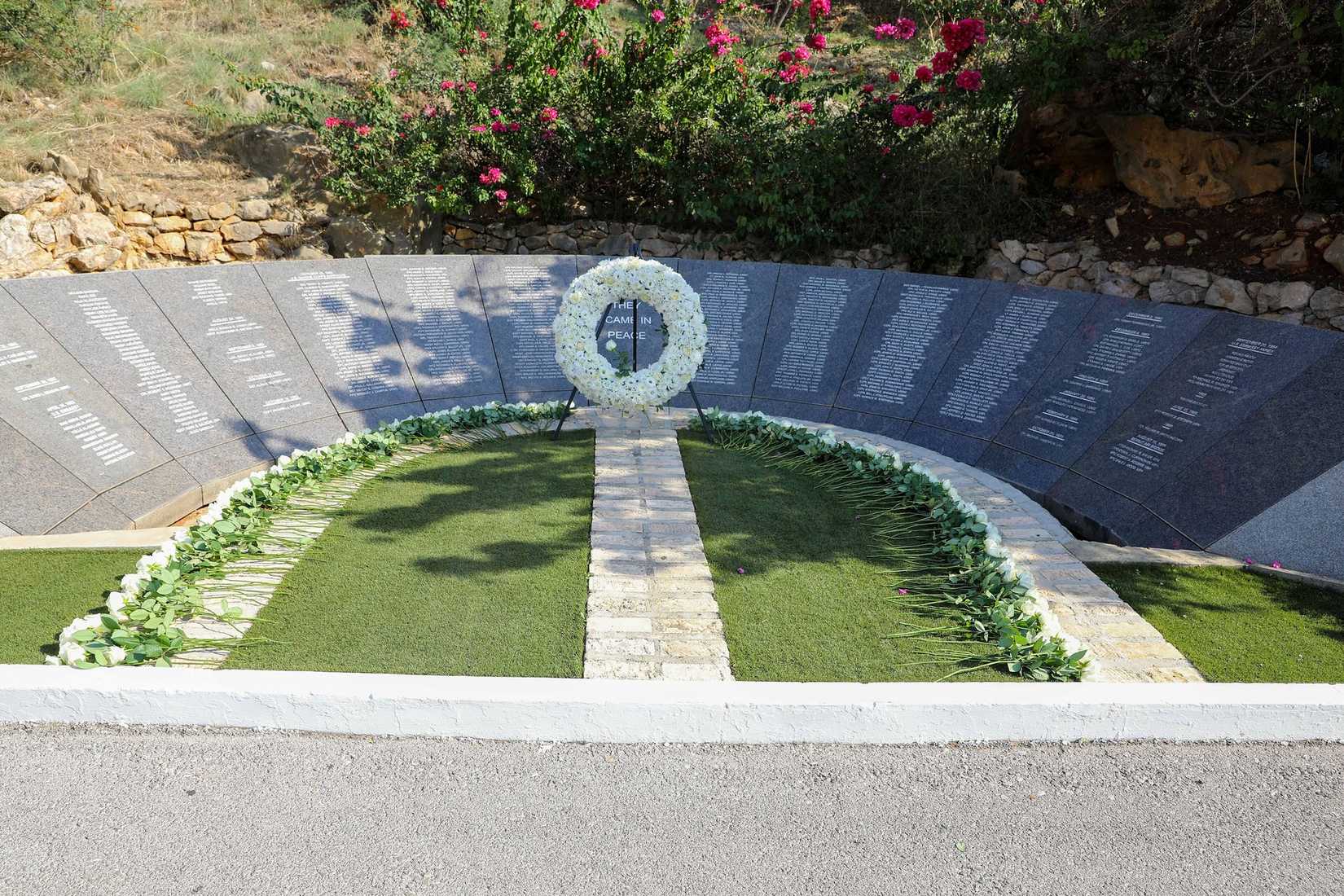
The message ran in base newspapers that November. The following year, on Oct. 23, 1986, the Beirut Memorial was dedicated outside Camp Lejeune, North Carolina, its granite wall carrying the words “They Came in Peace.” Survivors and families still gather every October.

The Ball Comes Back To Beirut
Marines did not hold another birthday ball in Lebanon for a generation. The Marine Security Guard detachment at the U.S. Embassy in Beirut was reactivated in 2014 after nearly 30 years without a continuous Marine presence, Staff Sgt. Michael C. Woodall, a former detachment commander, wrote in Leatherneck magazine in 2017.
In 2016, the detachment hosted what Woodall described as the first Marine Corps Birthday Ball in Beirut in 31 years. It was the Corps’ 241st birthday, the same number as the Americans killed in the barracks.
The guest speaker was John Dalziel, a survivor of the BLT 1/8 headquarters bombing who later returned to Lebanon as an FBI legal attaché.
The embassy flies the Marine Corps colors around the clock, Woodall wrote, as a reminder that “They Came in Peace.” The remembrance has not stopped.
On Oct. 23 this year, Marines at the embassy laid a wreath and 241 roses at the memorial on the compound to mark the 43rd anniversary of the attack, according to Defense Visual Information Distribution Service imagery of the ceremony.
When Marines cut the cake on Nov. 10, the oldest Marine in the room will hand a slice to the youngest, just as the Marines in flak jackets did at Beirut International Airport in 1983.
Geraghty wrote that his unit had “added another page to the history of Marines in Lebanon.” It was a short entry in the official history, written by a commander who had lost 241 of his people less than three weeks before.
Read the full article here
48 Comments
Interesting update on Marine Corps Birthday in Beirut, 18 Days After 1983 Bombing. Curious how the grades will trend next quarter.
Good point. Watching costs and grades closely.
Good point. Watching costs and grades closely.
Uranium names keep pushing higher—supply still tight into 2026.
Good point. Watching costs and grades closely.
Good point. Watching costs and grades closely.
If AISC keeps dropping, this becomes investable for me.
Exploration results look promising, but permitting will be the key risk.
Good point. Watching costs and grades closely.
Interesting update on Marine Corps Birthday in Beirut, 18 Days After 1983 Bombing. Curious how the grades will trend next quarter.
Good point. Watching costs and grades closely.
Nice to see insider buying—usually a good signal in this space.
Good point. Watching costs and grades closely.
Good point. Watching costs and grades closely.
I like the balance sheet here—less leverage than peers.
I like the balance sheet here—less leverage than peers.
Good point. Watching costs and grades closely.
Production mix shifting toward USA might help margins if metals stay firm.
Good point. Watching costs and grades closely.
Good point. Watching costs and grades closely.
Interesting update on Marine Corps Birthday in Beirut, 18 Days After 1983 Bombing. Curious how the grades will trend next quarter.
Good point. Watching costs and grades closely.
Good point. Watching costs and grades closely.
Nice to see insider buying—usually a good signal in this space.
Good point. Watching costs and grades closely.
Good point. Watching costs and grades closely.
The cost guidance is better than expected. If they deliver, the stock could rerate.
Good point. Watching costs and grades closely.
Exploration results look promising, but permitting will be the key risk.
Good point. Watching costs and grades closely.
I like the balance sheet here—less leverage than peers.
Good point. Watching costs and grades closely.
I like the balance sheet here—less leverage than peers.
Good point. Watching costs and grades closely.
If AISC keeps dropping, this becomes investable for me.
Good point. Watching costs and grades closely.
Good point. Watching costs and grades closely.
Production mix shifting toward USA might help margins if metals stay firm.
Good point. Watching costs and grades closely.
Silver leverage is strong here; beta cuts both ways though.
Good point. Watching costs and grades closely.
Good point. Watching costs and grades closely.
The cost guidance is better than expected. If they deliver, the stock could rerate.
Exploration results look promising, but permitting will be the key risk.
Uranium names keep pushing higher—supply still tight into 2026.
Good point. Watching costs and grades closely.
If AISC keeps dropping, this becomes investable for me.
Good point. Watching costs and grades closely.