


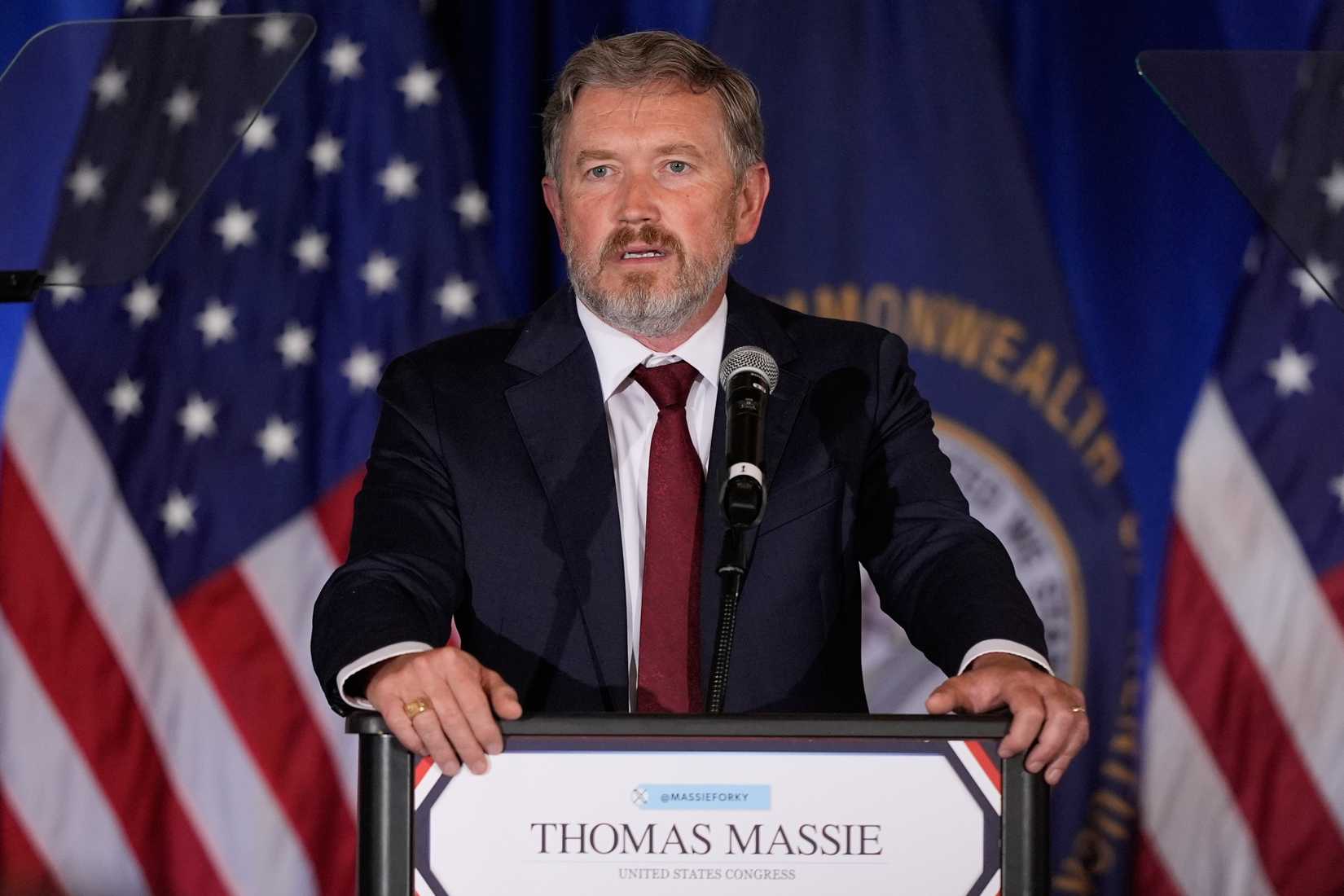
Rep. Thomas Massie wanted his impeachment effort against Defense Secretary Pete Hegseth to force Congress to confront a constitutional dispute that has persisted for decades: How much authority does Congress actually have to stop a president from waging war?
Now that the House has sidelined his impeachment push, the Kentucky Republican is pivoting to
H.Con.Res. 126, a new war powers resolution he filed Nov. 10 to force a mid-December floor vote on removing U.S. forces from hostilities with Iran. Massie had first raised the war powers question during a Nov. 9 press conference, after introducing eight articles of impeachment against Hegseth, including three alleging violations of the War Powers Resolution of 1973.
“One of the things that I really want out of this is to litigate whether Congress has war powers or not,” Massie said.
Asked why he targeted Hegseth rather than President Donald Trump, Massie suggested that removing a senior administration official could pressure the president to reconsider his approach.
Massie — who leaves Congress in January after losing his May Republican primary to Trump-backed challenger Ed Gallrein — warned in a Nov. 5 X post that his resolution was “a much gentler version of what’s coming” once Democrats take control of Congress in January, and argued on X that lawmakers should judge Hegseth’s actions rather than whether they support the war.
Impeachment could establish congressional accountability, but a binding judicial ruling on the law would require a separate court case.
His effort encountered an immediate obstacle. On Nov. 10, the House voted 211-204 to refer the impeachment resolution, H.Res. 1655, to the Judiciary Committee, effectively preventing a vote on the charges themselves. Massie was the only Republican to oppose the procedural motion, joined by 203 Democrats. Eleven Democrats and seven Republicans did not vote.
Of the 11 Democrats who missed the vote, lawmakers offered several explanations:
- Traffic delays near the Capitol: Reps. Melanie Stansbury, D-N.M.; Laura Gillen, D-N.Y.; Jonathan Jackson, D-Ill.; and Marilyn Strickland, D-Wash., cited traffic delays near the Capitol in social media posts and statements from their offices.
- Vote closed early: In posts on Facebook and X, Reps. Julia Brownley, D-Calif., and Brittany Pettersen, D-Colo., accused Republican leadership of closing the vote before they could reach the House floor. Brownley specifically blamed Speaker Mike Johnson.
- Veterans event: Former House Speaker Nancy Pelosi, D-Calif., was in San Francisco attending a veterans event, according to her office.
- Medical procedure: Rep. Lou Correa, D-Calif., wrote on Instagram that he was undergoing a medical procedure.
- Personal emergency: Rep. Steven Horsford, D-Nev., said on the House floor the next day that he missed the vote because of a personal emergency
- Unexplained: Other Democratic absences remained unexplained.
Rep. Pat Ryan, D-N.Y., said on X that he left the hospital early after a back surgery the day prior in order to vote.
Had the 11 absent Democrats voted against referral, with the other votes unchanged, the motion would have failed 211-215, defeating the referral motion. However, seven Republicans also missed the vote, and their participation could have changed that outcome.
Three War Powers Provisions at Issue
Massie’s impeachment resolution identified three alleged violations involving the war with Iran, which began Feb. 28 without a declaration of war or specific congressional authorization.
1. Section 2(c): When presidents can use force.
The first allegation concerns Section 2(c) of the War Powers Resolution, which states that presidents may introduce U.S. forces into hostilities pursuant to a declaration of war, specific congressional authorization or a national emergency created by an attack on the United States, its territories, possessions or armed forces.
The War Powers Resolution is federal law, enacted over President Richard Nixon’s veto in 1973. However, Section 2(c) states Congress’ interpretation of presidential authority rather than imposing a separate legal prohibition. The Justice Department’s Office of Legal Counsel has maintained that presidents possess broader authority under Article II of the Constitution to conduct certain military operations without prior congressional approval.
2. Section 5(c): Concurrent resolution withdrawal.
The second allegation concerns Section 5(c), which directs the president to withdraw forces from unauthorized hostilities if both chambers of Congress adopt a concurrent resolution requiring their removal. Congress approved such a resolution concerning Iran in June. The House voted 215-208 on June 3, followed by a 50-48 Senate vote June 23.
A concurrent resolution passes both chambers but does not require the president’s signature. A joint resolution, by contrast, must be signed by the president or passed over a presidential veto to become law. Section 5(c) therefore allows Congress to demand withdrawal without giving the president an opportunity to veto the measure.
However, the Supreme Court’s 1983 decision in INS v. Chadha established that Congress generally cannot exercise legislative authority over executive actions without following the constitutional lawmaking process, including presenting legislation to the president. The Congressional Research Service has consequently questioned Section 5(c)’s constitutionality, although the Supreme Court has never directly invalidated the provision.
Even if Congress challenged the administration in court, lawmakers could face another obstacle: Federal courts have frequently declined to decide war powers disputes, including because individual legislators lack standing to sue.
Section 5(b): The 60-day clock.
The third allegation involves Section 5(b), which generally requires presidents to terminate unauthorized hostilities within 60 days after submitting, or becoming obligated to submit, a report to Congress. The law permits an additional 30 days only when the president certifies in writing that unavoidable military necessity requires more time to withdraw forces safely.
Massie argues that continuing the Iran campaign beyond those statutory deadlines violates federal law.
Massie addressed the contested withdrawal provision at his press conference, arguing that it remains part of federal law and that executive officials cannot simply disregard it.
He also suggested House Speaker Mike Johnson should bring a lawsuit against the administration.
Congress Has Other Ways to Restrict Military Operations
Congress can also limit military operations through funding restrictions or legislation that becomes law with the president’s signature or a congressional veto override.
Congress authorized the Afghanistan and Iraq wars through separate authorizations for use of military force, or AUMFs, rather than formal declarations of war. Congress repealed the 1991 and 2002 Iraq authorizations in December 2025 as part of the annual defense authorization bill, while the 2001 AUMF remains in effect.
The 2001 AUMF authorized force against those responsible for the Sept. 11 attacks and those who harbored them, and successive administrations have interpreted it to cover additional terrorist organizations with no direct involvement in 9/11 — prompting calls for reform because it has no expiration date, even as the Trump administration relies instead on the president’s independent constitutional authority to justify the Iran campaign.
Hegseth Responds as Lame-Duck War Powers Fight Continues
Hegseth rejected the impeachment allegations during a Nov. 10 Pentagon briefing, calling the resolution a “farce” and a “stunt”.
“None of these are high crimes or misdemeanors. They’re partisan policy disagreements from people who want to politicize our military,” Hegseth said, adding that no defense secretary in U.S. history has been impeached for carrying out lawful military operations.
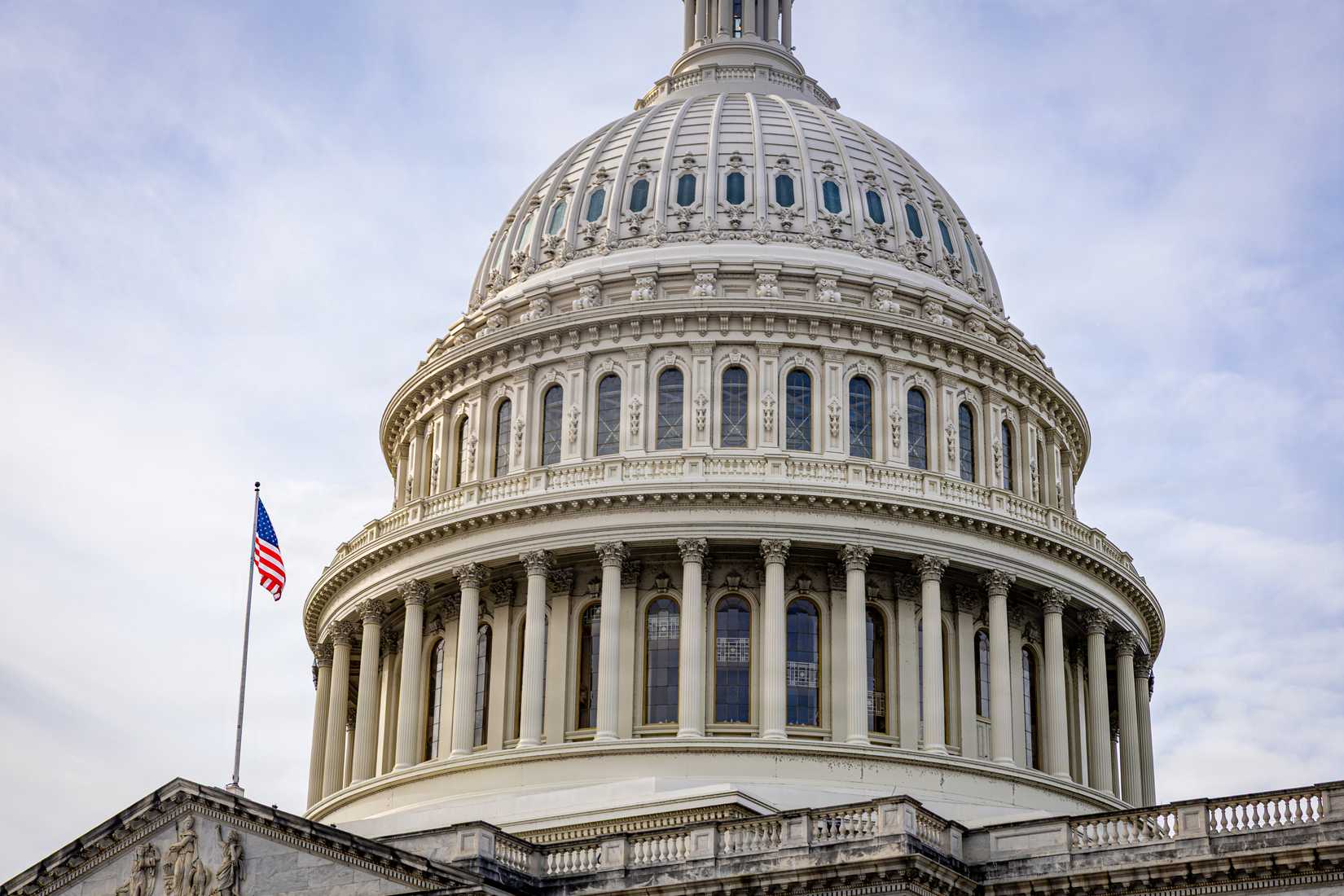
United States Capitol building with the American flag blowing in the wind in Washington, D.C., Dec. 10. 2025. The US. Capitol is the meeting place of the nation’s legislature, the U.S. Congress. (U.S. Army photo by Sgt. Eli Baker)
President Donald Trump and the White House have similarly maintained that the president possesses inherent constitutional authority as commander in chief to direct military operations, with Trump defending Hegseth on Truth Social after the Nov. 10 House vote and touting the administration’s military campaigns in Iran and Venezuela.The House vote leaves Massie’s impeachment articles in committee, with no immediate prospect of a Senate trial. Incoming House Democratic leaders, including House Minority Leader Hakeem Jeffries, D-N.Y., and Rep. Pete Aguilar, D-Calif., said in interviews after the vote that Democrats plan to launch broad oversight investigations into the administration when they assume congressional control in January, while members such as Rep. Brendan Boyle, D-Pa., said they expect the House to revisit impeachment.
In posts on X and Facebook, Massie said he would not pursue another impeachment vote before his term expires in January, focusing instead on advancing H.Con.Res. 126.
Massie wrote on social media that he can force a floor vote by mid-December unless Johnson cancels scheduled legislative days — though he noted on X on Nov. 20 that Republican absences forced the House to adjourn early on Nov. 19 and cancel its Nov. 20 voting session.
Meanwhile, the Senate voted 51-48 on Nov. 19 to reject a separate House-passed Iran war powers resolution, with three Republicans voting in favor and one Democrat opposing it, underscoring the steep odds facing Massie’s push. More than 53 years after Congress enacted the War Powers Resolution, the Supreme Court has yet to resolve whether its concurrent-resolution withdrawal provision is constitutional.
Read the full article here
25 Comments
I like the balance sheet here—less leverage than peers.
Good point. Watching costs and grades closely.
Silver leverage is strong here; beta cuts both ways though.
Nice to see insider buying—usually a good signal in this space.
The cost guidance is better than expected. If they deliver, the stock could rerate.
Interesting update on Massie Pivots from Hegseth Impeachment to Lame-Duck Iran War Powers Vote. Curious how the grades will trend next quarter.
Silver leverage is strong here; beta cuts both ways though.
Good point. Watching costs and grades closely.
Nice to see insider buying—usually a good signal in this space.
Nice to see insider buying—usually a good signal in this space.
Silver leverage is strong here; beta cuts both ways though.
Good point. Watching costs and grades closely.
Good point. Watching costs and grades closely.
Silver leverage is strong here; beta cuts both ways though.
I like the balance sheet here—less leverage than peers.
Good point. Watching costs and grades closely.
Nice to see insider buying—usually a good signal in this space.
Good point. Watching costs and grades closely.
The cost guidance is better than expected. If they deliver, the stock could rerate.
Uranium names keep pushing higher—supply still tight into 2026.
I like the balance sheet here—less leverage than peers.
I like the balance sheet here—less leverage than peers.
Good point. Watching costs and grades closely.
I like the balance sheet here—less leverage than peers.
Interesting update on Massie Pivots from Hegseth Impeachment to Lame-Duck Iran War Powers Vote. Curious how the grades will trend next quarter.