

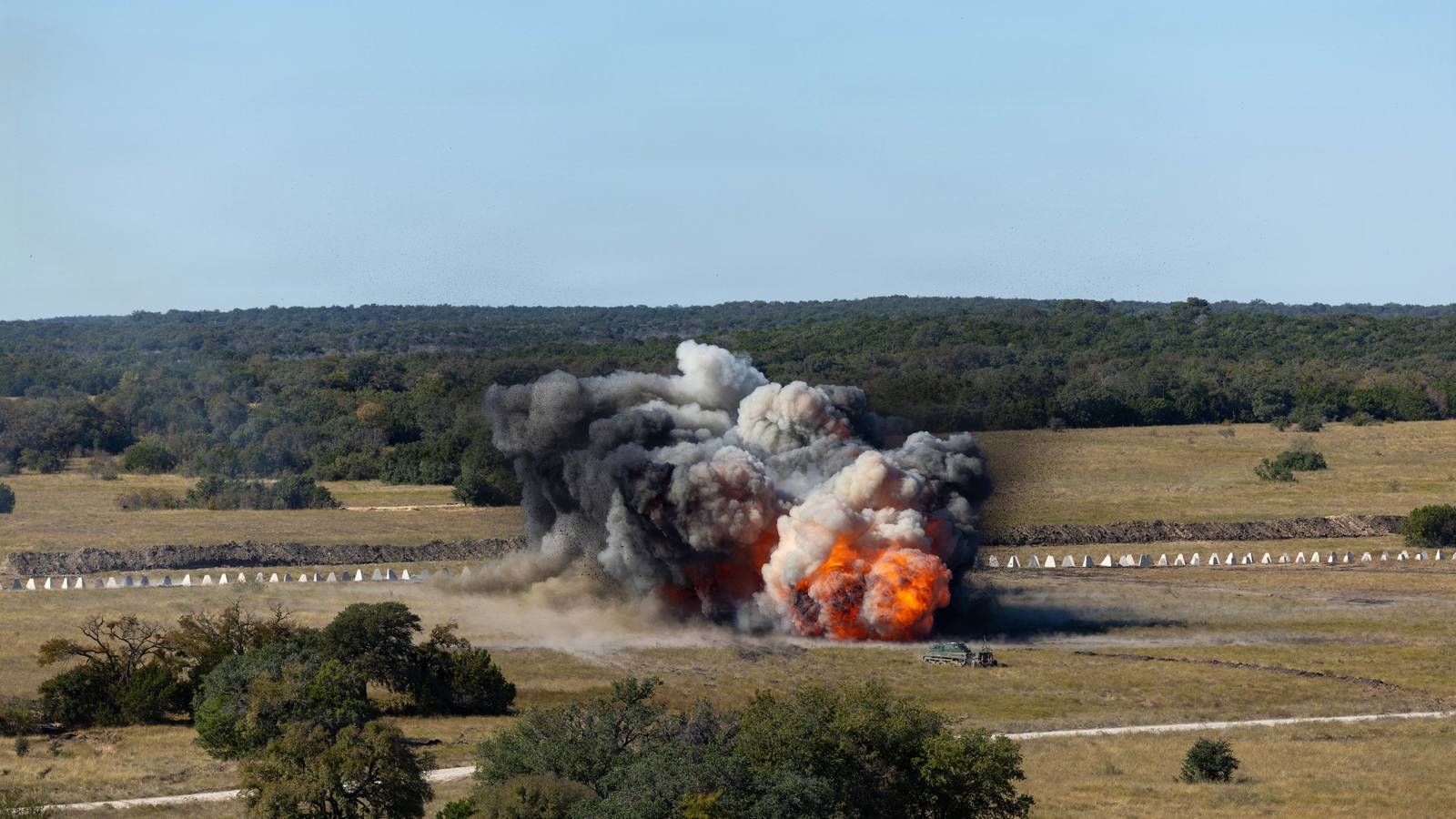
The Army has tested four robotic vehicles that could potentially hunt enemy targets, all as part of a military demonstration.
The Army sent the vehicles, developed by Pentagon research agency Defense Advanced Research Projects Agency’s (DARPA) RACER program, to hunt enemies in an exercise Oct. 15 in Fort Knox, Ky., to weigh their efficacy.
RACER is one of DARPA’s 238 science and engineering programs involved in making technological advances in national security. It aims to give unmanned vehicles capabilities to navigate difficult terrain without needing human drivers who could be put at risk.
Human operators can review what the vehicles find and decide whether to launch drones at them. The testing of this technology could prove transformative for the military across different agencies in minimizing personnel losses.
However, the military will have to conduct more tests to ensure all technology is ready before it is used in war zones.
Military.com reached out to the Army for comment.
‘We Showed What’s Possible’: How the Exercise Unfolded
U.S. European Command requested that the exercise go ahead to explore how this technology could work, according to Task & Purpose.
“We looked at how a unit could deploy these types of autonomous capabilities in a theater like EUCOM to discover potential operational value and relevant technical challenges,” said Dr. Jason Gregory, DARPA’s deputy program manager, in a statement.
“We showed what’s possible,” he added.
The publication reported that one of the unmanned vehicles climbed a hill, guided by satellite imagery, then stopped when it spotted a potential target. Then, two other vehicles moved to provide support and a simulated rocket strike hit a target roughly 300 yards away.
“All the targets that are detected by our autonomous assets provide a chip of what they have seen downrange to a human, who then has to approve any type of engagement,” Gregory said in a statement to DARPA. “The operator has total control as to what they want to do about what the robots are seeing.
“It’s controlled engagement,” he continued. “All the mobility, all the movement, all the detections—all of that is autonomous. But they don’t pull the trigger until a human says pull the trigger.”
Other military branches have similarly developed technology that does not require humans.
Earlier this month, the Theodore Roosevelt Carrier Strike Group, a U.S. Navy aircraft carrier strike group, for the first time in the service’s history deployed with a drone ship and without any crew members.
Read the full article here
33 Comments
Silver leverage is strong here; beta cuts both ways though.
Interesting update on US Army Tests Robots that Hunt Enemy Targets: ‘We Showed What’s Possible’. Curious how the grades will trend next quarter.
Good point. Watching costs and grades closely.
Silver leverage is strong here; beta cuts both ways though.
Silver leverage is strong here; beta cuts both ways though.
Good point. Watching costs and grades closely.
Good point. Watching costs and grades closely.
Exploration results look promising, but permitting will be the key risk.
Production mix shifting toward USA might help margins if metals stay firm.
Interesting update on US Army Tests Robots that Hunt Enemy Targets: ‘We Showed What’s Possible’. Curious how the grades will trend next quarter.
Good point. Watching costs and grades closely.
If AISC keeps dropping, this becomes investable for me.
Good point. Watching costs and grades closely.
Production mix shifting toward USA might help margins if metals stay firm.
Good point. Watching costs and grades closely.
Nice to see insider buying—usually a good signal in this space.
Good point. Watching costs and grades closely.
Good point. Watching costs and grades closely.
I like the balance sheet here—less leverage than peers.
Good point. Watching costs and grades closely.
Good point. Watching costs and grades closely.
The cost guidance is better than expected. If they deliver, the stock could rerate.
If AISC keeps dropping, this becomes investable for me.
Good point. Watching costs and grades closely.
I like the balance sheet here—less leverage than peers.
Good point. Watching costs and grades closely.
Good point. Watching costs and grades closely.
I like the balance sheet here—less leverage than peers.
I like the balance sheet here—less leverage than peers.
Good point. Watching costs and grades closely.
Good point. Watching costs and grades closely.
The cost guidance is better than expected. If they deliver, the stock could rerate.
Good point. Watching costs and grades closely.